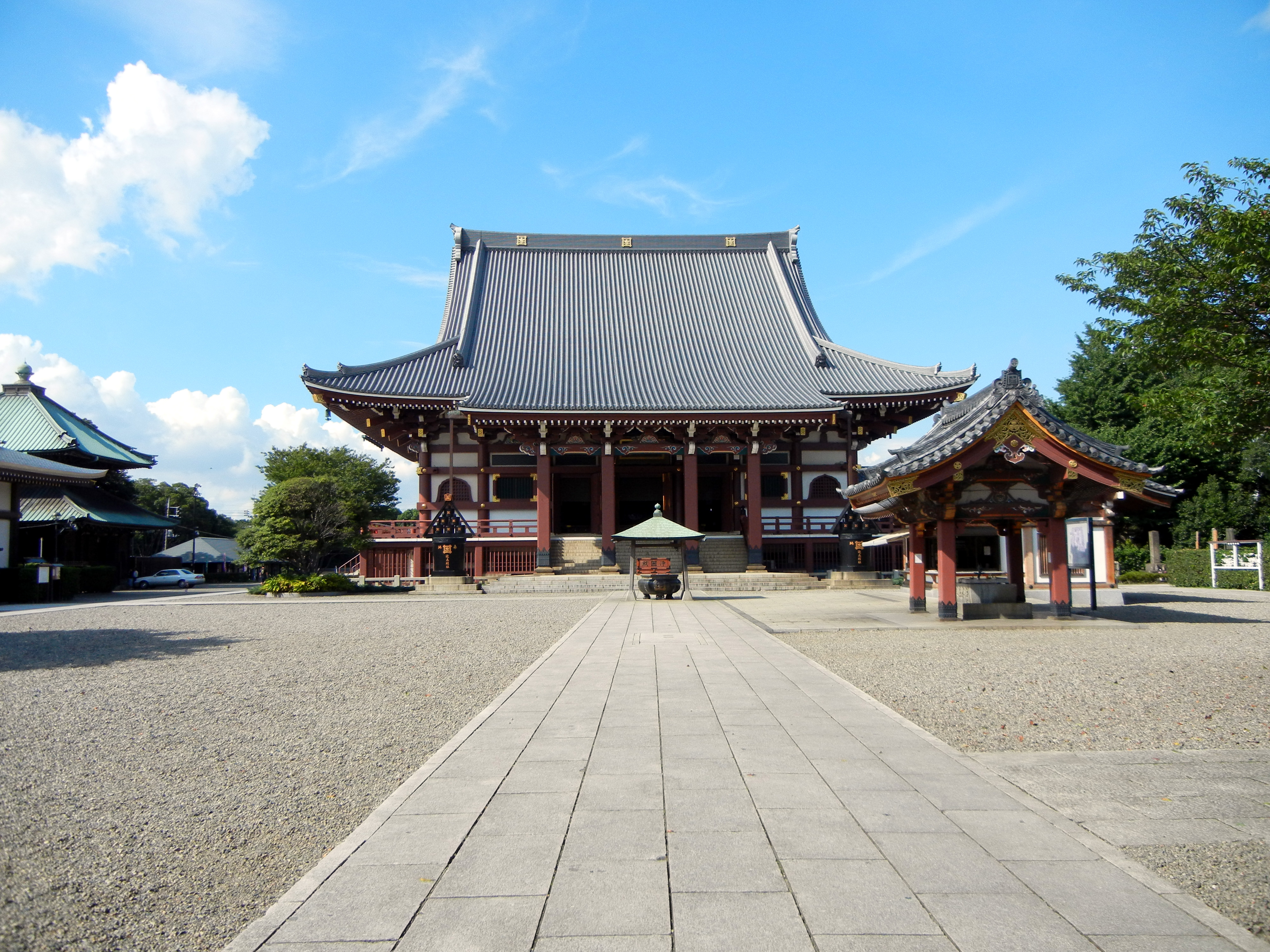
Ikegami Honmon-ji: Where Nichiren Drew His Last Breath
Every October 12, as darkness falls over the southern suburbs of Tokyo, roughly 3,000 people lift tall pagoda-shaped lanterns decorated with paper cherry blossoms onto their shoulders and begin walking from Ikegami Station toward the gates of Honmon-ji temple. Drums beat. Chanting fills the narrow streets. The procession covers two kilometers, arriving at the temple grounds around midnight. They are commemorating a death that occurred on this spot in 1282, when the Buddhist priest Nichiren -- founder of the school that bears his name -- drew his last breath at the estate of his follower Ikegami Munenaka. The temple that grew around that site has endured firebombing, reconstruction, and the suburban sprawl of modern Tokyo, but the lanterns still come every autumn.
A Disciple's Estate Becomes Sacred Ground
In September 1282, Nichiren set out from Mount Minobu for a hot spring in Hitachi Province, hoping to restore his failing health. He never arrived. His condition deteriorated on the journey, and he stopped at the estate of Ikegami Munenaka, a devoted follower and vassal of the Kamakura shogunate, in what was then a rural area of Musashi Province. Nichiren died there on October 13, 1282, at the age of sixty. His body was cremated on the grounds. After the priest's death, Munenaka donated a substantial portion of his property -- including the Hokkedo, a small private temple already on the estate -- to Nichiren's disciples. That donation became the foundation of Ikegami Honmon-ji. The hoto, a memorial structure marking the cremation site, was built in 1781 and still stands on the grounds today.
The Pagoda That Survived Centuries
The five-story pagoda, the temple's most striking structure, was built in 1608 in the Momoyama architectural style and is designated an Important Cultural Property of Japan -- widely regarded as the oldest five-story pagoda in the Kanto region. Its wooden tiers have weathered more than four centuries of earthquakes and typhoons. The kyozo, a repository of religious writings, dates to 1784. But most of the temple's other historic buildings did not survive the night of March 15, 1945, when American firebombing devastated large swaths of Tokyo. The pagoda endured; much else was destroyed. The reconstruction that followed has given the temple compound its current character -- a mix of ancient timber and postwar rebuilding, the deep patina of the pagoda contrasting with the cleaner lines of the structures around it.
Lanterns, Drums, and Cherry Blossoms in October
The O-Eshiki festival, held from October 11 to 13, transforms the streets between Ikegami Station and the temple into one of Tokyo's most vivid spiritual spectacles. The climax arrives on the evening of October 12, when the mando procession begins -- thousands of devotees carrying tall, elaborately decorated lantern stands adorned with paper cherry blossoms, accompanied by the rhythmic beating of hand drums and the chanting of the Lotus Sutra. The procession recalls the legend that cherry trees bloomed out of season at the moment of Nichiren's death. Utagawa Hiroshige, the great ukiyo-e artist, immortalized this scene in his One Hundred Famous Views of Edo series in the 1850s. By the late Edo period, when townspeople's culture flourished, the O-Eshiki had become synonymous with Honmon-ji itself.
An Unexpected Maritime Memorial
Among the temple's quieter monuments sits a memorial tablet with an unlikely story. On January 24, 1870, the American warship USS Oneida was rammed and sunk outside Yokohama by the British steamer Bombay, killing 125 people. Nineteen years later, in May 1889, a Buddhist ceremony was held at Ikegami Honmon-ji in memory of the lost sailors, and a memorial tablet was placed on the temple grounds. The tablet remains there today -- a small, unexpected connection between a Nichiren Buddhist temple in suburban Tokyo and a maritime disaster in Yokohama Bay. British traveler Basil Hall Chamberlain, writing in 1907, described the temple's setting: 'Its fine situation and magnificent timber make it one of the most attractive points within easy reach of Tokyo.' That description still holds, though the city has long since swallowed the countryside that once surrounded it.
From the Air
Located at 35.579N, 139.705E in Ota ward, southern Tokyo. The temple compound and five-story pagoda are visible from low altitude amid the dense residential grid of the Ikegami neighborhood. Tokyo Haneda International Airport (RJTT) lies approximately 3 nautical miles to the southeast -- the temple is directly under the approach path for some runway configurations. Best viewed at 2,000-3,000 feet AGL from the west, with the Tama River providing a visual reference to the south and Haneda's runways visible beyond.