Ikegami-Sone Site
Dendrochronology is unforgiving. It doesn't deal in approximations or centuries -- it counts rings, one per year, and delivers a verdict. When Japanese researchers in the 1990s applied the technique to cypress pillars excavated from the Ikegami-Sone site, the answer came back with startling precision: 52 BC. The trees that became the columns of this massive building were felled in the same year Julius Caesar was consolidating power in Rome. Here, on the flat coastal plain between the modern cities of Izumi and Izumiotsu in Osaka Prefecture, a Yayoi settlement of extraordinary scale had been thriving for centuries -- and nobody paid much attention until a highway project accidentally revealed just how large it was.
An Accidental Discovery on the Expo Highway
The site's story is one of repeated near-misses with obscurity. Around 1900, a local resident began collecting shards of Yayoi pottery from the area, but no scholar came calling. Decades passed. Then, in preparation for the 1970 Osaka Expo, surveyors plotting the route for Japan National Route 26 stumbled onto something unexpected: the settlement was enormous. Stretching 1.5 kilometers north to south and 600 meters east to west, the site covered 600,000 square meters -- an area larger than many modern Japanese towns. But just as the academic world took notice, the discovery of the Yoshinogari site in Kyushu captured all the headlines and funding. Ikegami-Sone slipped back into the shadows, its secrets still underground, waiting.
The Great Hall and the Hollowed Camphor
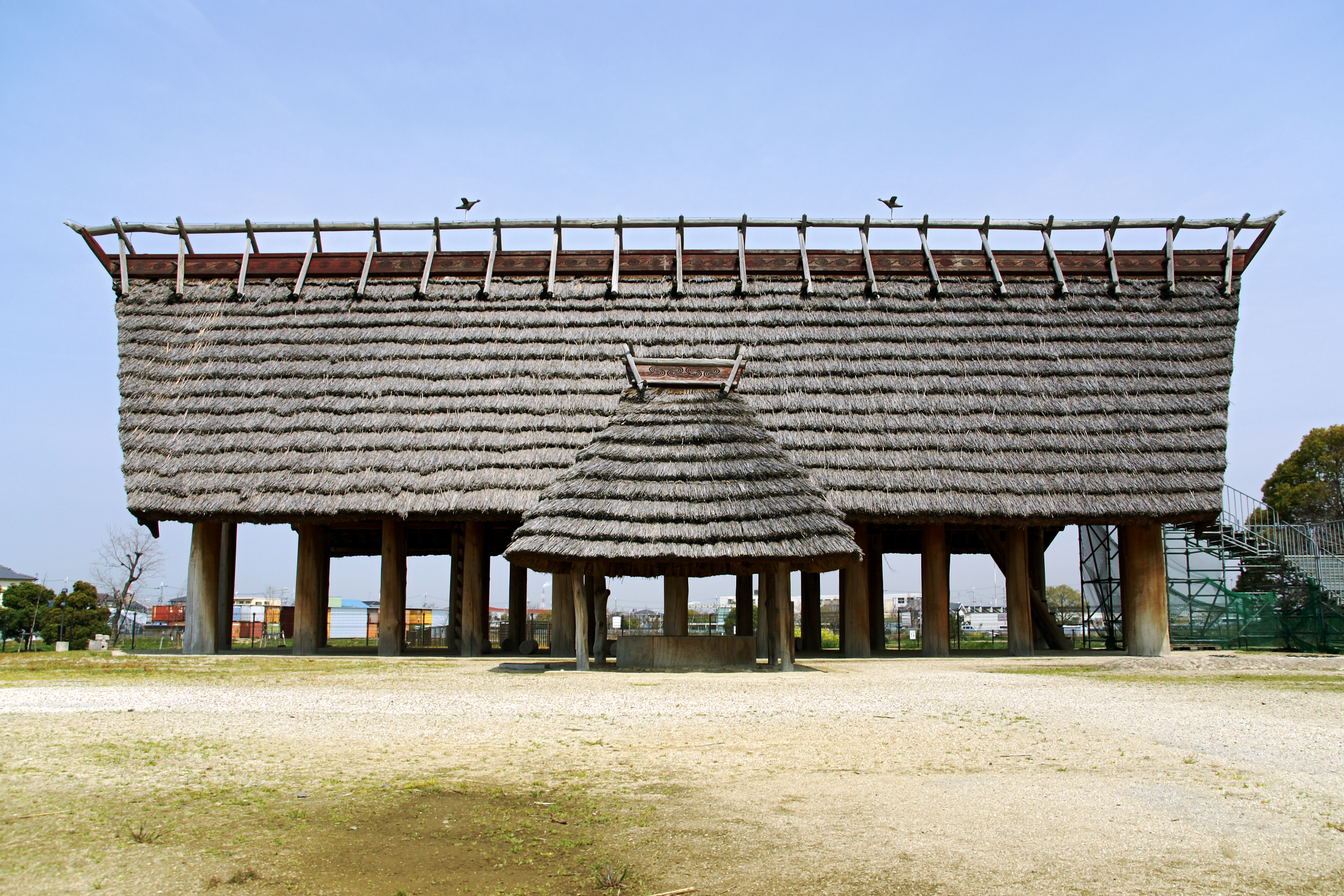
The 1990s brought a second chance. A re-survey to improve the historic park uncovered the foundations of a building that rewrote assumptions about Yayoi architecture. Measuring 19.2 by 6.9 meters, supported by cypress pillars 60 centimeters in diameter, it was one of the largest Yayoi-period structures ever found. Seventeen of what appear to have been 26 original pillar roots survived. The post holes had been reused three or four times, meaning the building was reconstructed repeatedly over a century -- a communal investment spanning generations. Whether it served as a ritual hall or a chief's residence remains debated, but its central position within the settlement leaves little doubt of its importance. Beside the great building, excavators found the remains of a camphor tree 2.3 meters in diameter, hollowed out to form the walls of a well. To the south, scores of pit dwellings clustered together. To the west, rice paddies covering 250,000 square meters fed the population. The entire community was encircled by a double ring of moats, three to four meters wide, with a band of twenty square burial tombs ringing the outer perimeter.
The Stone Knife Factory
Among the artifacts recovered from the site, one category stands out for sheer volume: stone knives. Archaeologists found 1,300 finished examples and 300 unfinished ones, all crafted from green schist sourced from the Kinokawa River basin in Wakayama Prefecture. The presence of both completed tools and works-in-progress tells a clear story -- this was not just a settlement but a manufacturing center, producing and distributing stone knives across the region. Stone swords and spearheads also turned up, along with Yayoi pottery, bird-shaped wooden objects thought to be ritual items, and a long-necked jar depicting a dragon. That jar is particularly suggestive. Similar dragon-decorated vessels have been found in wells at other Yayoi sites and are associated with water rituals. The dragon is a rain-making deity in Chinese tradition, and the jar hints at contact with continental culture during this period. Notably absent from the site is ironware -- evidence that iron-working technology reached this part of the Kansai region later than it did northern Kyushu.
An Ancient City Preserved in Suburbia
Designated a National Historic Site in 1976, the Ikegami-Sone site has been maintained as an archaeological park since 2005. Reconstructed buildings rise above the flat terrain, giving visitors a sense of the settlement's scale. The adjacent Osaka Prefectural Museum of Yayoi Culture houses the stone knives, pottery, and the dragon jar. The park sits just a seven-minute walk from Shinodayama Station on the JR West Hanwa Line, a mundane commuter stop that belies the two millennia of history underfoot. In a region where ancient sites are routinely paved over for apartments and shopping centers, Ikegami-Sone survives as a rare window into the world that existed before Japan's recorded history began -- a community that farmed rice, manufactured tools, traded across provinces, and built monuments that their descendants would rebuild again and again for a hundred years.
From the Air
Located at 34.50N, 135.43E on the coastal plain of southern Osaka Prefecture between the cities of Izumi and Izumiotsu. The archaeological park is visible as a distinct green open space amid dense suburban development. Kansai International Airport (RJBB) lies approximately 10nm to the southwest on its artificial island in Osaka Bay. Osaka Itami Airport (RJOO) is roughly 25nm to the north-northeast. Best viewed at 3,000-5,000 feet AGL; the reconstructed buildings and open park grounds contrast sharply with the surrounding residential grid. The Hanwa Line railway corridor runs nearby as a visual reference.