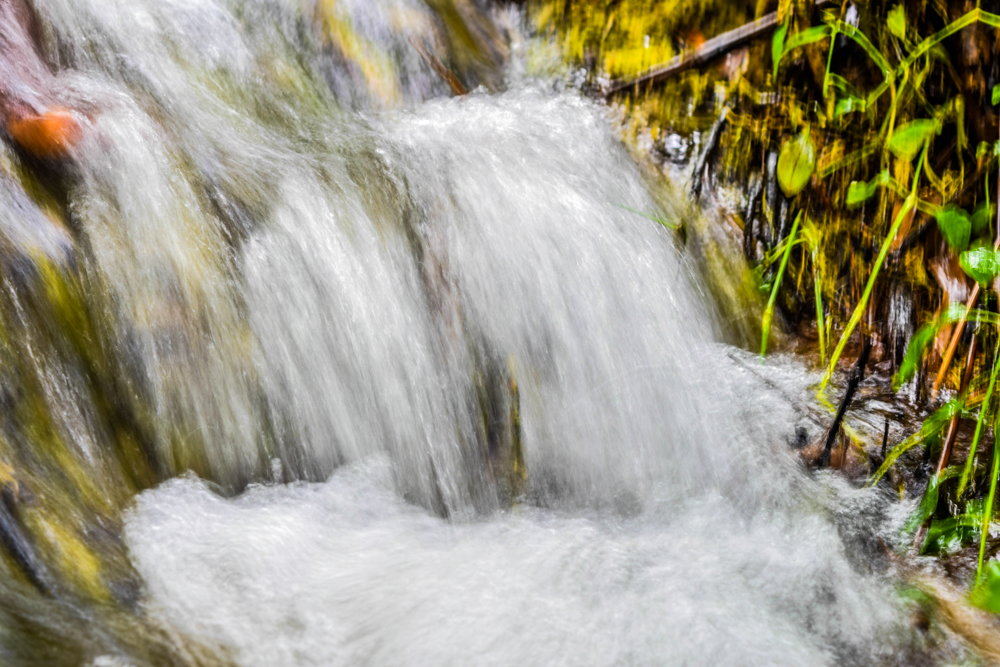
Ikogosi Warm Springs
Local tradition warned that visiting the source of the twin springs meant death -- that supernatural forces guarded this place where hot water and cold water emerged from the earth, side by side, and flowed downhill to merge at a single point without losing their distinct temperatures. In 1952, a Southern Baptist missionary named Rev. John S. McGee ignored the warnings. He pushed through the bush and up the hill to find what the Ikogosi people had long protected: a warm spring reaching 70 degrees Celsius at its source, flowing alongside a cold spring, the two meeting at a confluence where the warm water still registers 37 degrees. The phenomenon has no simple explanation, and that mystery is precisely what makes Ikogosi one of southwestern Nigeria's most remarkable natural sites.
The Missionary and the Walking Stick
McGee saw more than a geological curiosity. Working from his mission base in the nearby town of Igede, he envisioned a youth camp built around the springs. With support from the Ekiti Baptist Association and the Nigerian Baptist Convention, he secured 28 acres and began building. The Baptist Mission architect, Rev. Wilfred Congdon, designed 16 original structures: a swimming pool fed by the warm springs, built in 1962; a dining hall with kitchen; eight small cabins sleeping sixteen each; a residence for the McGees; and a chapel completed by the late 1960s. By 1968, hundreds of people were staying at the camp each year for retreats and vacations. McGee's relationship with the community ran deep. In 1957, the people of Igede installed him as "Chief Gbaiyegun." In 1961, the Ewi of Ado-Ekiti presented him with a prestigious beaded walking stick -- a gift that would later settle a confrontation with one of Nigeria's most prominent critics.
Rumors of Spies
After Nigeria's Biafran Civil War in the late 1960s, suspicion fell on the Baptist camp. Rumors circulated from Lagos alleging the facility was a front for the CIA. Dr. Tai Solarin, an influential Nigerian writer, published critical columns based on what turned out to be misinformation. Alumni of the Baptist College at Iwo eventually brought Solarin to the camp to meet McGee face-to-face. In McGee's office, the missionary produced the beaded walking stick given to him by the Ewi of Ado. "Your people do not give this to someone who does not love them," McGee told Solarin. The writer stared at the stick in astonishment. "Where did you get this?" he asked. His attitude shifted completely. But the political winds were less easily turned. By 1973, the Nigerian government had opened its own guest house by the warm springs pool and, in January 1974, took control of the swimming pool itself -- the camp's featured attraction.
Decline and the Creeping Bush
When the McGees retired from Nigeria in July 1977, the community honored John McGee as "Chief Akorewolu of Ikogosi" in a farewell ceremony. No one from the mission stepped forward to manage the camp. The following year, the Nigerian Baptist Convention sold the entire property to the government for 300,000 naira. Without sustained management, the site deteriorated rapidly. When the McGees returned briefly in 1985, the camp was buried in bush. McGee walked the road he had built to the camp entrance but could barely see the buildings through the overgrowth. He did not bother going in. The swimming pool area, under government control since the early 1970s, fared somewhat better, with guest chalets built alongside it, but tourism development stalled for decades.
Warm Water, New Beginnings
It was not until 2011 to 2014, under the leadership of the Ekiti State government, that serious redevelopment finally reached Ikogosi. New partnerships brought resources to rebuild the resort facilities to a modern standard. Buildings with stone exteriors -- preserved from the original Baptist camp -- stand as quiet reminders of McGee's vision. The warm springs continue to flow, their temperature unchanged. The cold spring still runs alongside, and the two still meet at their confluence in a way that defies easy scientific explanation. Research has confirmed the thermal properties but not fully explained the mechanism. For visitors who make the journey into the Ekiti hills, the springs offer something increasingly rare: a natural phenomenon that science can describe but has not yet reduced to the ordinary. The warnings that once kept people away have given way to welcome, but the sense of wonder remains.
From the Air
Ikogosi Warm Springs is located at 7.59°N, 4.99°E in the forested hills of Ekiti State, southwestern Nigeria. From the air, the area appears as dense green canopy with the small town of Ikogosi visible among the trees. The nearest significant airport is Akure Airport (DNAK), roughly 80 km to the south. The terrain is hilly and well-vegetated, part of the transitional zone between Nigeria's southern forests and northern savannas. The springs themselves are not visible from altitude, but the resort complex and cleared areas near the confluence provide a visual reference point.