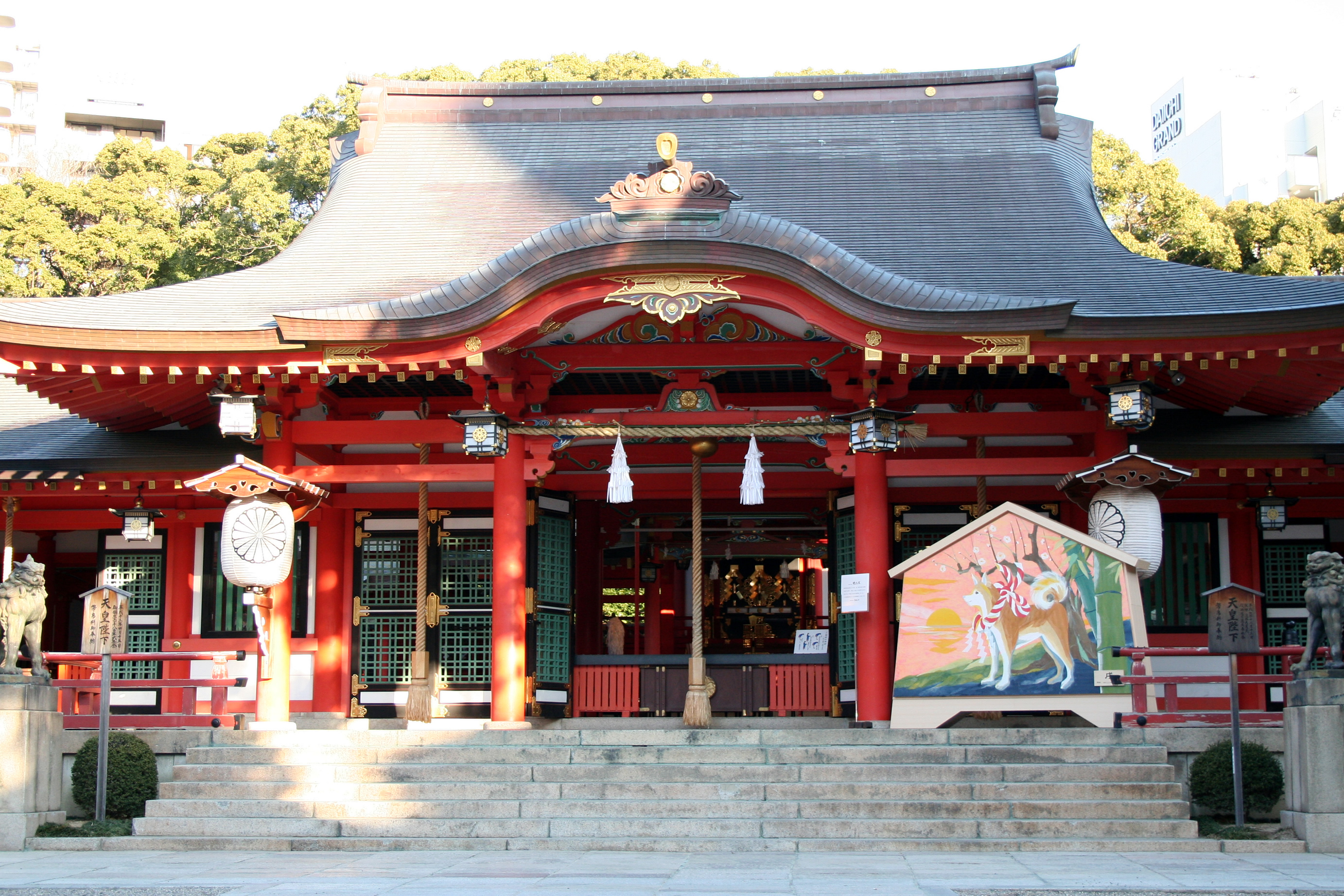
Ikuta Shrine
An ancient camphor tree stands in the Ikuta forest, its trunk scarred black from the firebombing of 1945. It should be dead. The incendiary raids that devastated Kobe burned the tree nearly to ruin, yet it recovered, put out new growth, and continued living for decades afterward. The people of Kobe adopted it as their own metaphor. Ikuta Shrine, which shelters that tree and has stood in one form or another since 201 AD, has been destroyed and rebuilt so many times that resilience is not just its history -- it is its theology. The deity enshrined here, Wakahirume-no-Mikoto, has come to be revered as a god of revival, and the shrine's story explains why.
An Empress Returns from War
According to the Nihon Shoki, Japan's oldest official chronicle, Empress Jingu founded Ikuta Shrine at the beginning of the third century AD after returning from a military campaign in Korea. The legend holds that she was nearly shipwrecked on the voyage home and survived by praying to Watatsumi, the sea deity. Grateful for her deliverance, she established three shrines in the Kobe region: Hirota Shrine, dedicated to the sun goddess Amaterasu; Nagata Shrine, dedicated to Kotoshiro-nushi (also known as Ebisu, god of fishermen and commerce); and Ikuta, dedicated to Wakahirume-no-Mikoto, a goddess associated with weaving and the bringing together of people. The shrine originally stood further north on Mount Isagoyama but was relocated in 799 AD after severe flooding threatened the site -- the first of many forced reinventions.
Battleground in the Forest
In 1184, during the Genpei War between the Taira and Minamoto clans, the Battle of Ichi-no-Tani raged across the Kobe coastline and into the Ikuta forest itself. Warriors fought among the ancient trees in one of the conflict's most storied engagements. Markers in Ikuta-no-mori, the sacred grove behind the shrine, still commemorate the locations of skirmishes, though the shrine's land was far larger in the twelfth century than it is today. The city of Kobe grew up around the forest, swallowing ground that once echoed with the clash of samurai. Today, two Noh plays -- Ebira and Ikuta Atsumori -- retell episodes from the battle and are performed annually at the shrine, keeping the medieval drama alive through one of Japan's most refined theatrical traditions.
Fire, Water, and Trembling Earth
The shrine's capacity for survival was tested repeatedly across the centuries. In 1938, catastrophic flooding from the nearby Ikuta River damaged the grounds. In 1945, American firebombing raids devastated central Kobe, burning the shrine structures and scarring the camphor trees in the forest. Each time, the shrine was restored with the support of local citizens who regarded it as inseparable from the city's identity. Then came January 17, 1995. The Great Hanshin-Awaji Earthquake struck at 5:46 in the morning, killing over 6,400 people and reducing parts of Kobe to rubble. Ikuta Shrine suffered significant structural damage. But it was rebuilt again, and in the aftermath, the shrine's resident deity took on a new dimension: Wakahirume-no-Mikoto became explicitly venerated as a god of revival, embodying the city's refusal to stay broken.
The Heart of Sannomiya
Today, Ikuta Shrine sits in the Chuo Ward, just ten minutes' walk from Sannomiya Station, Kobe's busiest transit hub. The name Sannomiya itself derives from the shrine's historical designation as the third shrine of Settsu Province. The compound holds fourteen subordinate shrines, including Matsuo Shrine for the sake-making deity, Daikai Shrine for maritime safety, and an Inari shrine for business prosperity. Visitors draw water fortunes from a basin, dip paper slips to reveal their luck, and tie heart-shaped ema plaques to racks in hopes of romantic connection -- Wakahirume's association with weaving and bringing people together has made Ikuta one of Kobe's most popular spots for matchmaking prayers. The sacred forest behind the main hall, with trees several hundred years old, remains a quiet retreat just steps from the neon and commerce of downtown. It is ancient ground that feels earned rather than preserved.
From the Air
Located at 34.695°N, 135.191°E in central Kobe, tucked within the dense urban grid of the Sannomiya district. The shrine's sacred forest (Ikuta-no-mori) appears as a distinctive patch of green canopy amid surrounding commercial buildings. Kobe Airport (RJBE) is approximately 7 km to the south on a reclaimed island in the bay. Osaka Itami Airport (RJOO) is 22 km northeast. Best spotted at 2,000-4,000 ft when following the Kobe waterfront, looking inland for the green canopy contrast against the urban surroundings.