Imai Foundation
Magnetic tape does not age politely. The binder that holds the iron oxide to the plastic base hydrolyses with time and humidity, the colors shift, and the picture eventually slumps into smears and dropouts. The first generation of video artists — the people who built a new art form in the late 1960s and 1970s — recorded almost everything they made on exactly this kind of fragile stock. In a 1920s pavilion at Düsseldorf's Ehrenhof complex, the imai Foundation has been racing that decay since 2006: about 3,000 works by some of the medium's pioneers, all of them needing to be migrated, documented and kept alive faster than the tape can fail.
An Archive Rescued From Cologne
The institute was born to save a specific collection. Throughout the 1980s and 1990s, a Cologne-based media art agency called 235 MEDIA had served as one of Germany's main distributors of video art. By the early 2000s, its archive of tapes was in trouble. In 2006, the city of Düsseldorf, the Kunststiftung NRW and the Kulturstiftung des Bundes pooled their support to create a new foundation — imai, the inter media art institute — explicitly to take over the 235 MEDIA collection, preserve it, and make it accessible. The institute set up shop inside the NRW Forum at the Ehrenhof, the riverside cultural complex Wilhelm Kreis designed in 1925-26, with the Kunstakademie Düsseldorf and the museum kunst palast as neighbors.
The Names on the Tapes
The archive now holds roughly 3,000 artistic and documentary works dating from the 1960s to the present. The strongest concentration is in the late 1970s and early 1980s, the years when video art moved from being a curiosity to being a recognized medium. The artist list reads like a foundation document of the field: Steina and Woody Vasulka, whose hand-built synthesizers turned electronics into image; Dara Birnbaum, who cut up television to reveal its grammar; Valie Export, whose body performances challenged everything in 1960s Vienna; Gary Hill, Nan Hoover, Ulrike Rosenbach, Marcel Odenbach, Robert Cahen, Jürgen Klauke. American, Asian and European pioneers, single-channel works on tape, alongside documentaries of land art and performance that exist nowhere else.
Case Studies in Saving Art
Preserving video art is harder than preserving a painting because the work is bound to its technology. A 1984 installation that required four specific CRT monitors and a working laserdisc player cannot simply be migrated to a new format — sometimes the obsolete hardware is part of the work itself. Since 2006, imai has used a case-study approach, taking one installation at a time and treating it as a research problem with restorers, art historians, technicians and the artist (when still living) all in the room. The first case study tackled Studio Azzurro's Il Nuotatore (va troppo spesso ad Heidelberg), a 1984 piece. Others have followed: Gary Hill's In Situ (1986), Bill Seaman's Exchange Fields (2000), Katharina Sieverding's Testcuts I (2010), Nan Hoover's Light Composition: Documenta 8 (1987), and Lutz Mommartz's Zweileinwandkino (1968/2014). Each one is published, conferenced, and added to the methodology.
The Video Lounge
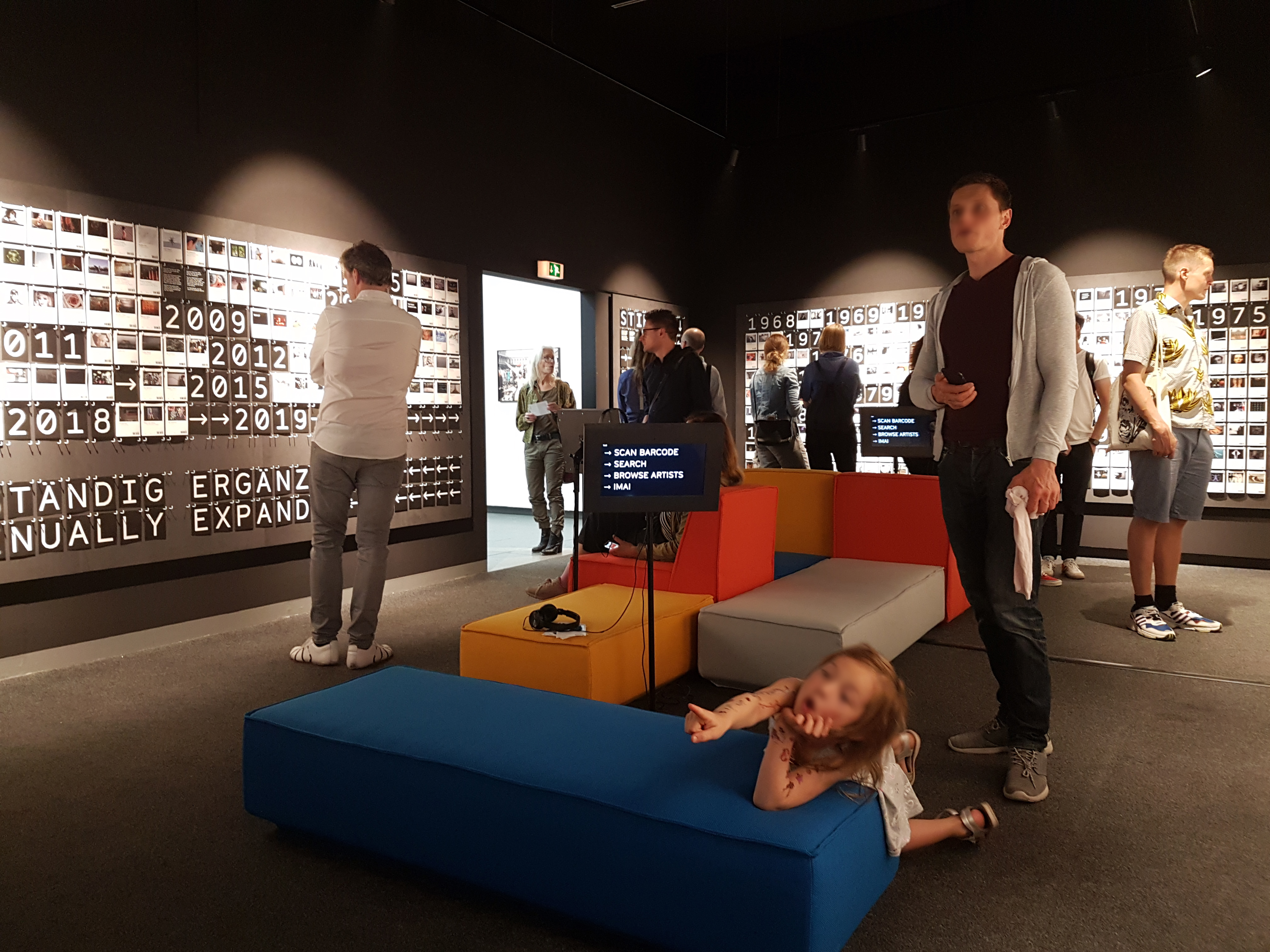
The public side of the institute is the video lounge, installed in the NRW Forum in 2019. The setup is modest: tablets, headphones, a curated catalogue of up to 1,500 works from the archive. A visitor with an afternoon can sit down and pull up Vasulka, then Birnbaum, then Hoover, and watch the medium discover itself in real time. Before the lounge, this material lived largely in academic settings and the occasional festival screening. The lounge made it walkable. The institute's exhibitions extend the reach further — the 2014 Quadriennale show The Invisible Force Behind, the earlier Images against Darkness at KIT (Kunst im Tunnel), which projected video onto the underground tunnel space beneath the Rhine — and at each one, the central problem keeps surfacing: how do you show, in 2026, an artwork that was conceived in 1984 to live on Sony U-matic?
A Quiet Institution With a Loud Mission
imai is not a museum in the usual sense. There is no gift shop, no blockbuster show, no line at the door. Its director, Renate Buschmann, sits over a board of trustees that includes Marcel Odenbach (the artist himself), the directors of the Lehmbruck Museum and the Museum Kunstpalast, the Julia Stoschek Collection, and the city's cultural director. The whole apparatus is pointed at the same task: keep the early decades of video art usable for the people who come after. The publications come out, the case studies pile up, the migrations continue. Walk into the Ehrenhof on any weekday afternoon and you will probably not notice anything dramatic happening. That is the point. The drama is in the tape, and the tape is being saved one work at a time.
From the Air
Coordinates 51.23°N, 6.80°E. The imai Foundation is housed in the NRW Forum at the Ehrenhof complex on the right bank of the Rhine in central Düsseldorf, immediately south of the Tonhalle and the Rheinpark. Düsseldorf International (EDDL) is about 8 km north-northwest. From altitude, look for the curved riverfront of the Düsseldorf old town, with the Rheinturm television tower as the most obvious landmark; the Ehrenhof complex sits in the green band of parkland upstream of it. Best viewing 2,000–4,000 ft.