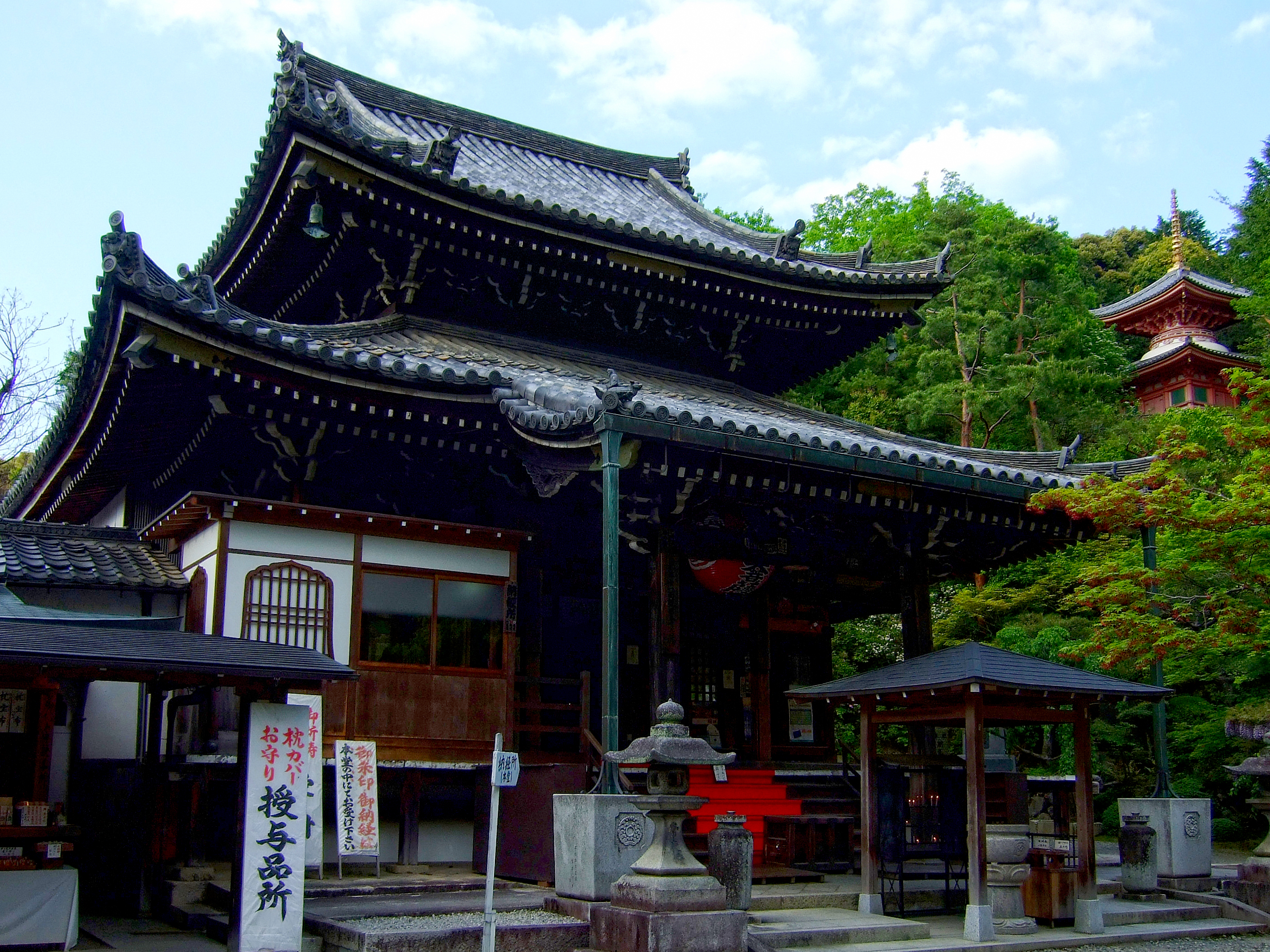
Imakumano Kannon-ji
Somewhere inside the main hall of this temple, nested within a larger wooden statue like a secret held for over a thousand years, sits a figure just 3.5 centimeters tall. According to temple legend, the Shinto sun goddess Amaterasu herself carved this tiny statue of the Eleven-Faced Kannon. Nobody alive has seen it. The statue is a hibutsu, a concealed image, hidden from public view since the monk Kukai placed it inside his own carved figure in the early ninth century. That act of sacred concealment became the founding gesture of Imakumano Kannon-ji, the fifteenth stop on Japan's Saigoku Kannon Pilgrimage, a route that has drawn the faithful across western Japan for over a millennium.
A Monk, a Light, and an Old Man on a Hill
The founding legend reads like a fever dream filtered through deep faith. In 807, the year after Kukai returned from studying esoteric Buddhism in Tang Dynasty China, he noticed a mysterious light glowing from the hills of Higashiyama in eastern Kyoto. Climbing to investigate, he encountered Kumano Gongen, one of the great Shinto-Buddhist syncretic deities, appearing in the form of an old man. The deity handed Kukai the miniature Kannon statue and instructed him to build a temple on the spot. With the backing of Emperor Saga, construction began around 812 and was completed during the Tencho era, between 824 and 833. The powerful courtier Fujiwara no Otsugu later sponsored a major expansion, completed by his son Fujiwara no Harutsu in 855. What began as one monk's encounter with a luminous hillside became an institution entwined with imperial power.
A New Kumano for the Capital
The temple's deeper significance emerged in the late Heian period, when it became Kyoto's own stand-in for the sacred Kumano Sanzan shrines deep in the mountains of Kii Province, hundreds of kilometers to the south. Emperor Goshirakawa, one of the most devout followers of the Kumano cult, found the journey to Kii impossibly long and arduous. In 1160, he solved the problem by enshrining the Kumano Gongen deity at this temple and bestowing the honorific mountain name Shin-Nachisan, meaning New Nachi Mountain, linking it directly to the great Nachi waterfall shrine. The name Imakumano itself means New Kumano, a declaration that the sacred power of the distant mountains had been transplanted to the very edge of the imperial capital. Goshirakawa reportedly suffered chronic headaches, and after praying at this temple, he claimed to have been cured. That imperial endorsement took hold. For centuries afterward, ordinary people visited Imakumano Kannon-ji seeking relief from headaches, trusting in the same Kannon that had healed an emperor.
Among the Aristocratic Dead
The hillside southwest of the temple served for centuries as a burial ground for Kyoto's aristocracy. This proximity to death was not incidental; it made Kannon-ji a natural home for funerals and memorial rites, embedding the temple in the social fabric of court life. The mausoleum of Emperor Go-Horikawa sits adjacent to the temple's southeast corner. Nearby, the residence of the poet Kiyohara Motosuke once stood, a detail that connects this place to one of Japan's greatest literary figures: Motosuke was the father of Sei Shonagon, the acerbic court lady who wrote The Pillow Book. During the reign of Emperor Shirakawa, the temple flourished as a center of Shugendo, the tradition of mountain asceticism that blended Buddhist and Shinto practices. Monks trained in the surrounding hills, channeling the wild landscape into spiritual discipline.
Burned and Rebuilt, Again and Again
Imakumano Kannon-ji shares the fate of nearly every significant Kyoto temple: destruction by fire, followed by patient reconstruction. The temple burned during the turbulence of the Nanboku-cho period in the fourteenth century, when rival imperial courts tore the country apart. It burned again during the Onin War of 1467 to 1477, the devastating conflict that leveled much of Kyoto and ushered in a century of civil war. Each time, the temple was rebuilt. A full restoration was completed in 1580, as the country began to reunify under warlords like Oda Nobunaga and Toyotomi Hideyoshi. The current main hall dates to 1712, its wooden beams and curving roof a testament to the Edo period craftsmen who gave it its present form. The bell tower and pagoda still punctuate the quiet temple grounds, where the hum of cicadas in summer is louder than any traffic.
Pilgrims on the Ancient Road
As the fifteenth stop on the Saigoku Kannon Pilgrimage, Imakumano Kannon-ji occupies a place in one of the oldest organized pilgrimage circuits in Japan, a route encompassing thirty-three temples across western Honshu dedicated to the bodhisattva of compassion. Pilgrims have walked this circuit since at least the Heian period, carrying prayer books stamped at each temple. Today, visitors still arrive on foot from nearby Tofukuji Station, a twenty-minute walk through the Higashiyama neighborhood. The approach threads through a residential area before opening onto the temple grounds, where stone paths lead past the pagoda and bell tower to the main hall. Inside, the hidden Kannon statue remains unseen, its power measured not by visibility but by the unbroken line of petitioners who have come here across twelve centuries, each trusting that something sacred waits behind closed doors.
From the Air
Located at 34.9797N, 135.7808E in the Higashiyama hills on the eastern edge of Kyoto. Best viewed at 2,000-3,000 feet AGL where the temple complex is visible nestled among the forested hills east of the Kamo River. The nearby Tofukuji temple complex and the sprawling grounds of Sennyuji serve as visual landmarks. Nearest airports: RJOO (Osaka Itami, 20 nm west), RJBB (Kansai International, 45 nm south). The dense urban grid of Kyoto contrasts sharply with the green temple hills from the air.