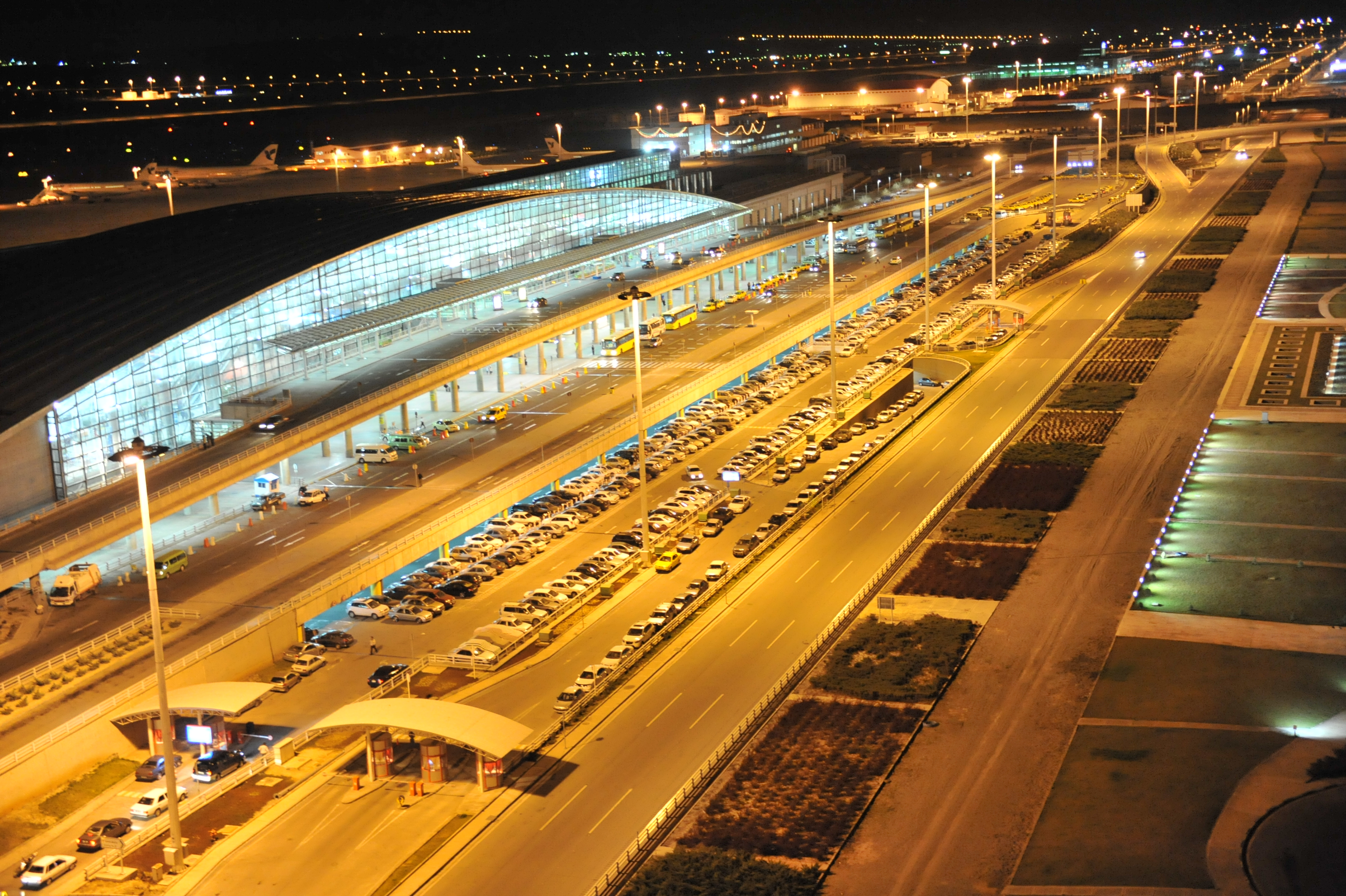
Imam Khomeini International Airport
On May 8, 2004, fighter jets scrambled to intercept a commercial airliner approaching Tehran. The military forced the plane to divert to Isfahan, threatening anti-aircraft fire if it attempted to land. The target was not an enemy aircraft. It was the second scheduled flight into Iran's brand-new international airport, and the Islamic Revolutionary Guard Corps had decided that no foreign-managed plane would touch its runways. Imam Khomeini International Airport had been open for barely three months before the very government that built it shut it down.
A Dream Deferred by Revolution and War
The airport's story begins in 1977, when construction started 35 kilometers southwest of Tehran on a facility originally called Aryamehr International Airport. Mehrabad, the city's existing airport, was buckling under growing demand. American firm Tippetts-Abbett-McCarthy-Stratton and Iranian architects Farman-Farmayan drew up the plans. Then came the 1979 revolution, and after that the devastating eight-year Iran-Iraq War. The runway work did not resume until 1989. Even then, economic devastation from the war and Iran's growing international isolation pushed the project to the margins. President Rafsanjani had more pressing concerns. The airport sat unfinished in the desert scrubland for years, a monument to ambitions larger than circumstances would allow.
Opening Day, Closing Day
President Khatami finally inaugurated the airport on February 1, 2004, timed to the 25th anniversary of the revolution. Officials envisioned it as a symbol of Iran's opening to the world, potentially the largest airport in the Middle East. Management was awarded to TAV, a Turkish-Austrian consortium. But the Revolutionary Guard had other ideas. Within three months, the military forced TAV's staff off the premises and handed operations to Iran Air. Conservatives in parliament accused TAV of business ties with Israel, a charge the company denied. According to analysts at the Council on Foreign Relations, The Guardian, and The Washington Post, the real motive was simpler: the Revolutionary Guard wanted a greater share of the profits. The Washington Post described the airport as a symbol of the divide between Iranians who wanted to engage with the world and those who did not. The incident damaged relations between Iran and Turkey. The airport finally reopened in April 2005 under Iranian management.
A Barometer of Sanctions
The airport's international connections have risen and fallen with Iran's diplomatic fortunes. In 2016, after the Iran nuclear deal, Air France, Alitalia, British Airways, KLM, and Thai Airways all resumed service to Tehran. The same year, French hotel chain AccorHotels opened a Novotel and an Ibis on the airport grounds, the first international hotel brand in Iran since the revolution. Two years later, every one of those airlines pulled out again after the United States exited the nuclear agreement and reimposed sanctions. The hotels were renamed and taken over by local management. Today the airport is served primarily by Middle Eastern and Turkish carriers, with Lufthansa and Austrian Airlines among the few Western connections. It handled 7.27 million passengers in the fiscal year ending March 2019, making it Iran's third-busiest airport.
Tragedy on the Tarmac
The airport has also been the departure point for devastating losses. In July 2009, Caspian Airlines Flight 7908, a Tupolev Tu-154 bound for Yerevan, crashed in Qazvin province sixteen minutes after takeoff. All 168 people aboard died. On January 8, 2020, Ukraine International Airlines Flight 752 was shot down by the Revolutionary Guard Corps shortly after departing the airport. All 176 passengers and crew were killed, many of them Iranian-Canadian students and families returning home after the holidays. The tragedy drew international condemnation and sparked protests across Iran. In October 2024, the airport itself was struck by Israeli military airstrikes in retaliation for Iranian ballistic missile attacks.
Between Desert and Destiny
The airport sprawls across 13,400 hectares of former farmland at the edge of Robat Karim and Ray counties. Local residents Hasan Latifiyan and his wife Zahra Abdullahi donated a large portion of the land north of the airport for its construction and expansion. Terminal 1 is shaped like an arc whose ends dissolve into the desert horizon. The Salaam International Terminal, completed in 2019, expanded capacity further. Two runways stretch over four kilometers each, long enough for the heaviest widebody aircraft. A Tehran Metro station on Line 1, opened in August 2017, finally connected the airport to the capital by rail. The facility sits at the intersection of Iran's contradictions: ambitious in scale, constrained by politics, marked by tragedy, yet still the primary doorway through which the world arrives in Tehran.
From the Air
Located at 35.416N, 51.152E, approximately 35 km southwest of Tehran. ICAO code OIIE, IATA code IKA. Two parallel runways (11L/29R at 4,198m and 11R/29L at 4,092m). Mehrabad Airport (OIII) handles domestic traffic within the city. Approach from the south over flat desert terrain provides clear visibility of the arc-shaped Terminal 1 and the vast airport complex. Elevation approximately 1,007m (3,304 ft).