Imamzadeh Yahya
Where the mihrab once stood, there is now a pale indent in the wall. Printed signs, slightly tilted, remind worshippers to angle themselves twenty degrees toward Mecca. The original -- a masterwork of lusterware tilework completed around 1265 CE, its surface alive with arabesque designs in red, white, black, and blue -- sits in the Shangri La Museum of Islamic Art in Honolulu, Hawaii, more than 12,000 kilometers from the shrine it was built to serve. The Imamzadeh Yahya in Varamin, south of Tehran, holds the tomb of a sixth-generation descendant of Hasan ibn Ali. Its story is one of devotion that has survived both the Mongol empire and the systematic dismantling of its most beautiful surfaces.
Built by a Patron Who Shared the Bloodline
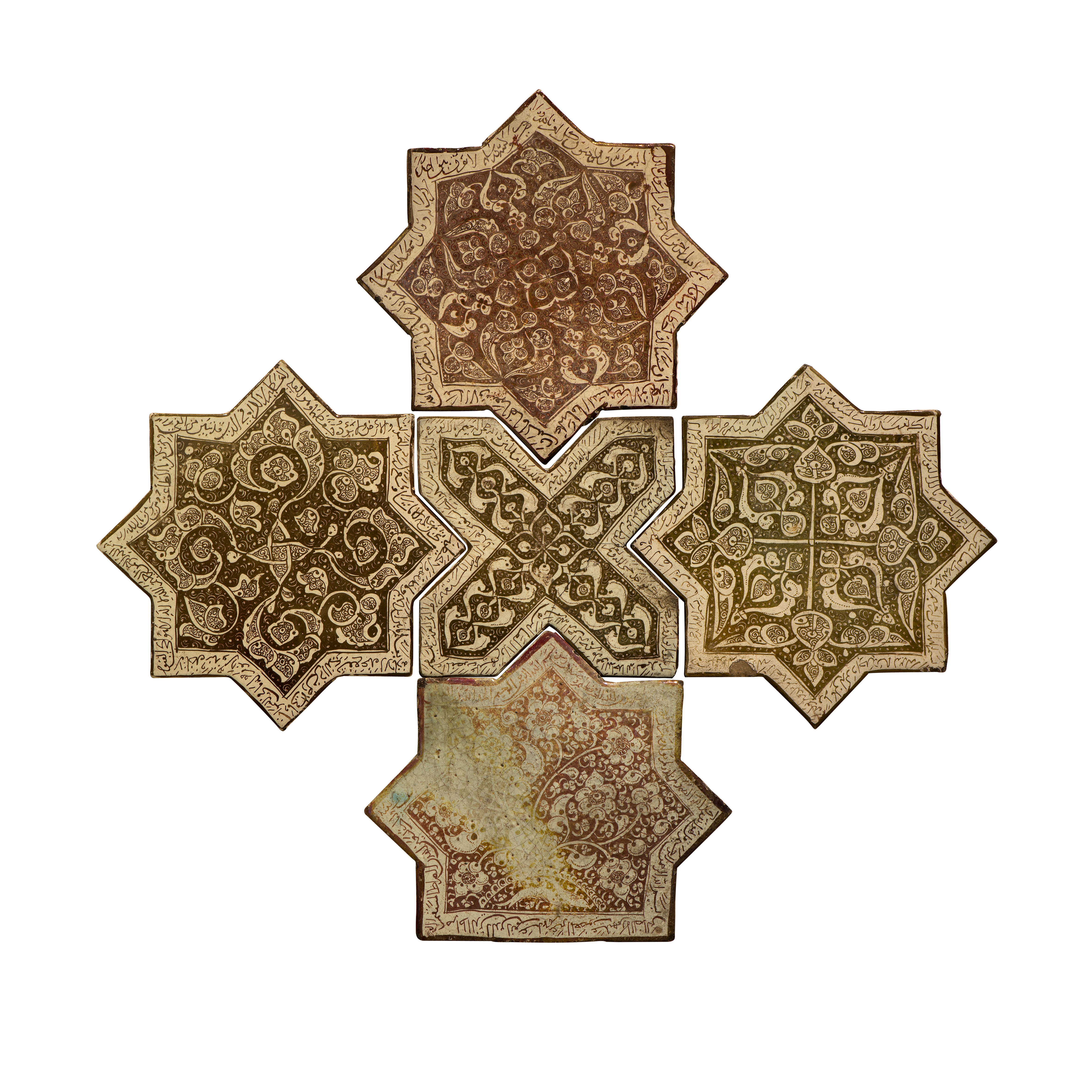
The mausoleum took shape during the Ilkhanate period, when Mongol successors to Genghis Khan governed Iran. Its patron, Fakhr al-Din, ruled the province of Ray at a time when Varamin served as the provincial capital. He was no mere administrator commissioning a civic project. Fakhr al-Din traced his own lineage to Hasan ibn Ali, the same figure entombed within the shrine, and he served as a court favorite under the Ilkhanate rulers Ghazan Khan and Uljaytu. His investment in the Imamzadeh was both political and personal -- a declaration of legitimacy inscribed in brick, tile, and calligraphy. The exterior is rectangular with a domed roof, enclosed by a low brick wall. At the entrance, a neo-Safavid style portal, added in a later era, announces the shrine in shades of blue and orange. Inside, the original tilework represented the height of Persian lusterware craftsmanship: pilasters in high relief supporting gabled arches, helical floral designs spiraling in blue and white, and bands of cursive calligraphy framing every surface.
Thirty Museums, One Shrine
Scholar Tomoko Masuya documents the stripping of the Imamzadeh Yahya across two distinct waves. The first, from 1862 to 1875, saw tiles systematically removed and sold throughout Europe and the United States. The second wave followed between 1881 and 1900. By the time the looting subsided, the shrine's most celebrated surfaces had been scattered across continents. Historian Keelan Overton estimates that as of 2020, tiles from this single building reside in at least 30 museums in cities including Doha, St. Petersburg, Tbilisi, London, Oxford, Paris, Glasgow, Baltimore, Chicago, Los Angeles, and Tokyo. Star-shaped lusterware tiles sit in the Walters Art Museum in Baltimore. A tile panel is displayed at the Victoria and Albert Museum in London. Pieces rest in the Hermitage Museum in St. Petersburg and in Hamburg's Museum fur Kunst und Gewerbe. The mihrab itself ended up in Honolulu. A few tiles remain at the Shrine Museum in Mashhad, but the qibla wall of the original building stands bare.
Fairy Lights Where Luster Once Gleamed
What makes the Imamzadeh Yahya remarkable today is not what was taken but what has grown in its place. Local worshippers have transformed the stripped interior into something entirely their own. Fairy lights and garlands hang from walls that once held priceless tilework. The cenotaph holds a mirror, candlesticks, and a Quran. Paper bills are scattered across the floor as offerings. Carpets and pillows serve both as decoration and practical accommodation for prayer. Prayer stones made from the sacred soil of Karbala are available for prostration. Visitors touch the zarih, kiss it, pray against it, and thread money through the holes in its protective screen. On either side of the empty mihrab space, collages display photographs of the building's tiles as they appear in museum exhibitions around the world -- a quiet documentation of absence. During Ashura and other holidays, these images give way to commemorative banners. The shrine breathes with the rhythms of its community.
A Courtyard That Serves the Living
The Imamzadeh Yahya is considered the most important imamzadeh in Varamin county, and its significance extends well beyond the tomb. The courtyard functions as public parkland where families spread picnic blankets and children play. Some visitors come to tend the graves of relatives buried in the complex's cemetery. The space hosts community events. In 2015, the shrine served as a pilgrimage destination for the observance of Arbaeen. Afghan immigrants who have settled in Varamin are drawn to the tomb's reputation -- Shi'a believers hold that Imamzadeh Yahya's spiritual presence remains active within the space, making prayers offered there more likely to be answered. Varamin officials have undertaken renovations in recent years, part of a broader effort to promote the site's historical significance for both locals and tourists. The Imamzadeh Yahya endures not as a museum piece frozen in time but as a living institution, its walls stripped of their original beauty yet filled with something the looters could never carry away.
From the Air
Located at 35.316N, 51.648E in southern Varamin, Tehran Province. The domed structure sits in a built-up area accessible from the Varamin-Tehran highway. Imam Khomeini International Airport (OIKB) lies approximately 40 km to the southwest; Mehrabad International Airport (OIII) is about 30 km to the northwest. Best viewed at 3,000-5,000 feet AGL. The flat plains south of Tehran stretch toward the Dasht-e Kavir desert to the southeast.