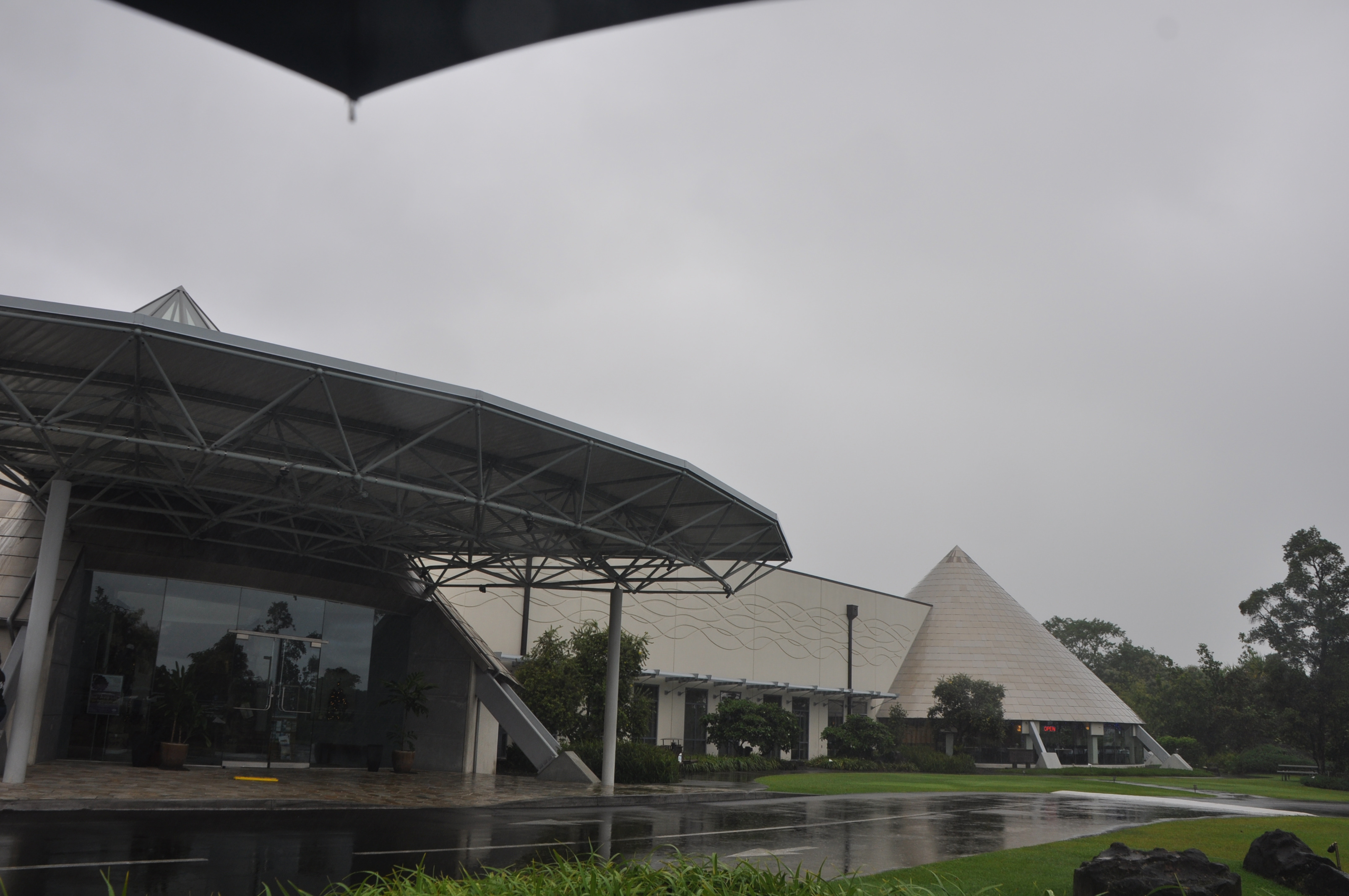
ʻImiloa Astronomy Center
Hawaiians call them "our first astronomers" - the Polynesian voyagers who read the stars, the swells, and the flight patterns of birds to navigate thousands of miles of open Pacific and find these islands. At the ʻImiloa Astronomy Center in Hilo, that ancient expertise shares space with the cutting-edge astrophysics conducted on Mauna Kea's summit, thirteen thousand feet above. The building's name means "exploring new knowledge" in Hawaiian, and the institution's central argument is that the exploration never stopped - it simply changed instruments.
Three Titanium Volcanoes
The building announces its purpose before you walk through the door. Three large titanium-clad cones rise from the hillside above the University of Hawaii at Hilo campus, representing the three volcanoes visible from this spot: Mauna Kea, Mauna Loa, and Hualalai. Designed by Honolulu architecture firm Durrant Media Five, the $28 million, 40,000-square-foot complex opened on February 20, 2006, overlooking Hilo Bay from its nine-acre site in the University Park for Science and Technology. The extensive gardens surrounding the building feature native and endemic plants alongside "canoe plants" - the taro, breadfruit, and sweet potato that Polynesian settlers carried across the ocean in their voyaging canoes. The landscaping is not decorative. It is an exhibit in its own right, illustrating the botanical knowledge that sustained long-distance Pacific navigation.
Two Ways of Seeing the Sky
The center's 120-seat planetarium anchors the experience with fulldome video projection, and the signature show - "Maunakea: Between Earth and Sky" - captures the dual identity that defines the place. All exhibits are bilingual, presented in both Hawaiian and English. One track follows the Polynesian voyagers, believed to have first reached Hawaii from the Marquesas Islands, navigating by the stars across the largest ocean on Earth. The other track follows the astronomers who now operate some of the world's most powerful telescopes on Mauna Kea's summit. The museum presents these as parallel endeavors rather than competing worldviews: both required precise observation, both demanded courage, and both were driven by the human need to understand what lies beyond the horizon. A separate theater presents the Kumulipo, the Hawaiian creation chant, while another offers an astronomy-focused origin story underwritten by the National Astronomical Observatory of Japan through the Subaru Telescope program.
The Longest Walk in the World
In September 2012, the Sagan Planet Walk - a scale model of the solar system that had existed since 1997 along a three-quarter-mile path through downtown Ithaca, New York - expanded by nearly 5,000 miles. A station representing Alpha Centauri, the sun's nearest stellar neighbor, was installed at the ʻImiloa Astronomy Center, making the Sagan Planet Walk the world's largest exhibition. The distance between Ithaca and Hilo, at the model's scale, is proportional to the actual 4.37 light-years separating our sun from Alpha Centauri. The Alpha Centauri station features a large Hawaiian figure representing the star in female form. It is a fitting endpoint: the Polynesians who first reached Hawaii were navigating toward stars, and this particular star is the closest one that nobody has reached yet.
Where the Mountain Meets the Shore
ʻImiloa sits near the base facilities for several of Mauna Kea's observatories, a deliberate proximity that connects the museum to the active science happening on the summit above. The monthly "Maunakea Skies" star talk, held on the last Saturday of each month, brings astronomers into the planetarium to discuss current research and celestial events. The center is part of the University of Hawaii at Hilo, and its educational mission extends into the community: school groups, visiting researchers, and tourists share the same exhibit halls. From the Sky Garden cafe, the view stretches across Hilo Bay toward the open Pacific - the same ocean the first Polynesian navigators crossed, using the same stars that the telescopes above now study in wavelengths the human eye cannot see. The continuity is the point. Exploration did not begin with lenses and mirrors. It began with eyes, patience, and the courage to sail beyond the horizon.
From the Air
Located at 19.701°N, 155.088°W on the University of Hawaii at Hilo campus, overlooking Hilo Bay on the Big Island's windward coast. The three distinctive titanium cones are visible from the air at moderate altitudes. Best viewed at 2,000-4,000 feet AGL approaching from the east over Hilo Bay. Nearest airport: PHTO (Hilo International Airport), approximately 3 miles south-southeast. Mauna Kea's summit observatories are visible to the west-northwest at higher altitudes, providing dramatic context for the center's dual mission.