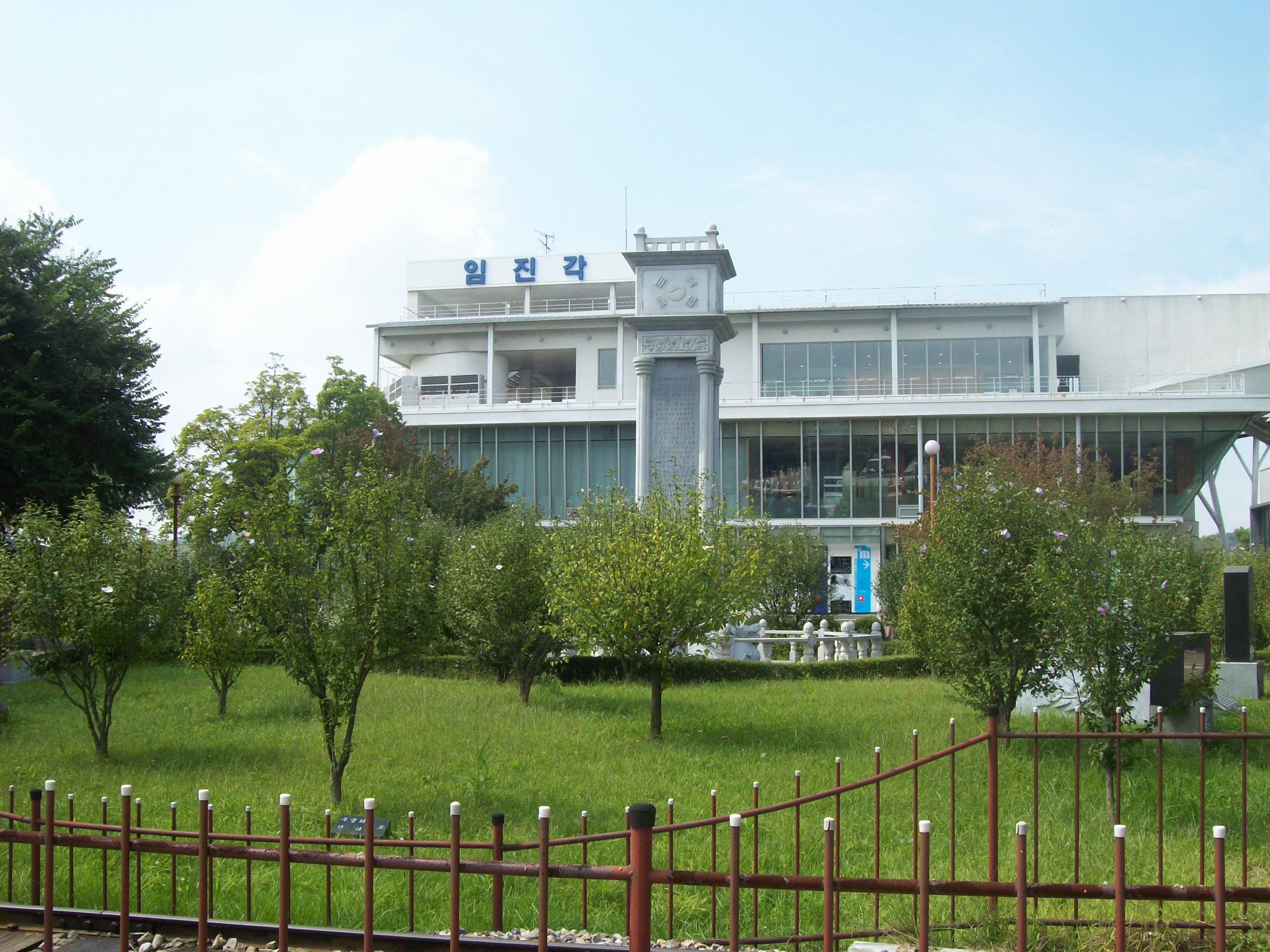
Imjingak
A rusted steam locomotive stands in a park on the Imjin River, its boiler punctured by over a thousand bullet holes. On New Year's Eve 1950, this train was hauling supplies to UN forces in North Korea when Chinese troops cut off the route ahead. The conductor tried to reverse course toward Munsan, but American soldiers stopped him -- better to destroy the train than let it fall into enemy hands. Seventy years later, the locomotive sits at Imjingak, registered as a Korean Cultural Heritage site, its shattered metal a testament to the speed with which the border closed and has stayed closed ever since.
Where the Road Ends
Imjingak was built in 1972, not as a tourist attraction but as a place of consolation. Its purpose was to give displaced Koreans -- people separated from their hometowns, their families, their entire former lives by the division of the peninsula -- somewhere to stand and look north. The park sits on the banks of the Imjin River along the tracks of the former Gyeongui Line, just outside the city of Paju. It occupies the last point on National Road No. 1 before the demilitarized zone begins, making it the furthest north most South Korean civilians can travel without special permission. Approximately 1.2 million people visit each year. They come for the memorials, the observation deck, and the simple act of standing as close to the border as they are allowed.
The Freedom Bridge
Crossing the Imjin River at Imjingak is the Freedom Bridge, a former railroad span that served as the route home for repatriated prisoners of war returning from the North. Until 1998, it was the only point of access from South Korea onto the DMZ not controlled by the South Korean Army, and the sole direct link to Camp Greaves, Camp Liberty Bell, and Panmunjom. The bridge's name carries an irony familiar to the Korean border: freedom, here, meant one direction only. Nearby, a second bridge sometimes confused with it -- also called the "bridge of freedom" -- served as an access bridge allowing one-way southbound traffic while northbound vehicles waited their turn. That bridge now crosses a stream adjacent to the Imjin River and connects to the inter-Korean railway, though no regular trains use it.
Monuments to the Forgotten
Imjingak's memorials tell the stories of those who fought in Korea and those who stayed. The Second Infantry Division memorial honors the first major U.S. unit to arrive from the continental United States, landing on July 23, 1950. The 2ID was unique in integrating South Korean soldiers called KATUSAs -- Korean Augmentation to the U.S. Army -- some 27,000 of whom served during the war. A separate monument commemorates the 187th Airborne "Rakkasans," whose advance party was the first American airborne unit to reach Korea in September 1950 and who led the last parachute assault of the war in March 1951. Three of the regiment's members earned the Medal of Honor: Lester Hammond Jr., Rodolfo P. Hernandez, and Richard G. Wilson. These are not abstract tributes. They name individuals, ground the numbers in human stories.
The Train That Cannot Leave
The bullet-riddled locomotive near the destroyed Dokgae Railroad Bridge remains the park's most visceral artifact. It is a KNR Mateo1 Class engine, the kind that once ran routinely between North and South. On December 31, 1950, it became stuck at Hanpo Station in what is now North Korea's Hwanghae Province when Chinese forces blocked the tracks ahead. American troops ordered its destruction rather than risk capture. What remains tells a simple story: a machine built to move that was forced to stop, in a country that was forced to divide. In 2004, the locomotive was designated a Cultural Heritage site, officially acknowledging that even wreckage carries meaning. Children climb on it. Families photograph it. Elderly Koreans from the North, who can no longer reach their birthplaces, sometimes stand beside it and weep.
From the Air
Located at 37.890N, 126.740E on the south bank of the Imjin River, near the city of Paju. Visible from the air as a park complex with distinctive memorials and the Freedom Bridge crossing the river toward the DMZ. Flight restrictions apply in this area. Nearest airports: Gimpo International (RKSS, ~40 km south), Incheon International (RKSI, ~65 km southwest). Seoul Air Base (RKSM) lies to the southeast.