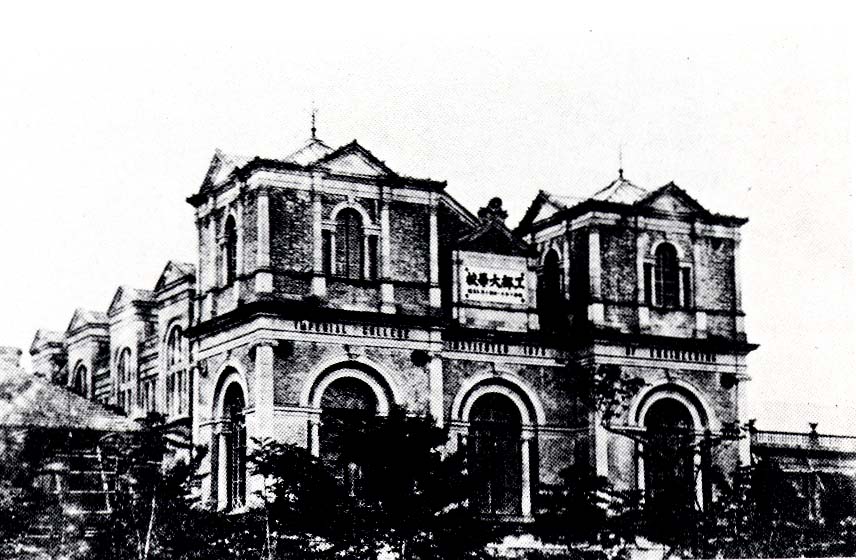
Imperial College of Engineering: The School That Built Modern Japan
Henry Dyer wrote the entire curriculum on the boat. Two months at sea between Britain and Japan, and the 25-year-old University of Glasgow graduate filled the time by designing a six-year engineering program that would transform a feudal nation into an industrial power. When he arrived in Tokyo in 1873, Yozo Yamao, head of the new Engineering Institution under the Ministry of Public Works, accepted the plan without a single revision. Classes began that October with seven instructors, all British, teaching everything in English. The students -- young Japanese men selected for their aptitude -- would go on to design the Bank of Japan headquarters, found NEC, engineer the Lake Biwa Canal, and build the National Diet Building. The Imperial College of Engineering existed for only thirteen years before it was absorbed into what became the University of Tokyo. But its graduates built modern Japan.
A Railway Engineer's Vision
The college began as an idea in the mind of Edmund Morel, a British chief engineer working for the Railway Department of the Meiji government. Morel understood that Japan's rush to modernize would stall unless it stopped relying on foreign engineers and started producing its own. On September 24, 1871, the Ministry of Public Works was formally established with eleven departments, one of them the Engineering Institution -- the Kogaku Rio. Morel and Yamao began searching for faculty through their British connections, but Morel died before the college opened. Yamao turned to industrialist Hugh Matheson, who tapped the networks of prominent Scottish engineers Lewis Gordon and William Rankine. It was Rankine who nominated Dyer -- a brilliant young scholar fresh out of Glasgow -- as the college's first principal. The appointment was a leap of faith in both directions: Japan entrusting its technical future to a man in his twenties, and Dyer betting his career on a country he had never visited.
Glasgow to Kasumigaseki
The campus rose in Kasumigaseki, at the heart of Tokyo's government district. The initial school building, designed in a simple Gothic style by Glasgow architect Colin Alexander McVean and Henry Batson Joyner, was the first substantial Western-style building in Japan. A clock tower shipped from Glasgow arrived with its glass face shattered during the voyage -- a replacement was installed a year after the building's completion. The main building, completed in 1876 by young architect Charles Alfred Chastel de Boinville, was so well designed for demonstration, experiment, and hands-on practice that British architect Edward Cockworthy Robins presented it to both the Royal Society and the Royal Institute of British Architects in 1880 as a model of technical education. Madam Palmieri performed the first Western opera concert in Japan in the school building in October 1875. The college comprised eight schools: architecture, chemistry, civil engineering, mechanical engineering, metallurgy, mining, shipbuilding, and telegraphy.
The Men Who Made the Nation
The college's graduates read like a roster of Japan's transformation. Tatsuno Kingo designed the headquarters of the Bank of Japan in 1896 and the grand Marunouchi Building at Tokyo Station in 1914 -- two buildings that defined the architectural identity of the capital. Kunihiko Iwadare founded NEC, which would become one of the world's largest electronics companies. Tanabe Sakuro served as chief engineer of the Lake Biwa Canal project and championed Japan's first large-scale hydropower electrical project. Sone Tatsuzo designed the Keio University Old Library in 1912 and oversaw the construction of the distinctive red brick buildings on the Mitsubishi Estate in Marunouchi. Kenkichi Yabashi organized the construction of the National Diet Building itself. All of them learned their craft in English, writing their graduation theses in a foreign language. Some of those theses survive today and are on display in Ueno Park.
Absorbed, Destroyed, Remembered
In 1885, the Ministry of Public Works was abolished, and the college was transferred to new oversight. The following year, it was folded into the newly created Imperial University -- later the University of Tokyo -- as its Faculty of Engineering. The campus buildings lived on: the main building served Gakushuin University for a time, and the school building housed Tokyo Jogakukan University. Then the Great Kanto Earthquake of 1923 struck. Both buildings suffered heavy damage and were demolished. The rubble was used to fill in the old moat nearby. Tatsuzo Sone, a graduate of the college's very first class, gathered his fellow alumni and built a small monument on the site using salvaged bricks from the original buildings. Today, the former campus at Kasumigaseki 3-chome, Chiyoda, is occupied by the Kasumigaseki Common Gate office complex and the Financial Services Agency. A red brick pillar and plaque mark where Dyer's college once stood -- a modest memorial to a school whose influence is written across the skyline of modern Tokyo.
From the Air
Located at 35.67°N, 139.75°E in the Kasumigaseki district of Chiyoda, central Tokyo, adjacent to the government quarter. The original campus site is now occupied by the Kasumigaseki Common Gate office complex. From the air, look for the cluster of government buildings south of the Imperial Palace grounds. Tokyo Haneda Airport (RJTT) is approximately 8 nautical miles south. Nearby landmarks include the National Diet Building to the west and Hibiya Park to the northeast. Best viewed at 3,000-5,000 feet AGL.