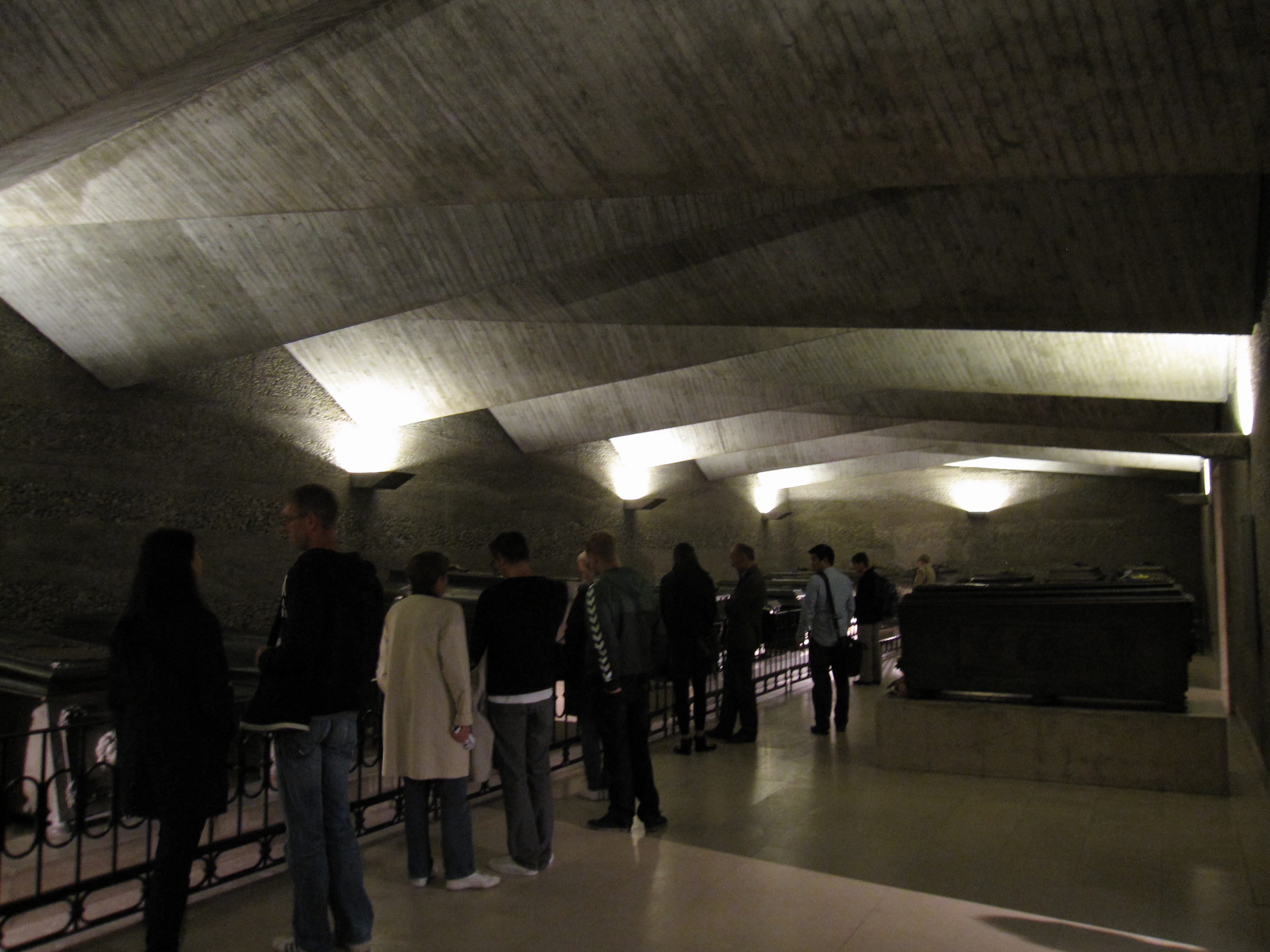
Imperial Crypt
The entrance is easy to miss. A small doorway beside the Capuchin Church on Neuer Markt square, unremarkable from the street, leads down a narrow staircase into the burial vault of Europe's most enduring dynasty. Since 1633, the Kapuzinergruft has received the remains of 145 Habsburg royals - twelve emperors, nineteen empresses, and an assortment of archdukes, archduchesses, and consorts whose collective reign shaped the continent for over six centuries. The sarcophagi progress from austere simplicity to baroque extravagance and back again, a timeline in metal and stone that tracks not just who held power but how that power wished to present itself even in death.
A Promise Kept Underground
The crypt exists because of a promise made by Empress Anna of Tyrol. In her will of November 10, 1617, she provided funds for a Capuchin monastery and burial vault near the Hofburg Palace. She died the following year, and her husband Emperor Matthias followed in 1619. Both were interred when the crypt was consecrated in 1633, becoming its first occupants. The choice of the Capuchins was deliberate: the order's commitment to poverty and simplicity was meant to serve as a reminder that even emperors are mortal. That humility still governs the entrance ritual. Tradition holds that when a Habsburg funeral procession arrives at the church door and the herald announces the deceased by their full array of titles, the Capuchin friar inside refuses entry. Only when the herald says simply 'a poor sinner' does the door open.
Bronze and Bone
Ten interconnected subterranean vaults house the collection, each built as the previous one filled. The sarcophagi range from the plain wooden coffins of the earliest burials to the extraordinary double sarcophagus of Empress Maria Theresa and her husband Francis I, designed by Balthasar Ferdinand Moll in 1753. That piece alone weighs several tons - a rococo monument where the imperial couple reclines atop their coffin as though merely resting, surrounded by allegorical figures and crowned skulls. It dominates the Maria Theresa Vault with a theatricality that her son Joseph II explicitly rejected. His own coffin, in deliberate contrast, is a simple copper box. The progression through the vaults is a walk through changing attitudes toward death: from Counter-Reformation austerity through baroque excess to Enlightenment restraint, then into the restrained grandeur of the 19th century and finally the stark concrete of the New Vault, built between 1960 and 1962.
Hearts Elsewhere
The Habsburgs did not rest in one piece. A tradition of divided burial sent their bodies to the Kapuzinergruft, their hearts to the Augustinian Church's Herzgruft in silver urns, and their viscera to copper urns in the catacombs beneath St. Stephen's Cathedral. This practice, which began in the 17th century, meant that a single ruler's remains could be distributed across three locations. The rationale was partly devotional, partly practical - multiple burial sites meant multiple churches could claim the honor of housing royal remains. Over 50 hearts sit in the Augustinian vault alone. The practice continued into the 20th century: when Empress Zita died in 1989, she was buried in the Kapuzinergruft, but her heart was taken to Muri Abbey in Switzerland, the ancestral Habsburg monastery. It was the last Habsburg divided burial.
The Last Arrivals
The New Vault, opened in 1962, brought modern architecture underground. Its stark concrete walls and subdued lighting stand in dramatic contrast to the ornate chambers above. Here rests Empress Zita, who died in Swiss exile in 1989 and was returned to Vienna for a state funeral that drew enormous crowds - a remarkable display of sentiment for a dynasty that had lost its throne 71 years earlier. Her son Otto von Habsburg, the last Crown Prince of Austria-Hungary, joined her in 2011. His funeral procession through Vienna drew tens of thousands of onlookers, and his burial in the crypt followed the traditional knocking ceremony at the church door. Only one burial space remains in the crypt, and there is no official plan for further expansion. The Capuchin friars still maintain the site, guiding visitors through a dynasty's worth of ambition, piety, and mortality compressed into a few hundred square meters beneath a quiet Viennese square.
From the Air
The Imperial Crypt lies at 48.206°N, 16.370°E in Vienna's Innere Stadt, on Neuer Markt square just a few hundred meters south of the Hofburg Palace. The Capuchin Church above is a modest structure easily lost among its neighbors from altitude. Vienna International Airport (LOWW/VIE) is 18km southeast. The crypt sits within the Ringstrasse loop - look for the horseshoe-shaped boulevard surrounding the historic center. St. Stephen's Cathedral spire, the most prominent landmark in the inner city, rises roughly 300 meters to the northeast.