Imperial Hotel, Tokyo: Four Lives at the Heart of a Capital
The telegram arrived in America on September 1, 1923, from Baron Kihachiro Okura: the Imperial Hotel stood undamaged while the Great Kanto Earthquake leveled Tokyo around it. Frank Lloyd Wright passed the message to journalists, and a legend was born -- though the truth was more complicated. The central section had slumped, floors had bulged, and a kitchen fire had broken out before being extinguished. On Tokyo's insurance damage scale of one to five, the hotel rated a two -- light damage -- while roughly one in five of the city's brick and reinforced concrete buildings escaped with no damage at all. The hotel survived, but it was not the miracle Wright advertised. That gap between legend and reality runs through the entire history of Tokyo's Imperial Hotel, a building that has been born, destroyed, and reborn four times since the 1890s, each incarnation reflecting what Japan wanted to say to the world.
Where Aristocracy Meets the West
Japanese aristocrats commissioned the first Imperial Hotel in the late 1880s to solve a practical problem: Western visitors were arriving in growing numbers, and Tokyo had nowhere suitable to receive them. Foreign Minister Count Inoue Kaoru and Viscount Shibusawa Eiichi backed the venture, and the site they chose could not have been more deliberate -- just south of the Imperial Palace grounds, overlooking what would become Hibiya Park, with the fashionable Ginza and Yurakucho neighborhoods nearby. The hotel was a statement of diplomatic intent, positioning Japan as a modern nation capable of hosting foreign dignitaries in the style they expected. The first building served its purpose for three decades before fire consumed it in April 1922, just ten days before a magnitude 6.8 earthquake struck Tokyo and toppled what remained.
Wright's Earthquake-Proof Gamble
Wright's second Imperial Hotel, built between 1919 and 1923, was designed in the Mayan Revival style -- a dramatic pyramid-like structure decorated with carved oya stone and poured concrete, its guest wings forming the letter H while public rooms occupied a taller central wing shaped like the letter I. Wright created over 700 drawings for the project. He designed the building to float on the alluvial mud beneath Tokyo 'as a battleship floats on water,' incorporating interlocking timber beams in the foundation, seismic separation joints spaced along the entire length, tapered walls thickened at the base, cantilevered floors and balconies, and suspended piping that curved rather than running in rigid straight lines. The north wing opened on July 2, 1922, hosting the reunion of the United States Naval Academy class of 1881. Wright left Japan three weeks later on July 22, never to return, leaving his apprentice Arata Endo to finish the south wing. The completed hotel officially opened in June 1923 -- three months before the earthquake that made it famous.
War, Wrestling, and Decay
The hotel's postwar chapter reads like a novel. During World War II, incendiary bombs gutted the South wing on May 25, 1945, destroying the Peacock Room -- the hotel's most celebrated interior space. Wright refused when asked to return and design repairs. American occupation forces commandeered the building from 1945 to 1952, and General MacArthur's land reforms forced the Okura family and the Imperial Household Agency to surrender their shares, ending the Imperial family's financial connection to the hotel. Then came the jewel heist. On January 15, 1956, American professional wrestler John MacFarland arranged a private showing of diamonds, rubies, and sapphires in his room, attacked the jewelry salesman, tied him up, stole his briefcase, and walked through the main lobby -- pausing to sign autographs on his way out. Police quickly identified the tall, red-haired Caucasian and arrested him that night at a Tokyo club. The gems were never recovered.
Demolished But Not Gone
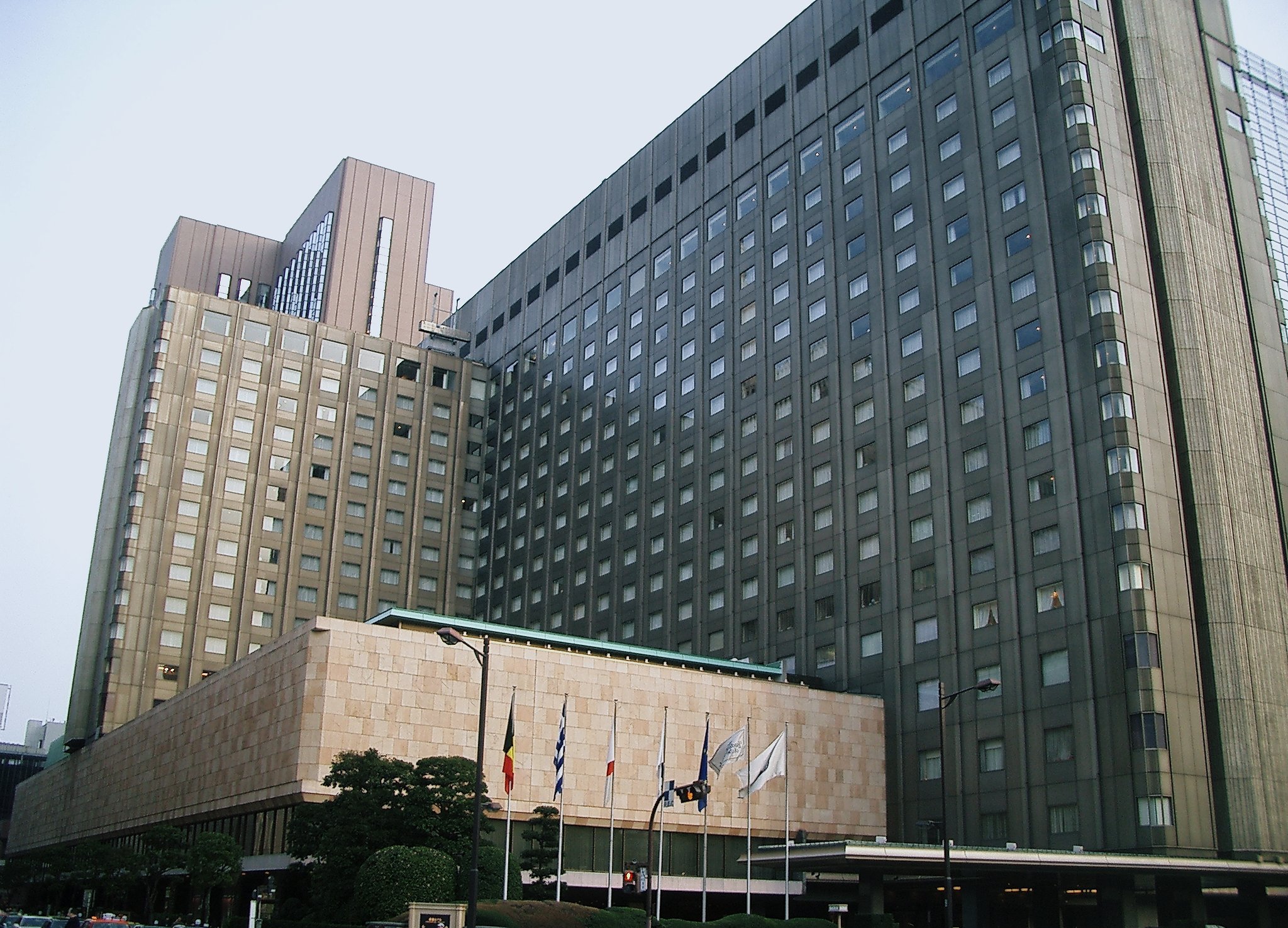
By the 1960s, Wright's masterpiece was sinking. The floating foundation that survived the earthquake had been settling unevenly for decades, with some sections dropping significantly. Decorative oya stone was crumbling and falling off. War damage to the banquet section and South wing had never been fully repaired. In a controversial decision in 1967, the hotel's board voted to demolish and replace it with a modern high-rise. The second Imperial Hotel closed on November 15, 1967. But preservationists salvaged what they could. The iconic central lobby wing and reflecting pool were carefully disassembled, transported to the Museum Meiji-mura near Nagoya, and painstakingly reconstructed -- a process that took seventeen years from demolition to the completion of the interior in October 1985. The third Imperial Hotel, a 17-story tower with 772 guest rooms, opened on March 10, 1970. A 31-story mixed-use tower joined it in 1983.
The Fourth Incarnation
The cycle continues. The 1983 tower was demolished in 2024, and the 1970 main building will follow. Real estate company Mitsui Fudosan has committed $2 billion to a new development that will integrate the hotel with adjacent Hibiya Park via a bridge spanning the six-lane road between them. A new tower annex is expected to open by 2030 on the site of the demolished tower, and the fourth Imperial Hotel itself is projected for completion in 2036. When it opens, it will be the fourth building to stand on this spot beside the palace moat in roughly 150 years -- each one reflecting the Japan of its era, from Meiji-era diplomacy to Wright's architectural ambition to postwar modernism to whatever Tokyo becomes next.
From the Air
Located at 35.67°N, 139.76°E in Uchisaiwaicho, Chiyoda ward, central Tokyo, immediately south of the Imperial Palace grounds. From altitude, look for Hibiya Park's green rectangle adjacent to the hotel site, with the Ginza district extending southeast. Tokyo Haneda Airport (RJTT) is approximately 7 nautical miles south-southwest. Narita International Airport (RJAA) is 35 nautical miles east-northeast. The hotel site sits between the dense commercial district of Ginza and the open grounds of the Imperial Palace. Best viewed at 3,000-5,000 feet AGL.