The Imperial War Museum: From Bedlam to Battlefield
The building was designed for madness. The former Bethlem Royal Hospital -- 'Bedlam,' in London slang -- was built in 1814 to house the mentally ill, its 580-foot facade stretching along Lambeth Road with a central portico and a dome that now seems disproportionately tall. When the hospital relocated to Beckenham in 1930, Lord Rothermere purchased the site intending to demolish the building and create a public park in one of London's most overcrowded neighborhoods. Instead, the central portion was preserved, its extensive wings removed and replaced by Geraldine Mary Harmsworth Park. In 1936, the Imperial War Museum moved in. A building that had contained suffering of one kind was repurposed to document suffering of another.
A Record of Toil and Sacrifice
The museum was the idea of Sir Alfred Mond, a Liberal MP who in 1917 proposed to Prime Minister David Lloyd George that Britain should document its war effort while the fighting was still underway. The War Cabinet agreed, and a committee began collecting material from the trenches, the factories, and the home front. From the beginning, the founders understood the danger of creating a shrine to militarism. Mond told King George V at the museum's opening in 1920 that it was 'not a monument of military glory, but a record of toil and sacrifice.' Sir Martin Conway, the first director general, insisted that exhibits must 'be vitalised by contributions expressive of the action, the experiences, the valour and the endurance of individuals.' On the August Bank Holiday 1920, 94,179 visitors came in a single day.
Collected Under Fire
The museum's collection grew through two world wars -- sometimes literally under fire. When the Second World War began, eighteen of the museum's artillery pieces were returned to military service during the equipment shortage after Dunkirk. The museum closed to the public in September 1940 with the onset of the Blitz. On 31 January 1941, a Luftwaffe bomb struck the naval gallery, destroying a Short Type 184 seaplane that had flown at the Battle of Jutland and damaging numerous ship models. While closed, the building served as a repair garage for government vehicles, a civil defense lecture center, and a firefighting training school. Today the collection encompasses more than two million items: personal papers, photographs, film, oral histories, artworks -- including paintings by John Singer Sargent, Wyndham Lewis, and John Nash -- firearms, vehicles, and aircraft.
The Atrium and Beyond
The museum's main hall was redesigned in the 1980s as a soaring atrium displaying military hardware, described by one critic as 'the biggest boys' bedroom in London.' Two fifteen-inch naval guns, mounted outside the entrance since 1968, set the tone -- one from HMS Ramillies, the other from both HMS Resolution and HMS Roberts, all fired in action during the Second World War. Inside, the museum's scope extends far beyond hardware. The Holocaust Exhibition, opened in 2000 at a cost of five million pounds, was the first permanent Holocaust exhibition in a British museum. The Churchill War Rooms, an underground wartime command center beneath Whitehall, became a branch in 1984. HMS Belfast, a light cruiser that fired some of the first shots of D-Day, has been moored on the Thames near Tower Bridge since 1971.
Five Branches, One Mission
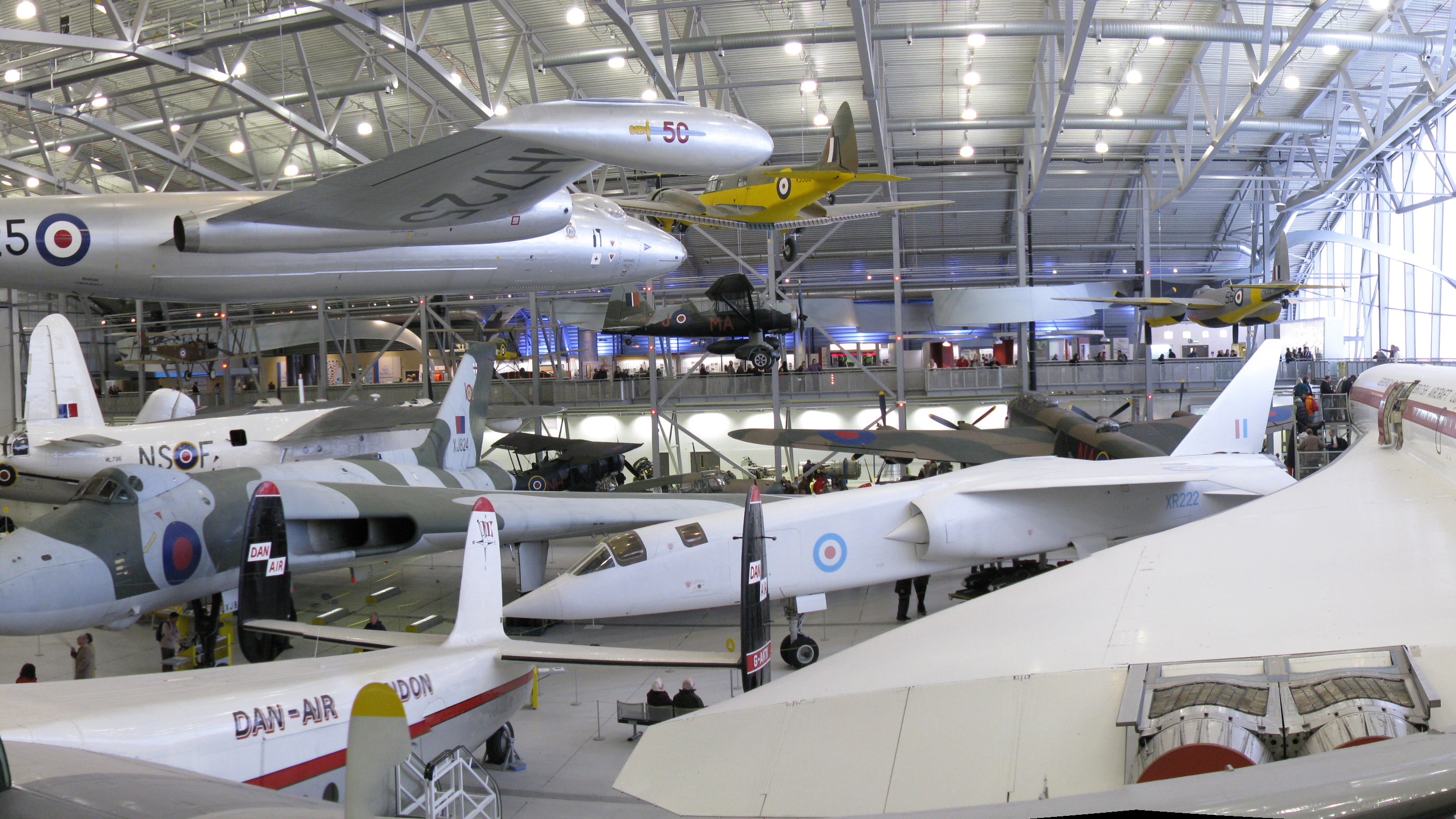
The museum expanded beyond its Southwark headquarters in the 1970s. Imperial War Museum Duxford, on a historic Battle of Britain airfield in Cambridgeshire, houses nearly two hundred aircraft in seven exhibition buildings, including the Stirling Prize-winning American Air Museum designed by Norman Foster. Imperial War Museum North, opened in 2002 in Trafford, Greater Manchester, was designed by Daniel Libeskind as a globe shattered by conflict and reassembled from its fragments. The museum's artistic program has kept pace with modern conflicts: commissioned artists have covered Northern Ireland, the Falklands, Bosnia, Iraq, and Afghanistan. Steve McQueen's Queen and Country project and Peter Howson's paintings from Bosnia sit alongside the Sargent and Nash works from the World Wars. The museum's film archive, one of the oldest in the world, includes The Battle of the Somme -- a 1916 documentary inscribed on the UNESCO Memory of the World register.
From the Air
The Imperial War Museum London (51.50N, 0.11W) is on Lambeth Road in Southwark, south of the Thames. The building's dome and the two large naval guns at the entrance are identifiable from lower altitudes. Geraldine Mary Harmsworth Park surrounds the museum. Nearby airports: London City (EGLC) 7nm east, Battersea Heliport 2nm west. Best viewed from 2,000ft.