In Flanders Fields
Sergeant-Major Cyril Allinson was delivering the brigade mail when he saw the major sitting in the back of an ambulance with a notepad. It was 3 May 1915 at an Advanced Dressing Station outside Ypres. The major was Lieutenant-Colonel John McCrae, 41 years old, a Canadian physician and gunner, and the day before he had personally conducted the burial service for his friend Lieutenant Alexis Helmer of the Canadian Field Artillery. Helmer had been killed by a German shell on 2 May, his body recovered piece by piece in a sandbag. McCrae had read the service over what they had. Now, the morning after, he was writing in the ambulance, and Allinson saw that the major's eyes kept lifting from the page to Helmer's grave. When McCrae handed him the page to read, Allinson memorised it on the spot. It was, he said later, almost an exact description of the scene in front of us both.
Alexis Helmer
Alexis Helmer was 22, a graduate of the Royal Military College of Canada, an only son, an artillery officer. He had been with McCrae's brigade through the chlorine cloud on 22 April, the first large-scale poison gas attack in the history of war, and through the two weeks of fighting that followed: a battle McCrae had described to his mother as a nightmare. On 2 May a shell hit Helmer directly. There was no body to bury, only what could be gathered into a blanket. McCrae, who had been a friend, conducted the service himself because the chaplain was elsewhere. They put him in a makeshift grave by the canal at Essex Farm, marked with a wooden cross. Wild poppies were already blooming in the disturbed earth between the crosses. The damage done to the soil by the bombardments had increased the lime content; the poppy was one of the few plants able to grow.
The Dead Speak
The poem is short. Thirteen rhymed lines in the strict French form of the rondeau, three stanzas, two recurring rhymes. McCrae had been writing verse since he was a boy in Guelph, Ontario, and his earlier poems had often dwelt on death and the peace that follows. This one is different. It is written from inside the grave. We are the Dead, the second stanza begins. Short days ago we lived, felt dawn, saw sunset glow, loved and were loved, and now we lie in Flanders fields. The voice is the dead men's, including Helmer's, including the men McCrae had failed to save in the dressing station behind him. They speak to those still alive, asking them to take up the quarrel with the foe, to hold the torch. The third stanza turns into recruiting rhetoric in a way that has troubled critics ever since. The first two stanzas have not lost their force in a hundred years.
He Threw It Away
When McCrae finished, he was not satisfied. According to one account, he crumpled the page and threw it away. Another version says he simply handed it to Allinson, who pocketed it. A third claims it was retrieved from a wastepaper basket by Edward Morrison or J. M. Elder. What is certain is that the poem survived and travelled. A copy turns up in the diary of Clare Gass, a Canadian battlefield nurse, in an October 1915 entry. McCrae himself worked on the poem for months. He submitted it to The Spectator in London. The Spectator rejected it. He sent it to Punch. Punch published it, anonymously, on 8 December 1915. It became, within weeks, the most quoted poem of the war.
The Poppy
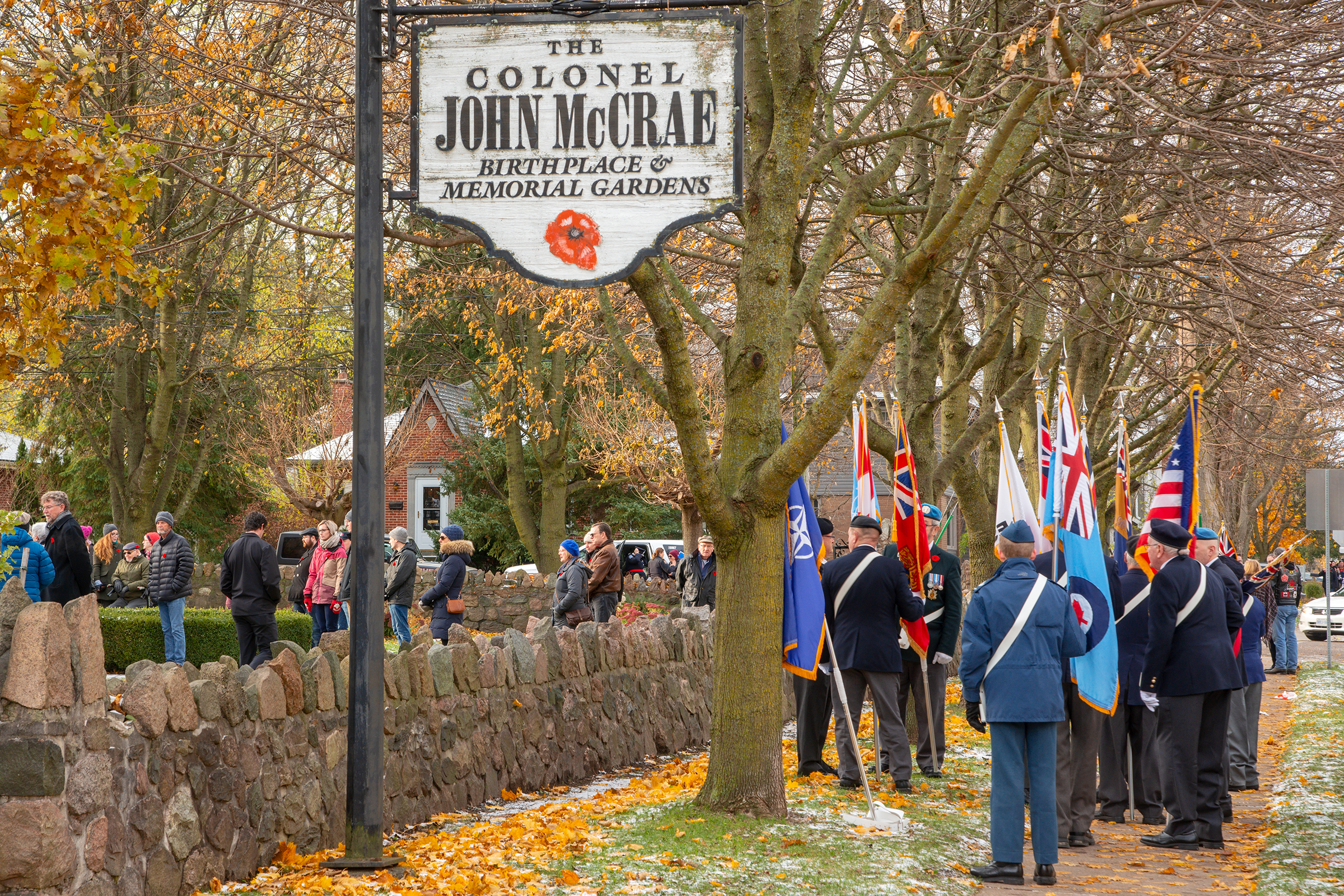
An American professor named Moina Michael read the poem in November 1918 and resolved to wear a red silk poppy from then on, year-round, in memory of the dead. She wrote a reply poem, We Shall Keep the Faith, and persuaded the American Legion in 1920 to adopt the poppy as its symbol. A French woman, Madame E. Guerin, then sold silk poppies in France to raise money for war orphans, and the next year sent poppy sellers to London. Field Marshal Haig, who in his other capacity was helping to found the Royal British Legion, took up the cause. From there it spread through the Commonwealth. The remembrance poppy is now, every November, worn by tens of millions of people who have never read McCrae's poem and could not name the friend whose grave produced it. The chain runs from Helmer, to McCrae, to Allinson, to the editors of Punch, to Michael, to Guerin, to Haig, to a small paper-and-plastic flower on a stranger's lapel a century later.
Wimereux
McCrae did not live to see the end of the war. After Ypres he was promoted and posted to the No. 3 Canadian General Hospital in Boulogne-sur-Mer, where he ran the medical service for three years. The work and the grief wore him down. On 23 January 1918 he was promoted to colonel and appointed Consulting Physician to the British Armies in France. The same day he contracted pneumonia. It became meningitis. He died at the military hospital in Wimereux on 28 January 1918 and was buried there with full military honours, wearing the same uniform he had worn when he wrote his poem, though he was now 45 years old — four years older than the lieutenant-colonel who had sat in the ambulance at Essex Farm. His book In Flanders Fields and Other Poems was published the following year. A monument now stands at Essex Farm, near the place where Helmer is thought to have been buried, near the place where the poem was written. The poppies still grow there in summer. The crosses too.
From the Air
The poem was written at the Essex Farm Advanced Dressing Station beside the Yser Canal, approximately 50.87 degrees north, 2.87 degrees east, two kilometres north of Ypres in West Flanders, Belgium. The article coordinates point to the John McCrae Memorial Site at Essex Farm Cemetery, where the bunkers of the dressing station still survive in the canal embankment. Recommended viewing altitude 1,500 to 2,500 feet to take in Ypres and the salient battlefields. Nearest airports are Ostend-Bruges (EBOS) approximately 30 nautical miles northwest, Kortrijk-Wevelgem (EBKT) about 12 nautical miles south, and Lille (LFQQ) across the French border. The canal is the long straight watercourse running north-south just west of the line.