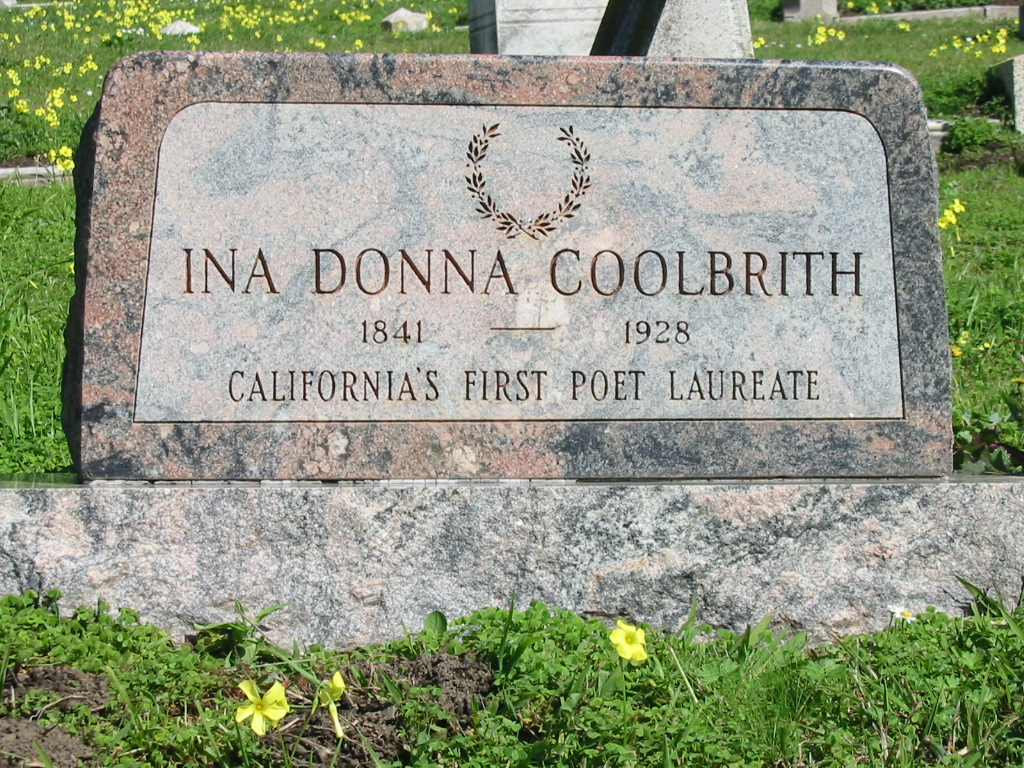
Ina Coolbrith
She was born Josephine Donna Smith in Nauvoo, Illinois, in 1841, the niece of Joseph Smith, founder of the Church of Jesus Christ of Latter-day Saints. By the time she died in 1928, she had buried that name so thoroughly that most of the literary world knew nothing of it. Ina Coolbrith - the name she took from her mother's family - became the voice of California poetry, the first poet laureate of any American state, and a quiet architect of the San Francisco literary scene that produced some of the country's most celebrated writers. She never published a memoir. The 1906 earthquake burned the one she was writing.
Escape from Nauvoo
Coolbrith's father, Don Carlos Smith, died of malarial fever four months after her birth. A sister died a month later. Her mother eventually left the Mormon community and brought her daughters west, and Coolbrith entered her teens in Los Angeles. She began publishing poems at age eleven, writing under her mother's maiden name. At seventeen she married Robert Bruce Carsley, an ironworker and part-time actor. The marriage was brief and abusive. She ended it, moved to San Francisco, and started over - a pattern she would repeat throughout her life, shedding old identities the way a snake sheds skin. Each reinvention brought her closer to the writer she intended to be.
The Golden Gate Trinity
In San Francisco, Coolbrith fell into the orbit of Bret Harte and Charles Warren Stoddard, and the three became inseparable. They called themselves the Golden Gate Trinity, and together they shaped the Overland Monthly, the literary journal that put California writing on the national map. Coolbrith supplied a poem for every issue for a decade straight - a streak that Stoddard said was unmatched, noting she never had a submission returned by a publisher. Her work caught the attention of critics far beyond the Bay Area. The New York Times praised "The Mother's Grief." John Greenleaf Whittier included "When the Grass Shall Cover Me" in his anthology Songs of Three Centuries, and it was judged the best poem in the collection. Mark Twain, Ambrose Bierce, Alfred Lord Tennyson, and John Muir all crossed her path, drawn by a talent that was, as one reviewer put it, "singularly sympathetic" and "palpably spontaneous."
The Librarian Who Shaped a Generation
Coolbrith's generosity cost her. When she befriended the eccentric poet Cincinnatus Hiner Miller, she suggested he rename himself Joaquin Miller after the legendary Californio outlaw Joaquin Murrieta, and advised him to dress the part with long hair and a mountain man costume. The rebranding worked spectacularly - Miller became internationally famous. While he toured Europe, living out their shared dream of visiting Lord Byron's tomb, Coolbrith stayed behind to raise his Wintu daughter alongside her own family members. The financial burden drove her to accept a position as Oakland's city librarian. Her poetry output slowed, but she found a different kind of influence. For nineteen years she guided young readers through the stacks, among them a teenager named Jack London and a girl named Isadora Duncan. Both would later credit her with opening doors to the worlds they eventually conquered.
Fire, Phoenix, Laureate
Oakland's library board fired Coolbrith after nineteen years of service when patrons demanded reorganization. She moved back to San Francisco, where members of the Bohemian Club invited her to serve as their librarian. She began writing a history of California literature, rich with autobiographical material that would have illuminated decades of the state's cultural life. Then came April 18, 1906. The earthquake and subsequent fire destroyed her home and consumed the manuscript. Friends rallied. Author Gertrude Atherton and the Bohemian Club set her up in a new house, and Coolbrith resumed writing with a fury that surprised even her admirers. Freed from the library's demands, she traveled to New York by train and dramatically increased her poetry output.
California Remained Her Inspiration
On June 30, 1915, at the Panama-Pacific International Exposition, Ina Coolbrith was named California's poet laureate - the first poet laureate of any state in the nation. She was seventy-four. She continued writing for eight more years, her subjects ranging far beyond the melancholy and uplift that publishers typically expected from women poets of her era. Later California poet laureate Carol Muske-Dukes observed that though Coolbrith's poems "were steeped in a high tea lavender style" shaped by British literary traditions, "California remained her inspiration." She died on February 29, 1928, at eighty-six. A park on Russian Hill bears her name today, near the neighborhood where she once held literary salons that introduced unknown writers to the publishers who would make them famous.
From the Air
Ina Coolbrith's life centered on Oakland and San Francisco. Her Oakland home and the library where she worked as city librarian are located near 37.833N, 122.239W. From the air, Oakland's downtown grid and Lake Merritt are the primary landmarks. Ina Coolbrith Park in San Francisco sits on Russian Hill at approximately 37.799N, 122.415W, offering views of Alcatraz and the Golden Gate Bridge. Nearest airports: Oakland International (KOAK) approximately 7 nm south of her Oakland locations, and San Francisco International (KSFO) approximately 11 nm south of the Russian Hill park. Clear Bay Area days offer excellent visibility of both cities.