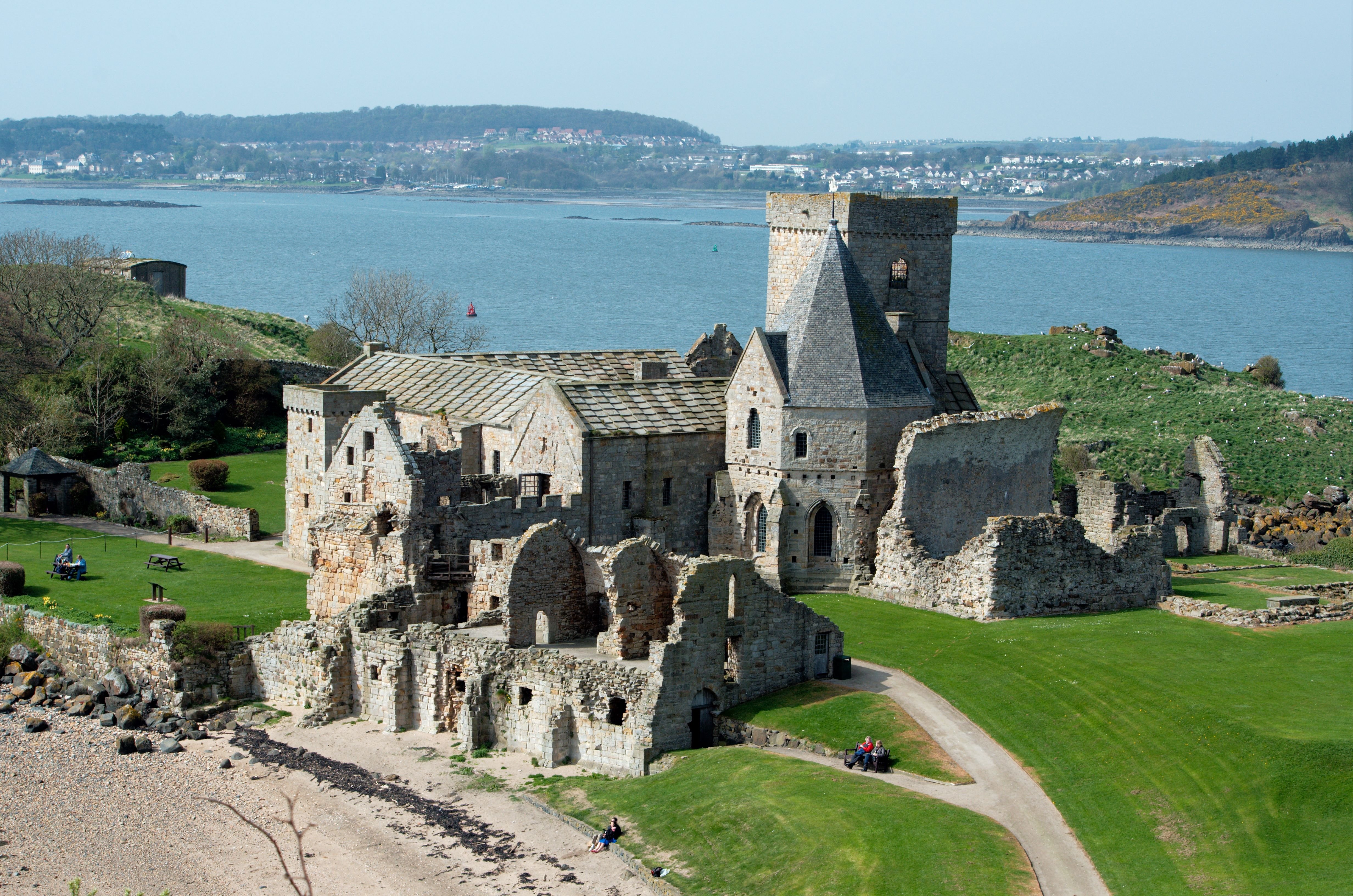
Inchcolm Abbey
In 1123, King Alexander I of Scotland was crossing the Firth of Forth when a storm drove his ship ashore on a small island called Inchcolm. He was stranded there for three days, surviving on whatever the island's sole inhabitant -- a hermit dedicated to St Columba -- could provide. The king survived, and vowed to found a monastery in gratitude. He never did -- Alexander I died in 1124, one year after the storm. It fell to his brother, David I, to honour the promise: David invited Augustinian canons to establish a priory on the island around 1140. The priory that grew from that act became one of the most important monastic houses in Scotland. Today it holds a distinction no other Scottish monastery can claim: it is the most complete surviving monastic complex in the country. The cloisters, chapter house, warming house, and refectory are all intact. Nearly nine centuries after a shipwrecked king stumbled ashore, the buildings still stand.
The Island in the Firth
Inchcolm sits in the Firth of Forth, roughly midway between Edinburgh and the coast of Fife. The island is small -- barely a quarter of a mile long -- but its position in the estuary made it strategically and spiritually significant. The name comes from the Gaelic Innis Choluim, the island of Columba, reflecting the tradition that St Columba himself may have visited or established a presence here. The hermit whom Alexander I encountered was maintaining a devotion to Columba that stretched back centuries. The abbey that replaced the hermit's cell was established during the episcopate of Gregoir, Bishop of Dunkeld, and was initially a priory staffed by Augustinian canons regular. It became a full abbey in 1235.
Bower and the Antiphoner
Among the abbey's most notable residents was Walter Bower, the 15th-century chronicler who served as abbot and wrote the Scotichronicon, a history of Scotland that remains one of the most important medieval Scottish texts. The abbey also gives its name to the Inchcolm Antiphoner, a 14th-century manuscript containing some of the few surviving examples of Celtic Plainchant. The Antiphoner includes a substantial number of chants dedicated to St Columba, and while these may derive from other monastic foundations with Columban associations -- Iona or Oronsay Priory -- Inchcolm is considered the most likely source. The manuscript survives at the University of Edinburgh, a fragile link to the sound world of medieval Scotland.
Raids and Reformation
The island's position made it vulnerable. English forces attacked from 1296 onward, and the abbey endured repeated raids during the Wars of Scottish Independence. Despite the damage, the monastic community persisted for over four centuries. The Scottish Reformation of 1560 finally ended monastic life on the island. The abbey was abandoned, and in July 1581, stones were taken from the buildings and shipped to Edinburgh to repair the Tolbooth. Yet the abbey survived this plundering better than almost any other Scottish monastery. The compact island setting may have helped -- there was no nearby town to scavenge the ruins for building material, and the effort of transporting stone across the Firth limited how much could be removed.
Shakespeare and Fortification
William Shakespeare referenced Inchcolm in Macbeth, written in 1606, linking the island to the literary imagination of the period. After the Reformation, the island's strategic value outlasted its spiritual purpose. It was used for defensive purposes during several conflicts, its position commanding the approaches to Edinburgh from the sea. Military installations were added during the First and Second World Wars. The abbey complex, however, was left largely undisturbed. It is now cared for by Historic Environment Scotland, which maintains a visitor centre near the landing pier. Visitors reach Inchcolm by ferry from South Queensferry, the crossing itself offering views of the Forth Bridge and the Fife coastline. A Latin inscription carved above the abbey's entrance translates roughly as a wish that the house may stand until an ant drinks the ocean and a tortoise walks around the world.
From the Air
Inchcolm Abbey is at 56.030N, 3.302W on the island of Inchcolm in the Firth of Forth, roughly midway between Edinburgh and the Fife coast. The small island with its intact medieval abbey complex is clearly visible from altitude. The Forth Bridge, Forth Road Bridge, and Queensferry Crossing are nearby to the west. Nearest airport: Edinburgh (EGPH), approximately 8 nm south-southwest. Best viewed at 1,500-3,000 ft.