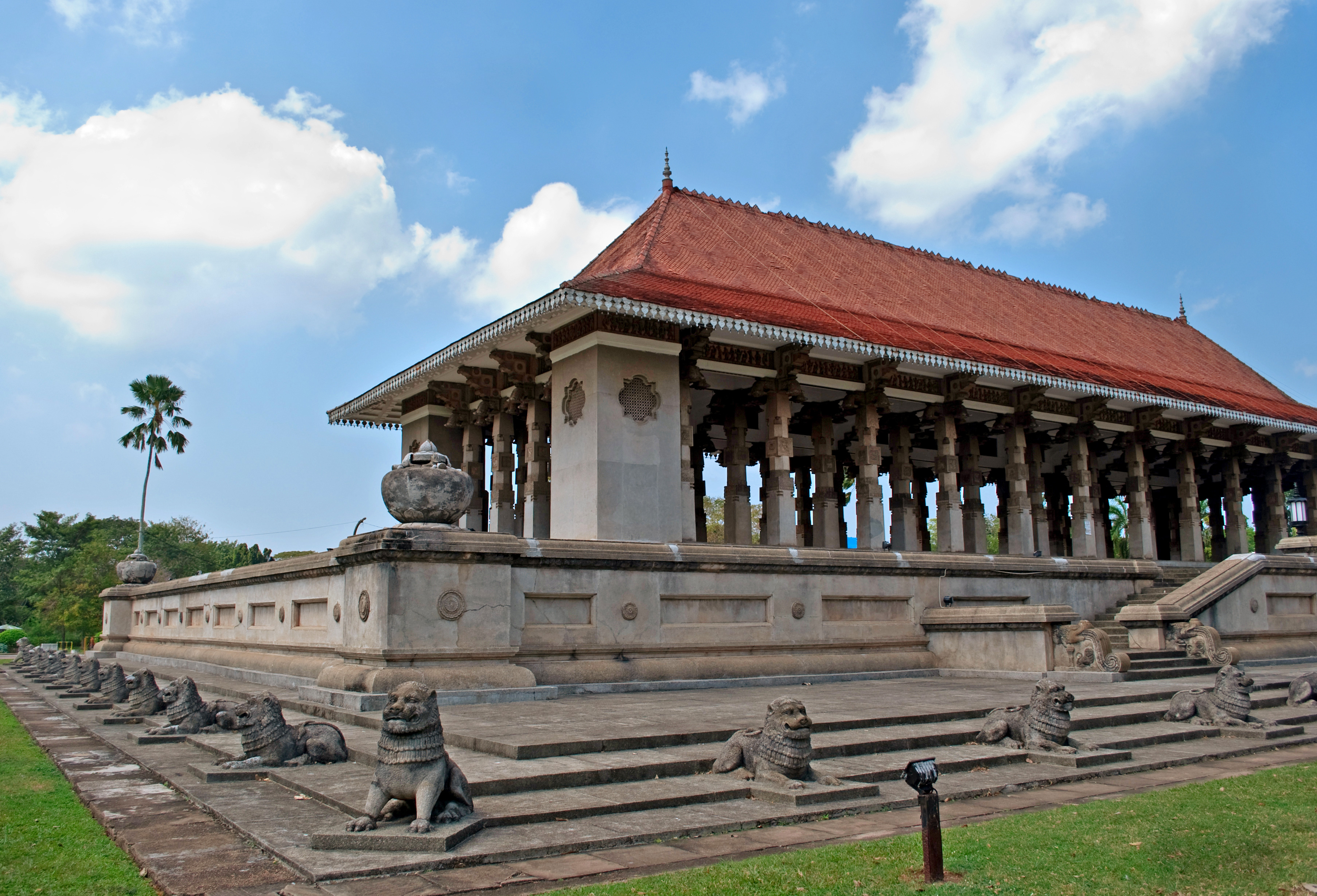
Independence Memorial Hall
The architects made a pointed choice. When Sri Lanka needed a monument to commemorate its independence from Britain, a team of eight led by Tom Neville Wynne-Jones designed a building modeled on the Magul Maduwa, the royal audience hall of the Kingdom of Kandy. That was the same hall where, on March 2, 1815, the Kandyan Convention was signed between the British and the Kandyan chieftains, ending the last native kingdom on the island. The Independence Memorial Hall thus looks backward and forward simultaneously: its form remembers what was lost, its purpose celebrates what was reclaimed.
The Day It Began
On February 4, 1948, at a special podium erected in what was then called Torrington Square, Prince Henry, Duke of Gloucester, formally opened the first parliament of independent Ceylon. The ceremony marked the restoration of full governing responsibility to a Ceylonese-elected legislature after more than a century of British colonial rule. The Independence Memorial Hall was subsequently built on that exact location, in the Cinnamon Gardens neighborhood of Colombo. At its head stands a statue of Don Stephen Senanayake, the country's first prime minister and the man known as "The Father of the Nation." The hall served as more than a monument. It functioned as the ceremonial assembly hall for both the Senate of Ceylon and the House of Representatives until parliament relocated to its new complex.
An Architecture of Memory
The design team Wynne-Jones assembled included F. H. Billimoria, Shirley de Alwis, Oliver Weerasinghe, Homi Billimoria, Justin Samarasekera, and M. B. Morina. Together they created a structure that quotes the Kandyan architectural tradition while functioning as a modern civic building. The Magul Maduwa, their reference point, was the ceremonial hall where Kandyan kings received audiences. By the time it was used for the 1815 convention that formally ceded the kingdom to Britain, the hall had become a symbol of sovereignty lost. Rebuilding its form as a monument to sovereignty regained gave the Independence Memorial Hall a layered meaning that pure modernism could not have achieved. The building speaks in architectural terms to a story that spans centuries: independence is not simply a political event but a recovery of identity.
Where the Nation Gathers
Most of Sri Lanka's annual Independence Day celebrations, held each February 4th, take place at the hall. But the building has served as the backdrop for many of the country's most solemn moments as well. State funerals for presidents, artists, monks, and national figures have been held here, including those of President Ranasinghe Premadasa, filmmaker Lester James Peries, musician W. D. Amaradeva, and actress Malini Fonseka. In 2015, President Maithripala Sirisena took his oath of office at the memorial. The hall has appeared in international popular culture too: it served as a pit stop on The Amazing Race Asia, The Amazing Race Australia, and the Israeli edition of The Amazing Race. Through celebration and mourning alike, the building continues to serve as the physical point where Sri Lanka's national identity is performed and reaffirmed.
Independence Square Today
The hall sits within Independence Square, formerly Torrington Square, in Colombo's Cinnamon Gardens district. The surrounding area has been developed into a public space that includes the Independence Memorial Museum, which houses exhibits on the independence movement and the country's political history. The square itself has become a gathering place for Colombo residents, a public park in a city where open space is precious. The contrast with its original purpose as a colonial-era square is telling: what was once named for a British administrator now carries the name of the event that ended British administration. The Cinnamon Gardens neighborhood, one of Colombo's most affluent, provides a quiet setting that belies the hall's charged symbolism. Yet on Independence Day, when the crowds gather and the flags go up, the building sheds its everyday quietude and becomes, again, the place where a nation remembers what it took to become itself.
From the Air
Independence Memorial Hall is located at 6.904N, 79.868E in the Cinnamon Gardens district of central Colombo, approximately 2 kilometers inland from the coast. The open-columned hall with its distinctive Kandyan-style roof is visible as a landmark structure within Independence Square's green space. Best viewed at 1,000-2,000 feet AGL. Bandaranaike International Airport (VCBI) is approximately 19 nautical miles north. Ratmalana Airport (VCCC) is about 4 nautical miles southwest. The surrounding Cinnamon Gardens area features wide tree-lined avenues and lower-density development compared to Colombo's commercial core.