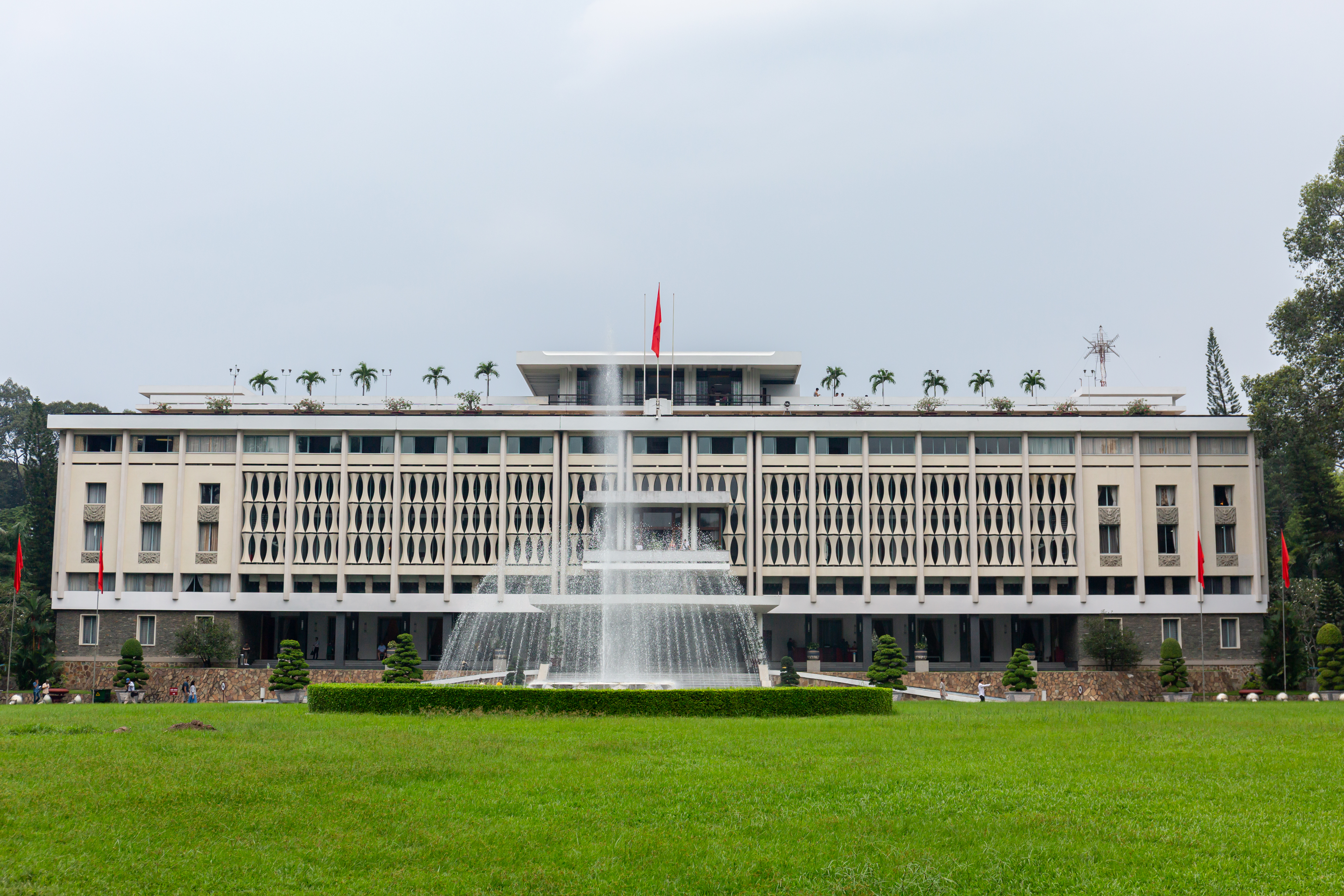
Independence Palace
At 10:45 on the morning of April 30, 1975, a T-54 tank bulldozed through the wrought-iron gates of the Independence Palace in Saigon. The driver, Bui Quang Than, had no idea he was creating one of the most iconic images of the twentieth century. Inside the building, the last president of South Vietnam sat waiting to surrender. The war was over. Today the palace stands almost exactly as it did in that final hour -- clocks stopped, maps still pinned to the war room walls, the president's desk still arranged as though he might return. It is less a museum than a freeze frame, a building caught mid-breath between two Vietnams.
A Palace Born from Wreckage
The Independence Palace that visitors see today is not the original. In February 1962, two dissident pilots of the South Vietnamese Air Force bombed the old Norodom Palace, badly damaging the left wing and forcing President Ngo Dinh Diem to relocate. Rather than repair it, Diem ordered the damaged structure demolished and a new palace built from scratch. He chose architect Ngo Viet Thu for the project -- a remarkable selection, given that Thu had won the Grand Prix de Rome in 1955, the highest honor of the Beaux-Arts tradition in Paris. Thu's design blended modernist architecture with subtle references to Vietnamese culture, incorporating traditional feng shui principles and characters from classical calligraphy into the building's lines. Construction began on July 1, 1962, but Diem would never see his palace completed. In November 1963, a coup d'etat led by General Duong Van Minh overthrew his government, and both Diem and his brother Ngo Dinh Nhu were assassinated. The new palace was inaugurated three years later, on October 31, 1966, by General Nguyen Van Thieu.
Power and Paranoia Underground
Walk through the palace's upper floors and you encounter the official face of South Vietnam: a grand reception hall, a state banquet room with lacquered columns, the president's office with its twin telephones and helicopter-landing map. Everything is mid-century diplomatic elegance. Then you descend into the basement, and the atmosphere changes entirely. Below the palace lies a command bunker with meter-thick reinforced concrete walls, a telecommunications center bristling with period radio equipment, and a war room where maps of troop movements still hang under fluorescent light. This was Thieu's real workplace during the final years of the war -- the place where the collapse of South Vietnam was tracked in real time as province after province fell during the 1975 Ho Chi Minh Campaign. The contrast between the sunlit reception rooms above and the bunker's claustrophobic corridors below captures the dual reality of the South Vietnamese presidency: public ceremony upstairs, existential dread below.
The Last Days of April
By mid-April 1975, North Vietnamese forces were closing on Saigon from every direction. On April 8, pilot Nguyen Thanh Trung -- a communist spy who had served undetected in the South Vietnamese Air Force -- took off from Bien Hoa Air Base in an F-5E fighter jet and bombed the palace, though the damage was minor. President Thieu resigned on April 21 and fled the country. His successor, Tran Van Huong, lasted six days before handing power to General Duong Van Minh, who had led the 1963 coup against Diem twelve years earlier. Minh's presidency lasted forty-three hours. On the morning of April 30, North Vietnamese tanks rolled down the boulevard toward the palace. Tank 843 rammed into a side gate and stalled; Tank 390 then surged forward and crashed through the main front gate. Commander Bui Quang Than of Tank 843 raced to the palace rooftop and raised the liberation flag on the balcony. Minh, waiting inside with his cabinet, told the arriving soldiers he was ready to transfer power. The North Vietnamese commander replied: "You cannot give up what you do not have."
Frozen in 1975
Renamed Reunification Hall after the war, the palace was preserved largely as it stood on that final day. Visitors walk through Thieu's private quarters on the third floor, past the cinema and the rooftop nightclub -- remnants of a lifestyle that ended abruptly. The second floor holds the grand state rooms: the Credentials Presenting Room, the State Banqueting Room, and the president's office, still furnished with its original desk and chairs. Downstairs in the basement bunker, vintage radio equipment and war maps remain in place, their annotations still legible. In the garden, a replica of the tank that breached the gate sits near the entrance. The palace draws visitors not for architectural splendor -- Thu's design is handsome but restrained -- but for the uncanny feeling of stepping into a moment that changed a country. The building is depicted on the 200-dong banknote of the old South Vietnamese currency, a denomination that no longer exists, issued by a government that no longer exists, showing a palace that belongs to a country that no longer exists.
From the Air
Independence Palace sits at 10.777N, 106.695E in central Ho Chi Minh City (District 1), surrounded by parkland visible from above. The white modernist structure with its distinctive flat roof and symmetrical wings is identifiable from low altitude. Tan Son Nhat International Airport (VVTS) is approximately 7 km to the northwest. Bien Hoa Air Base (VVBH), historically significant to the palace's story, lies about 30 km northeast.