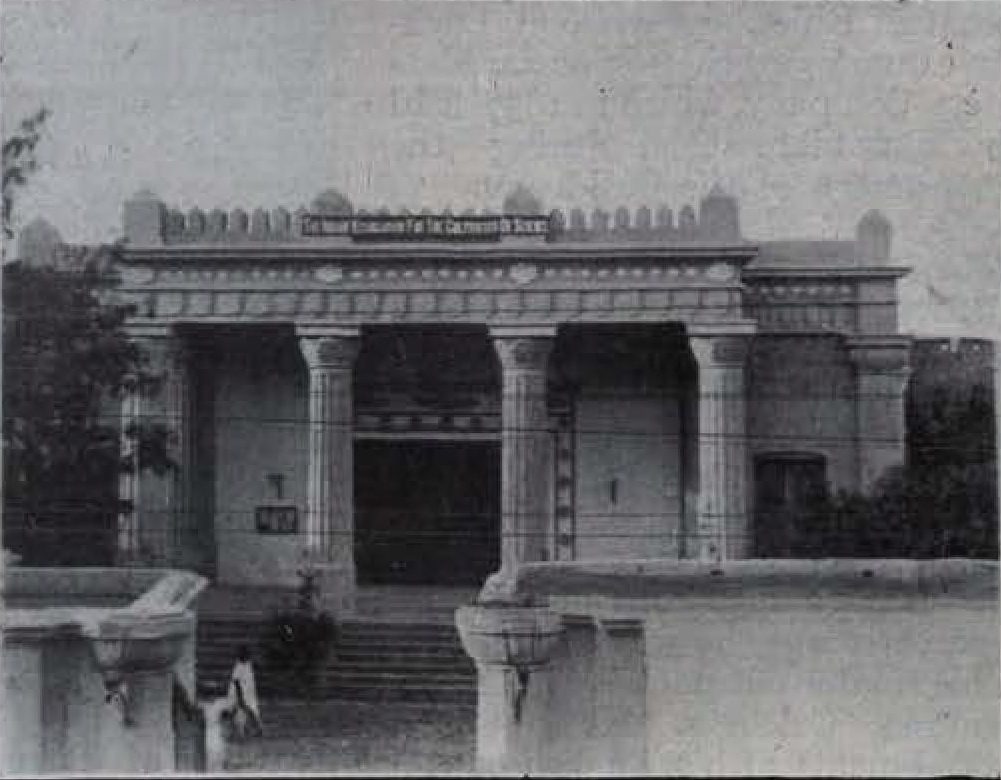
Indian Association for the Cultivation of Science
In 1907, a young accountant named Chandrasekhara Venkata Raman arrived in Calcutta for a government posting. He was not a professional scientist. He was an Assistant Accountant General with a physics obsession. But the Indian Association for the Cultivation of Science -- a modest research institute in the city, founded three decades earlier by a medical doctor who believed Indians should pursue science for its own sake -- let him use its laboratories in his spare time, even at what Raman later described as "very unusual hours." Over the next two decades, working in those labs, Raman would discover a phenomenon that bears his name, win Asia's first Nobel Prize in Physics, and put this quiet institution on the map of world science.
A Doctor's Conviction
The Indian Association for the Cultivation of Science was founded on July 29, 1876 -- the same decade as the telephone and the phonograph. Its creator was Mahendralal Sarkar, a private medical practitioner in Calcutta who had no laboratory, no government backing, and no institutional pedigree. What he had was a conviction: that Indians needed their own institution for original scientific research, independent of colonial patronage. In an era when India's scientific infrastructure was almost entirely British-controlled, this was a radical idea. Sarkar raised funds privately and established the IACS as a place where Indians could study basic sciences on their own terms. It is the oldest research institute in India, and for its first several decades, it operated under the presidency of the Lieutenant-Governor of Bengal -- a concession to colonial reality that ended with Indian independence in 1947.
The Light That Scattered Differently
Raman's work at the IACS culminated in February 1928, when he and his collaborator K.S. Krishnan observed that when monochromatic light passes through a transparent substance, a small fraction of the scattered light shifts in wavelength. The effect was subtle -- only about one in ten million photons undergoes the shift -- but its implications were enormous. The Raman effect provided a new tool for studying the molecular structure of materials, and it earned Raman the Nobel Prize in Physics in 1930. He was the first Asian scientist to receive the award. His discovery was first published in the Indian Journal of Physics, a journal founded by the IACS in 1926 and still published today. In 1998, the American Chemical Society and the IACS jointly designated the discovery as an International Historic Chemical Landmark.
A Constellation of Minds
Raman was far from the only remarkable figure to pass through the IACS. Jagadish Chandra Bose, the physicist and biologist who pioneered radio science in India, was a former faculty member. Satyendra Nath Bose, whose work on quantum statistics gave the world the term "boson" and whose correspondence with Einstein led to the Bose-Einstein condensate theory, served on faculty and later as president of the institution. Meghnad Saha, whose ionization equation transformed astrophysics, was both a faculty member and the institute's first director. Two of the institution's associates have received the Bharat Ratna, India's highest civilian honor: Raman himself, and C.N.R. Rao, the chemist who chaired the IACS review committee.
Nine and a Half Acres of Discovery
Today the IACS sits on just 9.5 acres in the Jadavpur neighborhood of South Kolkata, wedged between Jadavpur University, the Central Glass and Ceramic Research Institute, and the Indian Institute of Chemical Biology -- a dense cluster of scientific institutions that makes this corner of the city one of India's quiet intellectual powerhouses. Since 2018, the IACS has held the status of a deemed university, organized into six academic schools spanning physical sciences, biological sciences, chemical sciences, materials sciences, mathematical and computational sciences, and applied and interdisciplinary sciences. Research continues in areas far beyond what Raman could have imagined. Scientists at the institute have developed new methods for targeting cancer cells by disrupting how they repair DNA during division. Professor Kankan Bhattacharyya's experiments on how water molecules behave near biological membranes led him to coin the term "biological water" -- a concept now used across biophysics.
The Next Campus
The IACS is expanding. In September 2018, the foundation stone was laid for a second campus at Baruipur, south of Kolkata. Named the Syamaprasad Mukherjee Advanced Research and Training campus -- SMART, for short -- the facility is designed to extend the institute's reach into engineering sciences and medical sciences alongside its traditional strengths in fundamental research. For an institution that began with one doctor's stubborn belief that Indians could do world-class science if given the tools, the expansion feels less like ambition than continuation. Mahendralal Sarkar's original laboratory is long gone. But the principle that drove him -- that curiosity, given space, produces breakthroughs -- has proven remarkably durable.
From the Air
Located at 22.499N, 88.367E in the Jadavpur neighborhood of South Kolkata. The 9.5-acre campus sits in a dense urban cluster alongside Jadavpur University and other research institutes. Nearest major airport is Netaji Subhash Chandra Bose International Airport (VECC), approximately 14 km north-northeast. Recommended viewing altitude: 2,000-3,000 feet. The campus is difficult to distinguish from surrounding institutions at altitude; look for the Jadavpur University area south of the Kolkata city center.