Indian Grinding Rock State Historic Park
The Miwok called it Chaw'se, the grinding rock, and for thousands of years women gathered here beneath the spreading oaks to pound acorns into meal. Today, 1,185 cup-shaped depressions worn into marbleized limestone tell the story of countless seasons of labor, laughter, and community. This is the largest collection of bedrock mortars anywhere in North America, and the only place in California where ancient petroglyphs deliberately decorate the grinding surfaces themselves.
Written in Stone
The main grinding rock sprawls across the meadow like a page from a book written over millennia. Each mortar hole began as a shallow depression, worn gradually deeper by generations of women pounding acorns with stone pestles. The deepest cups measure several inches across, polished smooth by centuries of use. But what makes Chaw'se unique are the petroglyphs that surround and interweave with the mortars: circles, spoked wheels, animal tracks, wavy lines, and human footprints. Some of these carvings may be two to three thousand years old, though they have weathered considerably and now require careful observation to discern. Nowhere else in California did Native peoples so intentionally combine their art with their daily labor, transforming a utilitarian workspace into something sacred.
The Acorn Economy
Valley oaks still shade the meadow, their gnarled branches spreading wide over the ancient grinding rock. For the Miwok, these trees represented wealth itself. Acorns provided the staple food for Sierra Nevada peoples, but the nuts required extensive processing to remove their bitter tannins. Women would crack the shells, grind the meat into flour using these very mortars, then leach the meal repeatedly with water. The resulting acorn mush could be boiled into porridge or baked into bread. A single family might process hundreds of pounds of acorns each fall, and the grinding rock at Chaw'se saw countless hours of communal work, the rhythmic thump of pestles creating a heartbeat for village life.
A Living Heritage
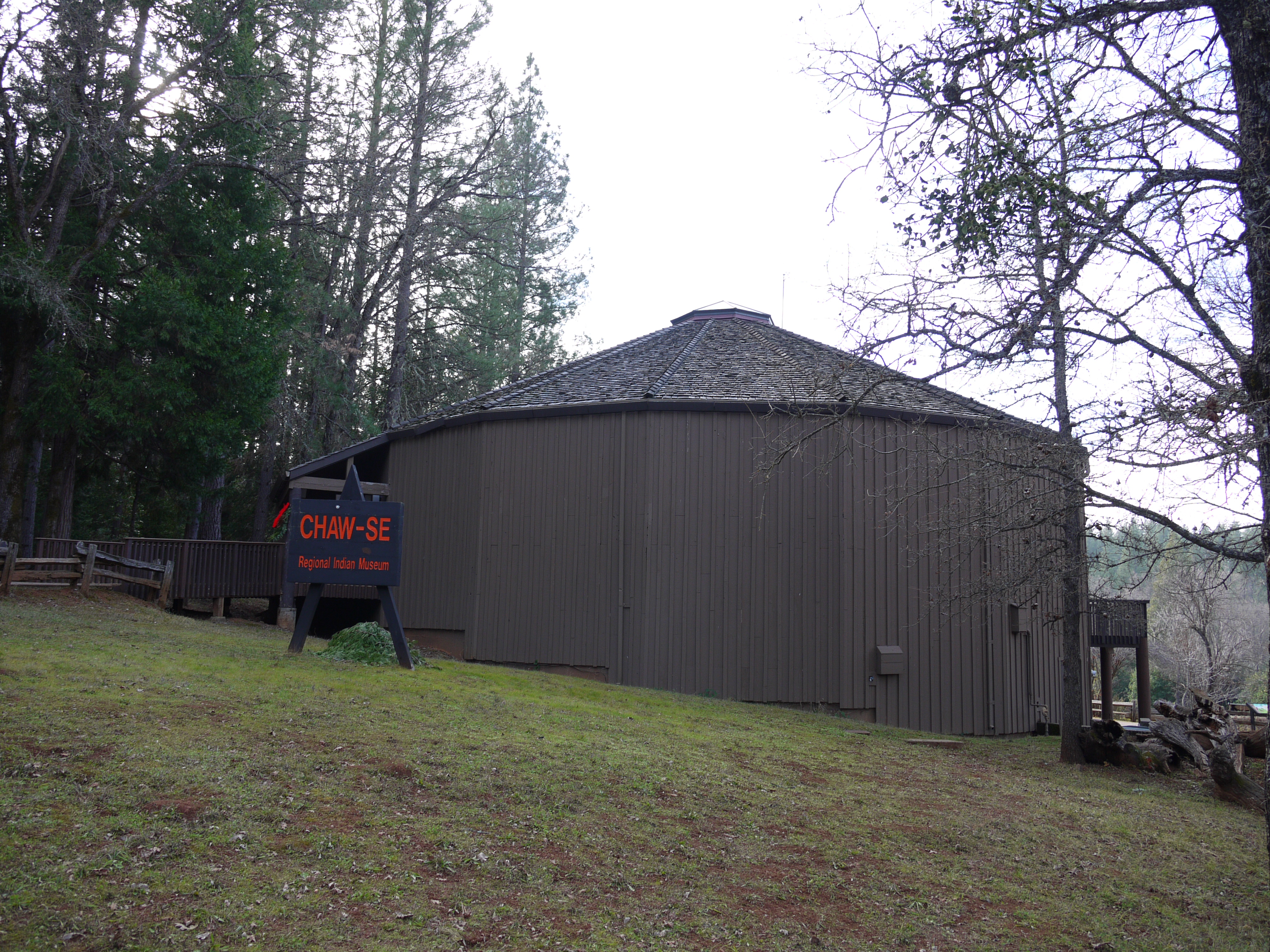
The park's reconstructed Miwok village includes a ceremonial roundhouse, designated California Historical Landmark #1001. The structure's circular design and semi-subterranean construction reflect traditional architecture, providing cool interiors during hot foothill summers and warmth during winter ceremonies. Inside the Chaw'se Regional Indian Museum, exhibits display the technology and craftsmanship of not just the Miwok but also the Maidu, Nisenan, Washoe, Yokuts, and other Sierra Nevada peoples. Baskets woven tight enough to hold water, obsidian tools flaked with precision, and ceremonial regalia speak to sophisticated cultures that thrived here for thousands of years before European contact.
Seasons at Chaw'se
The meadow at Chaw'se changes with the seasons. Spring brings wildflowers and the return of migratory birds, including the flash of western tanagers and the buzz of calliope hummingbirds. Turkey vultures ride thermals overhead while California quail scurry through the underbrush. Deer browse at dawn and dusk, and coyote calls echo across quiet summer nights. Occasionally, a black bear or mountain lion passes through, reminders that this 135-acre park sits at the boundary between foothill oak woodland and higher Sierra forests. At 2,400 feet elevation, the little valley maintains the same mild climate that made it attractive to the Miwok, who chose this spot for both its resources and its beauty.
From the Air
Located at 38.424N, 120.643W in the Sierra Nevada foothills, 12 miles east of Jackson, California. The park sits at approximately 2,400 feet elevation in a small valley. Best viewed from lower altitudes in clear conditions. The meadow and oak woodland are visible features. Nearest airports: Pine Mountain Lake (E45) approximately 25nm south, Columbia Airport (O22) approximately 20nm south. Avoid overflying at low altitude to protect the cultural site.