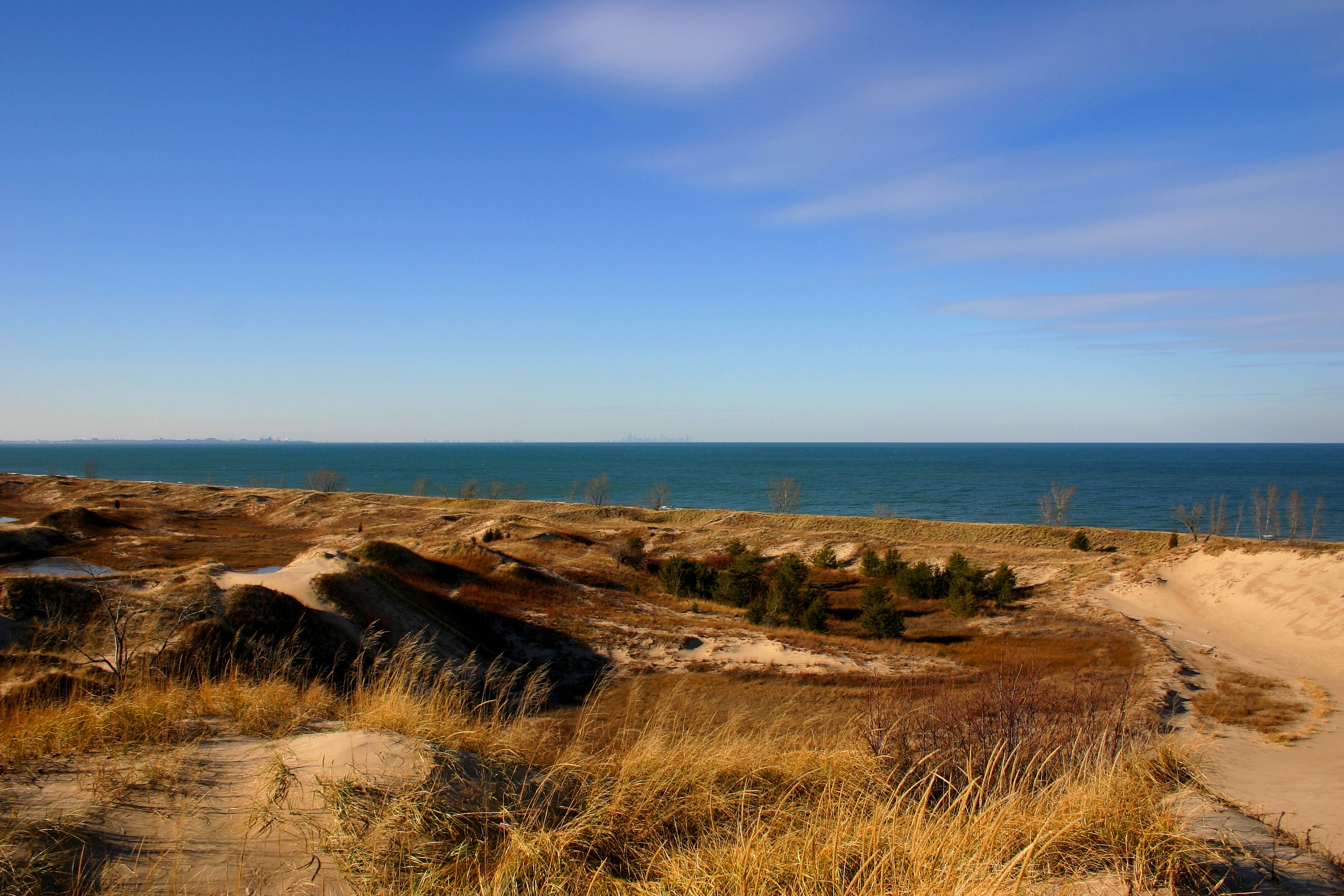
Indiana Dunes
Indiana Dunes is where ecology was born. In 1899, botanist Henry Cowles came to these Lake Michigan dunes to study how plant communities change over time - what he called 'ecological succession.' His research, showing how bare sand gradually becomes forest through predictable stages, founded a scientific discipline. The dunes he studied should have been destroyed a century ago. Steel mills built blast furnaces within sight of the beaches. Chicago sprawl pressed from the west. Power plants, ports, and industrial waste surrounded the remaining natural areas. Yet the dunes survived, protected by activists who fought for a century to preserve fragments of the original landscape. Indiana Dunes National Park, America's newest national park (designated 2019), preserves 15,000 acres of dunes, wetlands, and forests - an ecological laboratory squeezed between smokestacks and suburbs.
The Science
Henry Cowles arrived at the Indiana Dunes as a University of Chicago graduate student in the 1890s. The dunes offered a perfect laboratory: sand deposited by glacial lakes created surfaces of different ages, from newly formed foredunes to ancient back dunes. Cowles documented how plant communities changed over time on these surfaces - from beach grass to shrubs to forests. His 1899 dissertation, 'The Ecological Relations of the Vegetation on the Sand Dunes of Lake Michigan,' founded the science of ecological succession. Ecologists worldwide cite his work. The dunes became a pilgrimage site for scientists.
The Threat
Industrial development hit the southern Lake Michigan shore hard. U.S. Steel built its Gary Works in 1906, creating an entire city on former duneland. Additional steel mills, refineries, and power plants followed. The Port of Indiana-Burns Harbor carved into the dunes. By the mid-20th century, only fragments of the original landscape remained, surrounded by the most concentrated industrial zone in America. Air quality was terrible; waterways were polluted; the lake itself was dying. The dunes that remained did so only because they hadn't yet been profitable enough to destroy.
The Battle
Save the Dunes began in the 1950s, when Chicago activists organized to preserve what remained. The fight lasted decades. Senator Paul Douglas of Illinois championed the cause in Congress. Conservationists battled industrialists, developers, and often local residents who wanted jobs more than beaches. Indiana Dunes National Lakeshore was established in 1966 - a compromise that protected some land while leaving industry in place. The patchwork boundaries reflected political reality: steel mills sit between preserved areas. The fight never ended; preservation battles continued for decades.
The Park
In 2019, Indiana Dunes was redesignated as America's 61st national park. The name change acknowledged what had been true for decades: this small, fragmented park held extraordinary biodiversity. The combination of northern and southern species, lake effect climate, and varied habitats creates one of the most botanically diverse areas in the Midwest. Over 1,100 flowering plant species grow here - more than in any other national park of comparable size. The irony is profound: ecology was born here, industry nearly destroyed it, and now the survivors are celebrated.
Visiting Indiana Dunes
Indiana Dunes National Park stretches along 15 miles of Lake Michigan shoreline in northwestern Indiana, about 50 miles southeast of Chicago. Multiple beach access points offer swimming in summer; West Beach and Porter Beach are most developed. Hiking trails explore dunes, forests, and wetlands; the Cowles Bog Trail passes through the wetland where Cowles worked. The Paul H. Douglas Center provides environmental education. The landscape's industrial context is impossible to ignore - smoke stacks and cooling towers are visible from many beaches. Chicago O'Hare (ORD) and Midway (MDW) airports are closest; South Shore Line commuter trains stop at several park areas. Summer is beach season; spring and fall are best for hiking and birding.
From the Air
Located at 41.63°N, 87.05°W along the southern shore of Lake Michigan, northwestern Indiana. From altitude, the juxtaposition is dramatic: the green ribbon of preserved dunes alternates with industrial zones - steel mills, power plants, the Port of Indiana. Chicago's skyline is visible to the west. The preserved areas appear as forested and beach sections between development. The fragmented nature of the park, reflecting decades of preservation battles, is evident from the air.