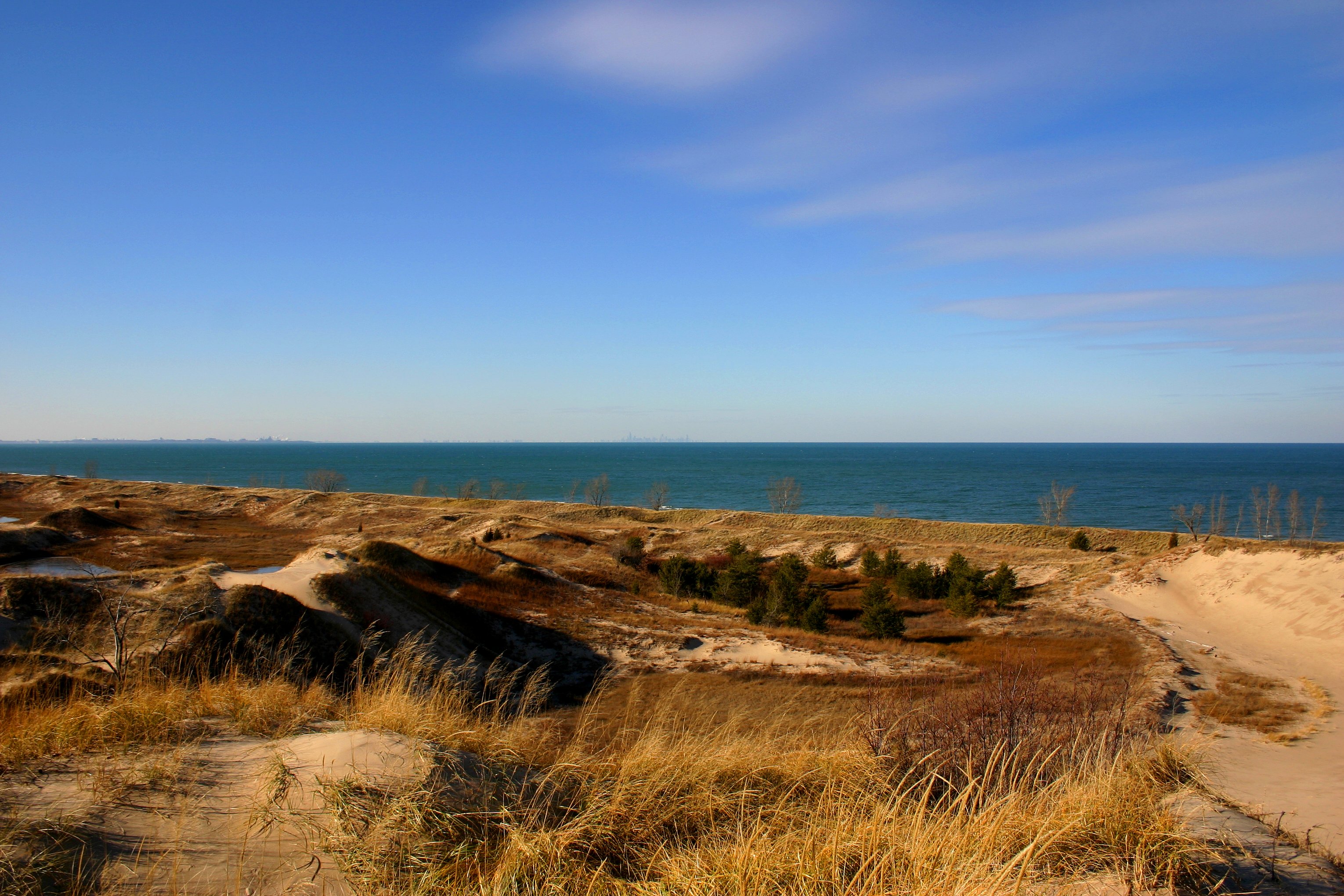
Indiana Dunes: Where the Sand Sings and Steel Mills Smoke
The sand sings at Indiana Dunes. Walk on certain beaches on certain days, and the quartz grains squeak and hum beneath your feet - a phenomenon so unusual that scientists still debate exactly why it happens. This is Indiana's 15 miles of Lake Michigan coastline, where glaciers dumped mountains of sand 15,000 years ago and humans have been fighting over it ever since. The dunes survived ice ages. They barely survived the 20th century. Steel mills sprouted along the shore, burning and smoking while dunes disappeared under slag heaps. Conservationists fought for decades to save what remained. What they saved is America's strangest national park: pristine beaches backed by smokestacks, rare ecosystems bordered by refineries, singing sands within earshot of heavy industry. It shouldn't work. Somehow it does.
The Singing
Singing sand requires precise conditions: uniform grain size, specific moisture content, and quartz composition. Indiana Dunes has all three on its best beaches. The sound ranges from a squeak to a low hum, produced when grains slide against each other at just the right rate. Indigenous peoples knew about the singing sand; European settlers dismissed their stories until scientists confirmed the phenomenon. Not every beach sings, and not every day - dry sand after a windy period works best. When conditions align, walking the beach becomes a musical experience, each step producing a note in an ancient song that glaciers composed.
The Battle
The fight to save Indiana Dunes lasted a century. Steel companies arrived in 1906, building mills and company towns along the shore. Bethlehem Steel. U.S. Steel. Burns Harbor. The dunes were in the way - rich companies with political power versus naturalists with mounting evidence of ecological uniqueness. A 1916 study found more plant species in the dunes than in any comparable area in the Midwest. Didn't matter. Industry kept growing. In 1966, after fifty years of advocacy, Indiana Dunes became a national lakeshore - but only after concessions allowed the Port of Indiana to consume more shoreline. The boundary looks like gerrymandering because it is.
The Ecology
The dunes host one of America's most diverse ecosystems per acre. Over 1,100 flowering plant species grow here - more than in any other national park unit. The diversity comes from convergence: northern and southern species meet, eastern and western species overlap, and the dunes create microclimates that support plants from prairies, forests, bogs, and shores within walking distance of each other. Prickly pear cactus grows near Jack pines. Arctic bearberry survives near southern dogwood. Scientists study the dunes as a laboratory for plant succession - watching how bare sand becomes forest over decades.
The Juxtaposition
Indiana Dunes National Park has the most unusual boundaries in the National Park System. The park wraps around steel mills, excludes private beaches, and shares views with cooling towers and smokestacks. From Mount Baldy, the highest dune, you can see the Chicago skyline in one direction and belching chimneys in the other. The juxtaposition isn't a bug; it's a feature. This is what American industrialization looks like alongside what it replaced. The contrast is educational, uncomfortable, and oddly beautiful - sunset through steel mill smoke creates colors no pristine wilderness can match.
Visiting Indiana Dunes
Indiana Dunes National Park stretches along Lake Michigan's southern shore in northwest Indiana. The park has multiple units with separate entrances; the main visitor center is in Porter. Popular beaches include West Beach, Dunewood Campground Beach, and Porter Beach. Mount Baldy, a 126-foot moving dune, is accessible via boardwalk (the dune swallows trees and has trapped people - stay on marked trails). The park is 50 miles from downtown Chicago and accessible by South Shore Line commuter rail - one of few national parks reachable by public transit. Summer weekends are crowded; fall offers solitude and color. Admission is $25 per vehicle. The singing sand phenomenon is most reliable on West Beach after dry, windy conditions.
From the Air
Located at 41.65°N, 87.05°W along Lake Michigan's southern shore. From altitude, Indiana Dunes appears as a narrow band of tan sand and green forest wedged between the blue lake and the industrial landscape of northwest Indiana. Steel mills are visible as massive complexes with smokestacks; the Port of Indiana interrupts the shoreline. Chicago's skyline rises to the west. The dunes themselves show as irregular sand formations, highest at Mount Baldy. The contrast between industry and nature is stark from any altitude - this is a park that exists in defiance of its surroundings.