Indianapolis: The Crossroads of America Where They Race 500 Miles
Indianapolis was purpose-built as Indiana's capital in 1821, located at the geographic center of the state regardless of whether that location made any other sense. The White River wasn't navigable; no major roads crossed the site; the city existed because the government decided it should exist. The planning shows: the Mile Square downtown is a grid anchored by Monument Circle, the streets radiating outward with mathematical regularity. Indianapolis became the 'Crossroads of America' when highways were built to cross there; the Indy 500 made it famous for one day each May. The city is self-consciously Midwestern - proud of its simplicity, unbothered by coastal dismissal, certain that being passed over is the same as being overlooked.
The 500
The Indianapolis 500, first run in 1911, is the world's largest single-day sporting event - over 300,000 people attend, watching cars circle the Indianapolis Motor Speedway for 500 miles. The speedway's 2.5-mile oval is instantly recognizable; the traditions - drinking milk after winning, kissing the bricks - are sacrosanct. The race is Memorial Day weekend's anchor, the unofficial start of summer, a uniquely American spectacle of speed, danger, and corporate sponsorship. The Speedway museum preserves the history; the Hall of Fame Museum honors the drivers. Indianapolis is many things; one day a year, it's the racing capital of the world.
The Monument
The Soldiers' and Sailors' Monument occupies the center of Monument Circle, the center of Indianapolis, rising 284 feet in limestone commemoration of Indiana's Civil War dead. The monument anchors the city's geography and self-image - everything radiates from the circle, every parade passes it, every holiday brings crowds. The monument predates the city's major growth, built in 1902 when Indianapolis was still relatively small. The commitment to a grand civic monument reflects civic ambition that the city's subsequent development hasn't always matched. The circle remains; the symbolism endures.
The Sports
Indianapolis has transformed itself into 'Amateur Sports Capital of the World' - hosting the NCAA headquarters, Final Four rotations, and numerous championships. The strategy was deliberate: in the 1970s, civic leaders decided sports could replace declining manufacturing as economic engine. The investments followed: the Hoosier Dome (now Lucas Oil Stadium), convention facilities, and the corporate hospitality that makes championship hosting profitable. The Colts arrived from Baltimore in 1984, in a controversial overnight move that added professional football. The Pacers provide NBA basketball in a basketball-obsessed state. Indianapolis proves that sports identity can be manufactured; whether manufactured identity satisfies is another question.
The Flat
Indianapolis is flat - the horizon extends unbroken, the terrain provides no drama, the landscape offers nothing to photograph. The flatness is both literal (the city sits on glacial till plain) and metaphorical (the culture is level, the expectations modest). The corn and soybeans that surround the metropolitan area provide income but not excitement. Indianapolis residents accept the flatness as feature rather than bug: traffic is manageable, housing is affordable, life is uncomplicated by geography or pretension. The acceptance is genuine; the defensiveness about coastal dismissal is also genuine.
Visiting Indianapolis
Indianapolis is served by Indianapolis International Airport (IND). Monument Circle anchors downtown; the observation deck offers flat views in all directions. The Indianapolis Motor Speedway and Hall of Fame Museum are essential; race day requires advance planning. The Indianapolis Museum of Art (Newfields) occupies a sprawling campus with outdoor sculpture. Mass Avenue offers restaurants and galleries. The Children's Museum of Indianapolis is among the world's largest. The food scene has improved dramatically; St. Elmo Steak House's shrimp cocktail (aggressively horseradish-heavy) is legendary. The experience rewards visitors who arrive without coastal expectations - Indianapolis is what it is, proudly.
From the Air
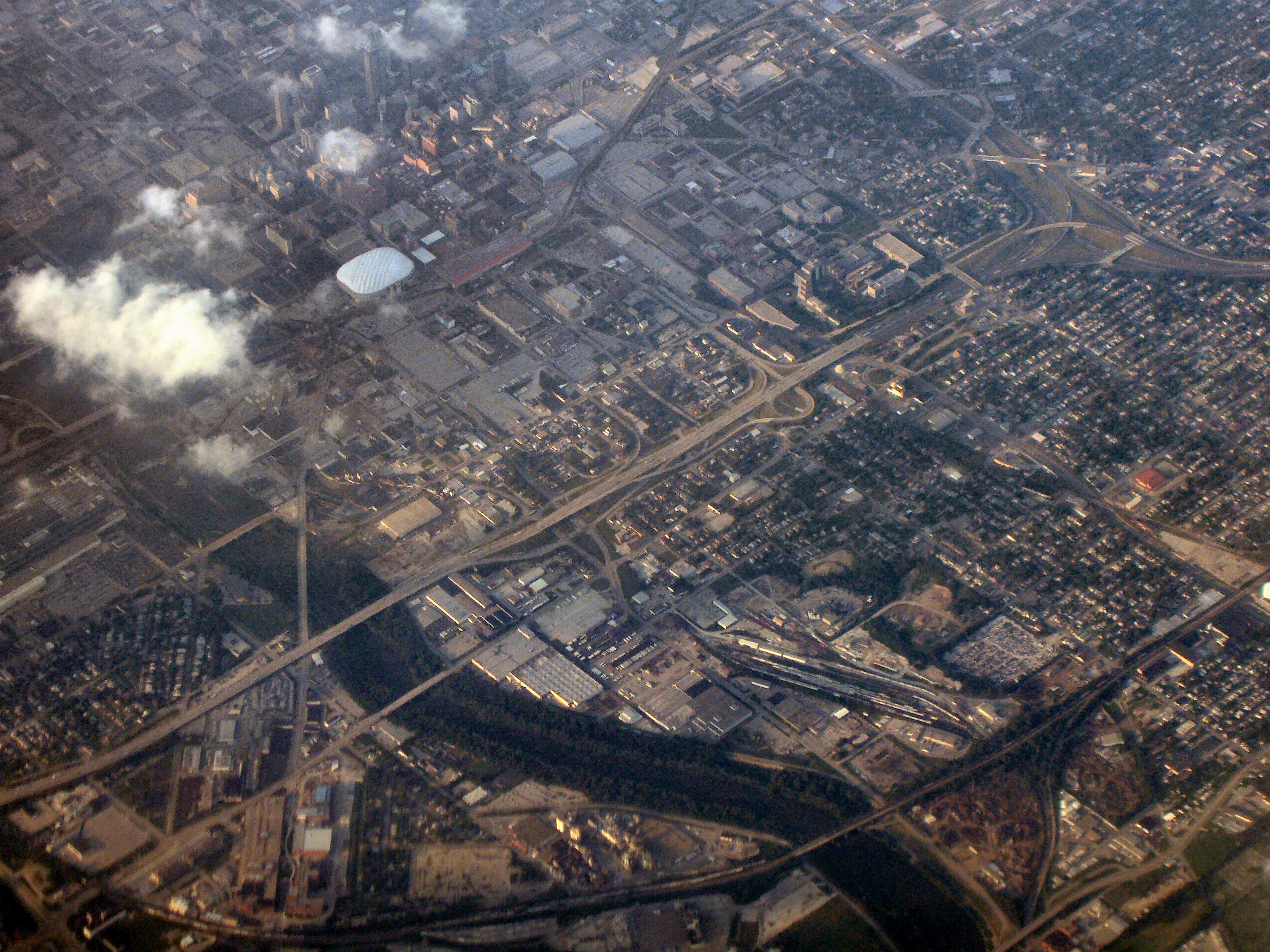
Located at 39.77°N, 86.16°W in central Indiana, almost exactly at the state's geographic center. From altitude, Indianapolis appears as a city in the middle of farmland - the Mile Square downtown visible as a grid with Monument Circle at center, the suburbs extending in all directions across flat terrain. The Indianapolis Motor Speedway's oval is visible to the northwest. The flatness is apparent - no terrain variation for miles. What appears from altitude as a city dropped onto prairie is Indiana's purpose-built capital - where the 500 brings the world's largest single-day crowd, where the monument anchors the grid, and where flyover country is proud to be flown over.