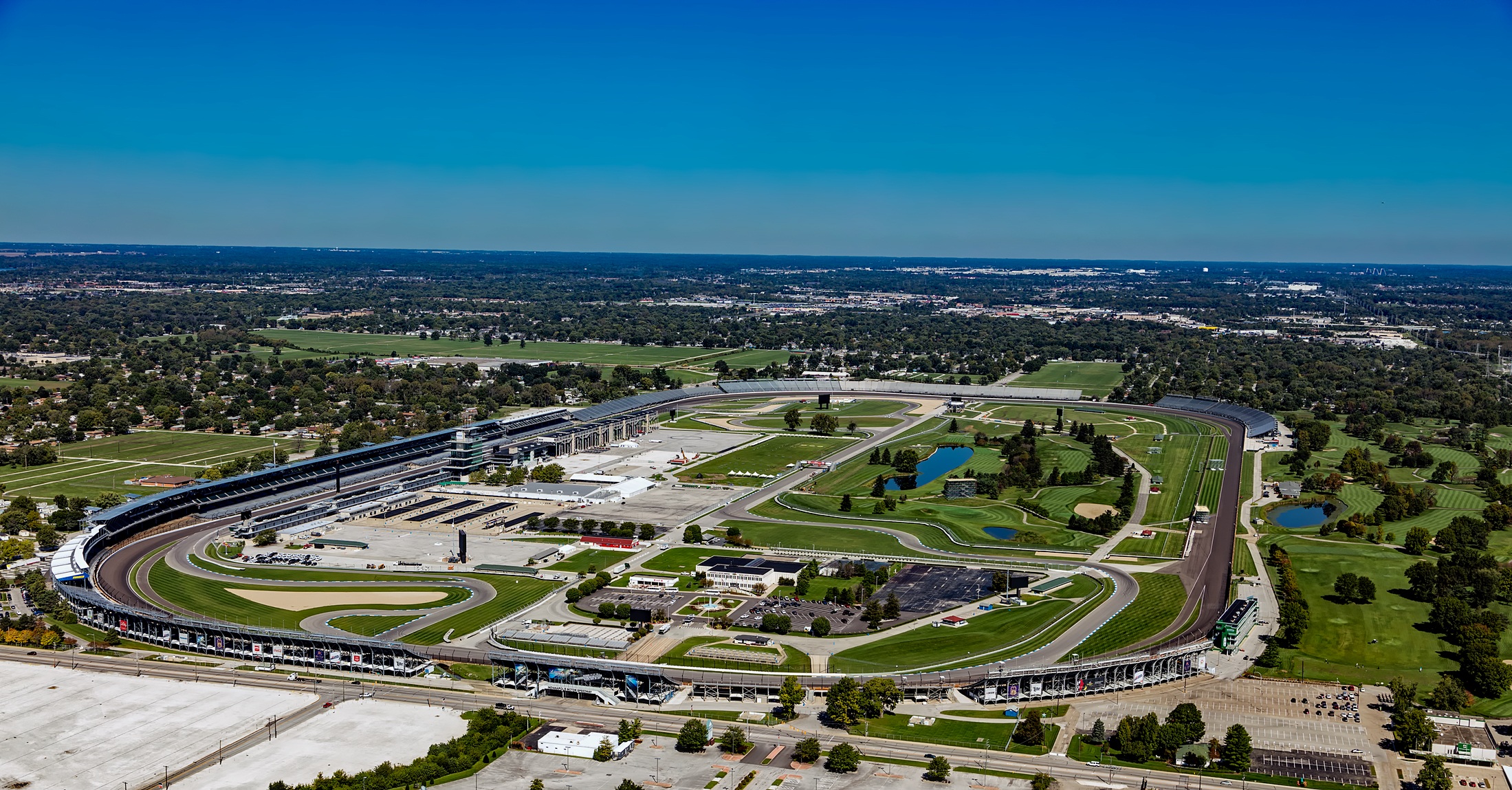
Indianapolis 500
One yard of brick is all that remains. The rest of the Indianapolis Motor Speedway's original racing surface -- 3.2 million bricks laid in the fall of 1909 -- has long since been paved over, but that single exposed strip at the start/finish line still anchors every Indianapolis 500 to a tradition that began in 1911. Winners kiss the bricks. Crews kneel to touch them. The strip is a threshold between the ordinary world and 500 miles of controlled chaos, where 33 cars accelerate to speeds exceeding 230 miles per hour in front of crowds that regularly surpass 350,000 people. Billed as The Greatest Spectacle in Racing and considered part of motorsport's Triple Crown alongside the 24 Hours of Le Mans and the Monaco Grand Prix, the Indy 500 is the largest single-day sporting event in the world.
A Track Paved in Ambition
Carl G. Fisher was an Indianapolis entrepreneur who saw the automobile not just as transportation but as spectacle. In 1909, he and partners James Allison, Frank Wheeler, and Arthur Newby built a gravel-and-tar oval northwest of the city, in the enclave that would become the town of Speedway, Indiana. Early races were disasters -- the surface broke apart, causing fatal accidents. But crowds of up to 40,000 proved the demand was real. Fisher spent $155,000 to repave the track with 3.2 million bricks and added a concrete perimeter wall. On Memorial Day 1911, the first Indianapolis 500 was run: a 500-mile race with a purse of $25,000. Ray Harroun won, notably the only driver racing without a riding mechanic -- a co-pilot who monitored oil pressure and watched for traffic. Eighty thousand spectators witnessed what became an annual American institution, interrupted only by the two World Wars.
Milk, Songs, and Sacred Rituals
The Indy 500 has accumulated traditions that no other sporting event can match. Since 1919, the Purdue All-American Marching Band has served as the host band. Since 1946, a singer has performed "Back Home Again in Indiana" before every race -- a tradition started when tenor James Melton was asked on the spur of the moment by Speedway president Tony Hulman. Jim Nabors carried the song from 1972 to 2014, and Jim Cornelison has sung it since 2017. The victory milk dates to 1933, when Louis Meyer requested buttermilk after his second win; a dairy executive saw the marketing opportunity and the tradition stuck. When 1993 winner Emerson Fittipaldi -- who owned an orange grove -- drank orange juice instead, fans booed him for years. The 33-car starting grid, arranged in eleven rows of three, has remained essentially unchanged since the beginning, and qualifying still requires four timed laps rather than the single-lap norm elsewhere in motorsport.
A Century of Speed
The technological evolution of the Indy 500 mirrors the arc of 20th-century engineering. The Offenhauser engine dominated from the 1930s through the 1960s, powering winner after winner with its four-cylinder reliability. Then Colin Chapman brought his mid-engined Team Lotus from England in 1963, and Jim Clark's second-place finish signaled a revolution. By 1965, Clark dominated the race outright, giving the Ford V8 its first Indy victory and breaking the Offenhauser stranglehold. European technology continued to reshape the field -- McLaren chassis won three races with the Offy engine in the 1970s, and by 1978 most championship cars used European-designed chassis and engines. Today, all entrants use 2.2-liter twin-turbocharged V6 engines from Chevrolet or Honda, fitted to Dallara chassis, with Firestone tires -- the same brand that supplied the very first race in 1911.
The Split and the Reunion
The most turbulent chapter in Indy 500 history began in 1994 when Speedway owner Tony George announced plans for the Indy Racing League, with the 500 as its centerpiece. In 1996, George reserved 25 of the 33 starting spots for IRL regulars, prompting CART teams to boycott and stage a rival U.S. 500 at Michigan on the same day. The split lasted twelve years. CART went bankrupt in 2003. Legendary teams like Penske, Ganassi, and Andretti defected to the IRL. In 2008, the two series finally reunified under the IndyCar banner. Through it all, the race itself endured. A. J. Foyt, Al Unser Sr., Rick Mears, and Helio Castroneves each won four times. Roger Penske, who now owns the Speedway itself, has accumulated 20 victories as a car owner -- the most dominant owner in the race's history.
The Greatest Spectacle
The Indianapolis Motor Speedway's permanent seating holds roughly 235,000 spectators, making it the world's largest sporting facility by capacity. With infield spectators, race-day crowds typically reach between 350,000 and 400,000. Roughly 12,500 personnel are mobilized for race weekend to support broadcast operations, medical services, crowd management, and logistics. The purse exceeded $13 million in 2011, with over $2.5 million going to the winner. The race shares Memorial Day weekend with the Coca-Cola 600 at Charlotte Motor Speedway, and a handful of drivers have attempted the "Double Duty" of racing both on the same day -- most notably Tony Stewart, who in 2001 became the only driver to complete the full 1,100-mile distance across both events. The Indy 500 remains, after more than a century, a spectacle with no true equivalent: half a million people gathered around a rectangle of Indiana asphalt where one yard of original brick still peeks through the pavement.
From the Air
The Indianapolis Motor Speedway is located at approximately 39.79N, 86.23W in Speedway, Indiana, an enclave suburb just west of downtown Indianapolis. The 2.5-mile oval is unmistakable from the air -- a massive rounded rectangle with distinctive turns, grandstands along the front stretch, and a sprawling infield. It is clearly visible from 5,000 feet and identifiable from much higher. The nearest major airport is Indianapolis International (KIND), about seven miles to the southwest. Eagle Creek Airpark (EYE) lies approximately four miles northwest. On race day, temporary flight restrictions are typically in effect over the Speedway.