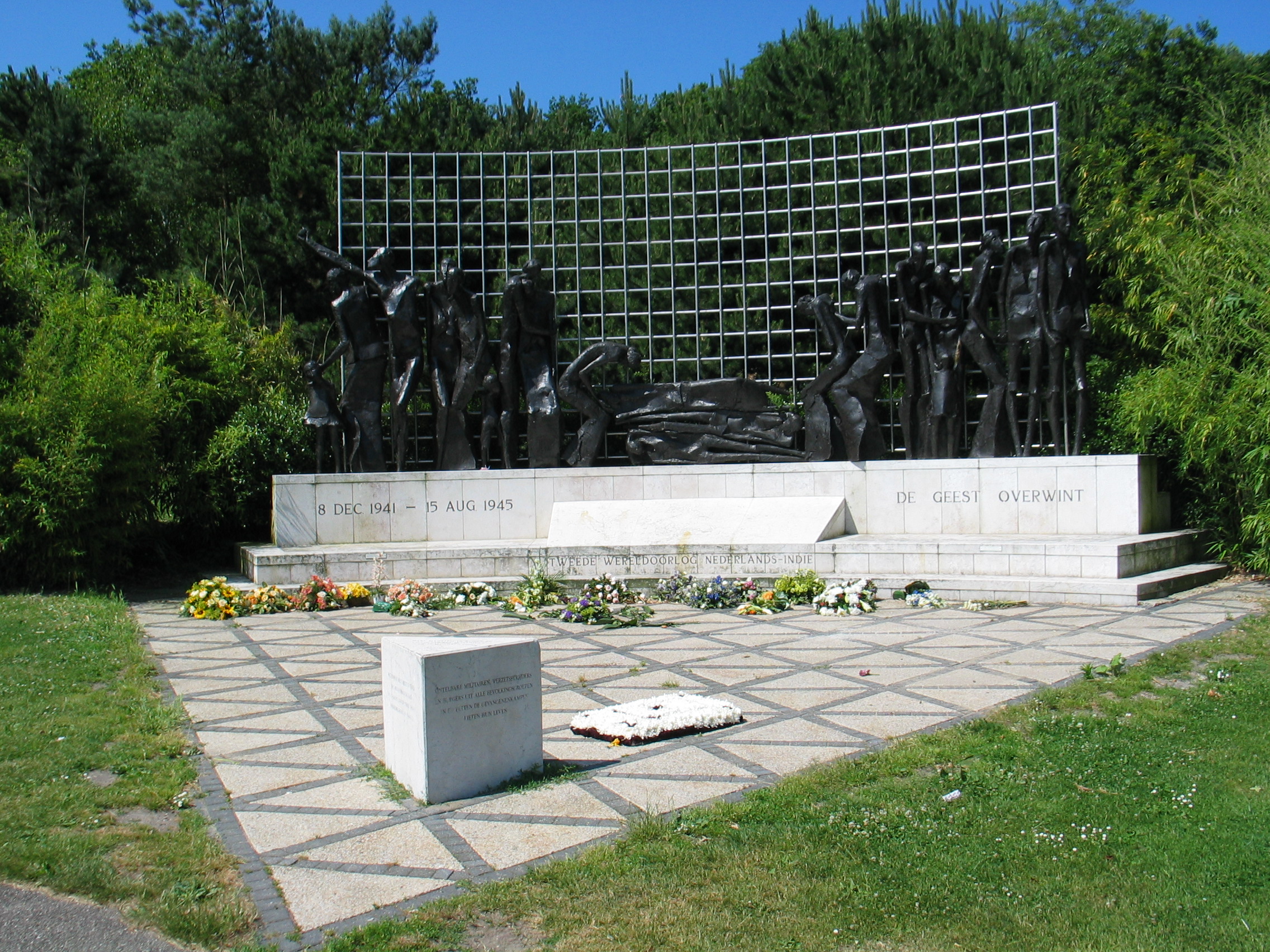
Indies Monument
It took the Netherlands forty-three years to build it. For most of that time, the country preferred to remember the war that happened to Europe rather than the war that happened to its colony, and the survivors of the Japanese occupation of the Dutch East Indies were left to grieve quietly, in private living rooms, on a date that was not yet a national holiday. August 15, 1945, the day Japan surrendered, came and went without official ceremony in The Hague for a long time. When the Indies Monument was finally unveiled on August 15, 1988, in a small park on the Prof. B. M. Teldersweg, Queen Beatrix presided over a crowd of people who had been waiting most of their lives to be officially seen. Earth from the seven Dutch war cemeteries in Indonesia had been brought back and sealed in an urn at the front of the monument. For families who had no grave to visit, the urn was the closest thing to one.
Who the Monument Is For
Between 1942 and 1945, Imperial Japanese forces occupied the Dutch East Indies, the colony that is now Indonesia. The occupation was brutal in ways that historians are still tabulating. Roughly 100,000 Dutch civilians - women, children, the elderly, the Indo population of mixed Dutch and Indonesian descent - were interned in camps where disease, starvation, and beatings killed tens of thousands of them. Dutch military prisoners were used as forced labor; many died building railways. Indonesian workers conscripted as romusha died in vastly greater numbers, though the monument here speaks specifically to the Dutch and Indo dead. Whole families disappeared into camps and came out smaller, or did not come out at all. The children who survived grew up speaking Dutch in a tropical country that, when the war ended, was already fighting its own war of independence against the Netherlands itself. They lost their war, lost their home, were repatriated to a cold country they had never seen, and were told, gently and not, that nobody really wanted to hear about it.
The Long Silence
The reasons for the delay were political and uncomfortable. After Indonesia declared independence in 1945, the Netherlands fought a four-year colonial war to keep the territory, ending in 1949. The Dutch government, embarrassed by the colonial past and unwilling to inflame the new diplomatic relationship with Jakarta, found it easier to focus its public mourning on the European war. Until 1961, the Netherlands' two great memorial days, May 4 and May 5, were dedicated almost exclusively to Dutch victims of Nazi Germany. Only from 1962 onward did they formally include those who died in the Dutch East Indies and during the Indonesian National Revolution. The Indies survivors, many of them already old, kept asking for a monument. They were given one, finally, in 1988. Memorial Day at the monument is August 15, not May 5. It is not a public holiday in the Netherlands. The asymmetry matters.
The Spirit Conquers
The sculptor Jaroslawa Dankowa designed the memorial as a wall of seventeen bronze figures gathered around a map of Southeast Asia, with the inscription De Geest Overwint - The Spirit Conquers. The figures are stylized, but their gestures are specific: a man bowed, a woman lifting a child, a body that does not quite fall. The commission that chose the design in 1986 had been led by the mayor of Amsterdam, himself a former government official in the Dutch East Indies, and the deputy mayor, a former Dutch resistance fighter. The brief they wrote is unusual for its honesty. They asked for recognition of the humiliation, the repression, hardship, pain and despair, and also of the hope, perseverance, courage and solidarity. They asked for acknowledgement of the causes, the circumstances and the consequences of that suffering. They did not ask for a heroic monument. They asked for one that admitted what had happened.
The Urns
The earth from the seven war cemeteries in Indonesia was the survivors' idea. In 2008 a second urn was added, holding earth from the Galala Tantui war cemetery on Ambon Island. The wreath-laying ceremony before each August 15 has its own quiet protocol. The Dutch ambassador to Indonesia lays a wreath at the Menteng Pulo War Cemetery on Java. Once every five years - in 2010, 2015, 2020 - wreaths are also laid at the Dutch war cemeteries across Indonesia, Australia, and Southeast Asia where Dutch victims of the war are buried. In Bronbeek, an old colonial-military home in Arnhem, a second commemoration site was established in 2010. Most of the people the monument was built for are now elderly or gone. Their children and grandchildren come instead - the second and third generations of Indo families who grew up with stories told sideways, around the dinner table, in fragments their parents could only sometimes finish.
The Kaifu Wreath
Three years after the unveiling, on July 19, 1991, Japanese Prime Minister Toshiki Kaifu came to The Hague on a state visit and laid a decorative garland at the monument. Later the same day, a Dutch Indo demonstrator pulled the wreath off the monument and threw it into the water. Prime Minister Ruud Lubbers apologized to Kaifu for the incident, and his apology provoked further anger from Indo survivors of the camps. The episode was small and very revealing. The Dutch state had built the monument; the Dutch state had also, the survivors felt, never quite reckoned with the experience the monument was meant to honor. A wreath thrown in the water by a man old enough to remember the camps was not a diplomatic incident. It was a sentence still being finished. In 2005, on the 60th anniversary of the Japanese surrender, a smaller version of the monument was unveiled at Madurodam, the miniature park founded by the parents of George Maduro, himself a Dutch resistance hero who died at Dachau. The two monuments - the full one in the park, the small one among the miniature buildings - speak quietly to each other across the same city.
From the Air
Located at 52.0978 degrees N, 4.2917 degrees E in a quiet park along the Prof. B. M. Teldersweg in northwest The Hague, near the city's diplomatic quarter. Best viewed at 1500-2500 ft AGL on approach to Rotterdam The Hague Airport (EHRD, about 7 nm south-southeast). The monument is in a small landscaped space; from altitude, orient using the nearby Madurodam miniature park and the green corridor running northwest toward Scheveningen and the North Sea. The Hague lies under the Schiphol TMA - check NOTAMs for royal-family or ICC-related airspace restrictions. Approach the location quietly: this is an active site of mourning, and August 15 each year is a major commemoration day.