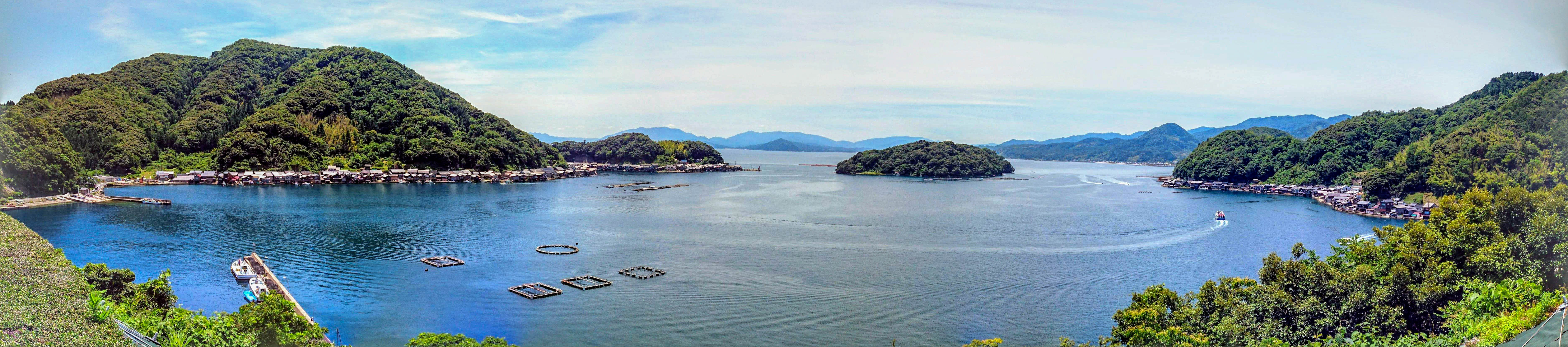
Ine-ura
The houses do not sit beside the water. They sit in it. Along five kilometers of Ine Bay's curving shoreline, roughly 230 wooden boathouses called funaya stand with their ground floors open to the sea, their foundations at the waterline, so that a fisherman could row his boat straight into his living room. This arrangement, found nowhere else in Japan at this scale, has persisted for centuries in a quiet corner of northern Kyoto Prefecture where steep mountains tumble directly into the Sea of Japan, leaving barely enough flat ground for a single road. In 2005, the Japanese government recognized Ine as the first fishing village ever designated an Important Preservation District for Groups of Traditional Buildings.
Where the Mountains Meet the Tide
Ine Bay is nearly circular, its entrance guarded by the island of Aoshima, which breaks incoming waves and creates the calm water that makes the funaya possible. The surrounding mountains rise sharply from the coast, leaving only a thin ribbon of flat land between cliff and sea. This geography dictated everything about how the village was built. There was no room for separate docks and warehouses, so the boathouses doubled as homes, with living quarters above and boat storage below. The original funaya were single-story structures with foundations of two or three tiers of granite stone, just wide enough for a wooden fishing boat. The settlement sits within Ine Town in Yoza District, a remote stretch of coast that once served as a waypoint on the ancient trade route connecting mainland China to Kyoto.
A Road That Remade the Shoreline
Until the 1930s, the only way to move through the village was along narrow alleyways squeezed between the funaya and the mountainside. Between 1931 and 1940, construction of the Kyoto Prefectural Ine Port Line transformed the settlement. Workers needed roughly five kilometers of road with a width of four meters, but there was simply no land to spare. The solution was to reclaim portions of the sea, and in the process, many of the funaya were relocated onto the newly created fill. This upheaval changed the boathouses themselves. Pushed onto reclaimed land, they were rebuilt as two-story structures, with the first floor still serving as a boat garage and the second floor converted into living space. The granite foundations of the old funaya gave way to modern concrete. Windows appeared on the upper floors. The road brought the village into the twentieth century, but it also began the slow transformation of the funaya from working boat shelters into something new.
Boats Too Big for the Door
The original logic of the funaya was elegant: a wooden fishing boat, light enough for one or two people to haul from the water, could be stored indoors on the ground floor, protected from rain, sun, and the wood-boring insects that thrive in the humid Sea of Japan climate. But modern fiberglass boats are larger and heavier than their wooden predecessors, and many no longer fit through the funaya openings. Fishermen now moor their vessels in front of the boathouses rather than inside them. Some owners have sealed the seaside openings with stone walls to keep out storm surges and high tides. The ground floors that once held boats have become storage rooms, workshops, or simply empty spaces. Smaller boats still tuck inside the occasional funaya, but the sight grows rarer each year.
The Venice They Never Planned
From a tour boat in the center of the bay, the funaya appear to float on the water, their wooden walls reflected in the still surface like a row of Venetian palazzi. This striking visual earned Ine the nickname 'the Venice of Japan,' a comparison that draws visitors from across the country and beyond. Yet the resemblance is coincidental. Venice was built on water by choice; Ine was pressed against it by geography. The village's appeal lies in the unplanned beauty of a community that adapted its architecture to an unyielding landscape over centuries. A growing number of funaya, while retaining their weathered wooden exteriors, have been converted into guesthouses, cafes, and restaurants. Visitors can now sleep in a boathouse and watch the morning light spread across the bay through the same opening where a fishing boat once rested. The designation as a National Preservation District in July 2005 brought both protection and tourism, ensuring that the funaya will endure even as their original purpose fades.
From the Air
Ine-ura sits at 35.6757N, 135.2877E on the northern coast of Kyoto Prefecture, along the Sea of Japan. From the air, look for the nearly circular Ine Bay with the small island of Aoshima guarding its entrance. The funaya boathouses line the inner shore in a distinctive arc visible even from moderate altitude. The nearest airport is Tajima Airport (RJBT) approximately 70 km to the west, though most visitors access the area via Amanohashidate, about 30 km to the southwest. Recommended viewing altitude: 2,000-4,000 feet to appreciate the ring of boathouses around the bay. The steep mountains dropping directly into the sea create dramatic terrain for low-altitude approaches.