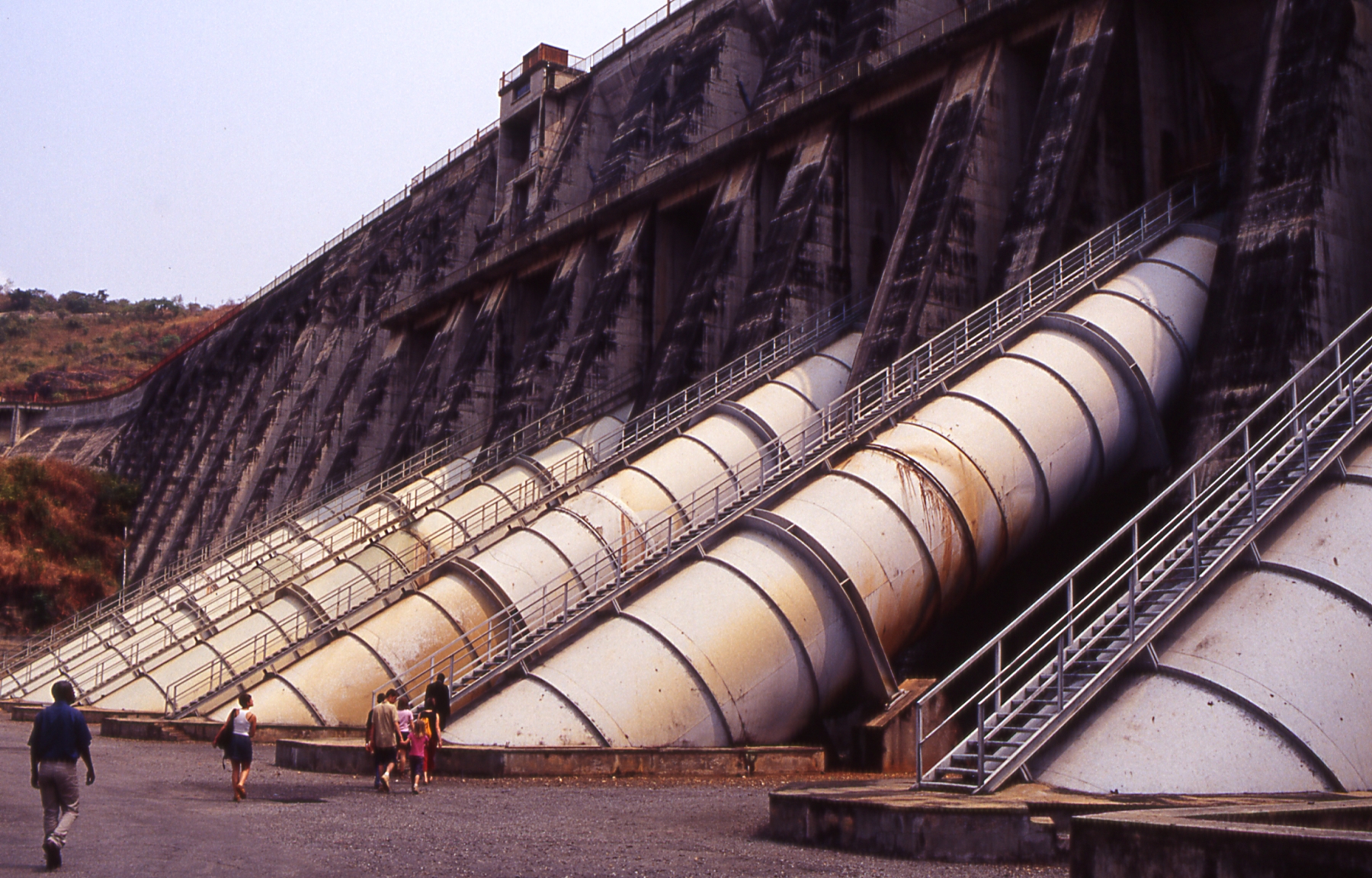
Inga Dams
A 1954 book called Engineers' Dreams listed the most ambitious construction projects the world could theoretically accomplish. Among them was the future Channel Tunnel. But the largest entry was something else entirely: an Inga Dam on the Congo River that would create a lake stretching into the Sahara Desert. Seven decades later, the dream remains mostly that. Two dams have been built at Inga Falls -- a set of rapids where the Congo drops 96 meters and pushes 42,000 cubic meters of water per second -- but they operate at roughly 40 percent of capacity. Meanwhile, plans for a Grand Inga project that would be the largest hydroelectric facility on Earth have been proposed, funded, defunded, redesigned, and stalled for decades.
The River That Could Light a Continent
The numbers at Inga Falls are staggering. The Congo River's mean annual flow here -- about 42,000 cubic meters per second -- combined with a 96-meter drop through the rapids gives the site a theoretical generating capacity of roughly 39.6 gigawatts. To put that in perspective, the Three Gorges Dam on China's Yangtze River, currently the world's largest hydroelectric facility, has an installed capacity of 22.5 gigawatts. The full Grand Inga concept would harness about 39,000 megawatts. In 2005, the entire African continent produced electricity equivalent to about 63 gigawatts. A single site on a single river in the Democratic Republic of the Congo holds the potential to match more than half of that output. A United States Geological Survey report recognized the Congo Basin's potential as early as 1921, concluding it contained "more than one-fourth of the world's potential water power."
From Belgian Ambition to Congolese Reality
Belgian colonial engineers began serious study of Inga Falls in the 1920s. Colonel Van Deuren surveyed the site in 1925, and over the following decades, plans grew progressively grander: aluminum smelters, isotope separation plants, an industrial zone to rival Germany's Ruhr. By 1958, an international syndicate called Aluminga was organizing to build the first phase. David Rockefeller visited the falls in February 1959. Then independence arrived. Belgian authorities tried to keep the project alive during decolonization negotiations, but newly elected Prime Minister Patrice Lumumba signed a fifty-year development contract with a Wall Street-based corporation instead. He was deposed by Mobutu Sese Seko less than two months later. It was under Mobutu's authoritarian rule that the first dam was actually built. Inga I, a six-turbine plant generating 351 megawatts, was completed in 1972. Inga II followed a decade later with 1,424 megawatts across eight turbines.
The White Elephant on the Rapids
The Inga-Shaba power line, built to transmit electricity from the dams to copper mines 1,800 kilometers away in the southeast, became a symbol of Mobutu-era overreach. By 1980, its costs consumed 24 percent of Congo's national debt. As of 1999, the country still owed the U.S. Export-Import Bank over $900 million for the project. The Washington Post compared the "grandiose" scheme unfavorably to a Peace Corps fish-farming initiative that had visibly improved lives with a fraction of the investment. Today, both dams have fallen into disrepair. Combined output hovers around 700 megawatts -- barely 40 percent of their installed capacity. Rehabilitation efforts have involved the World Bank, Siemens, and various Canadian firms, but contracts have stalled, been disputed, or produced incremental results. The infrastructure exists, the river still roars through the rapids, and much of the country remains without reliable electricity.
Grand Inga and the Dream That Won't Die
Plans for Inga III and the full Grand Inga project have been circulating since at least 1999, when South African President Thabo Mbeki highlighted the site in a speech to the Organisation of African Unity. The Western Power Corridor consortium -- involving utility companies from the DRC, South Africa, Angola, Namibia, and Botswana -- signed a memorandum of understanding in 2004. South Africa's Eskom envisioned an interconnected African grid eventually supplying power to Europe and the Middle East. But the project has lurched from one setback to another. The DRC snubbed Westcor to pursue its own bidding in 2009. A major Spanish construction partner dropped out in 2020. The World Bank withdrew funding in 2016 over disagreements. Cost estimates have climbed past $100 billion. An Oxford University study found that the average cost overrun for large dams across 65 countries is 96 percent. Critics argue the money would do more good invested in smaller, localized energy projects. Yet the river keeps flowing, the potential remains undeniable, and the plans keep returning to the table.
From the Air
Located at 5.52S, 13.62E in the western Democratic Republic of the Congo, approximately 140 miles southwest of Kinshasa. The Inga Falls rapids and dam structures are visible from altitude along the lower Congo River. Look for the river's dramatic cataracts and the infrastructure of the two existing dams. Nearest major airport: N'djili International Airport (FZAA) in Kinshasa, approximately 225 km to the northeast. The Matadi-Inga road provides ground access. The river corridor from Pool Malebo downstream through Livingstone Falls to Inga is one of Central Africa's most dramatic geographical features from the air.