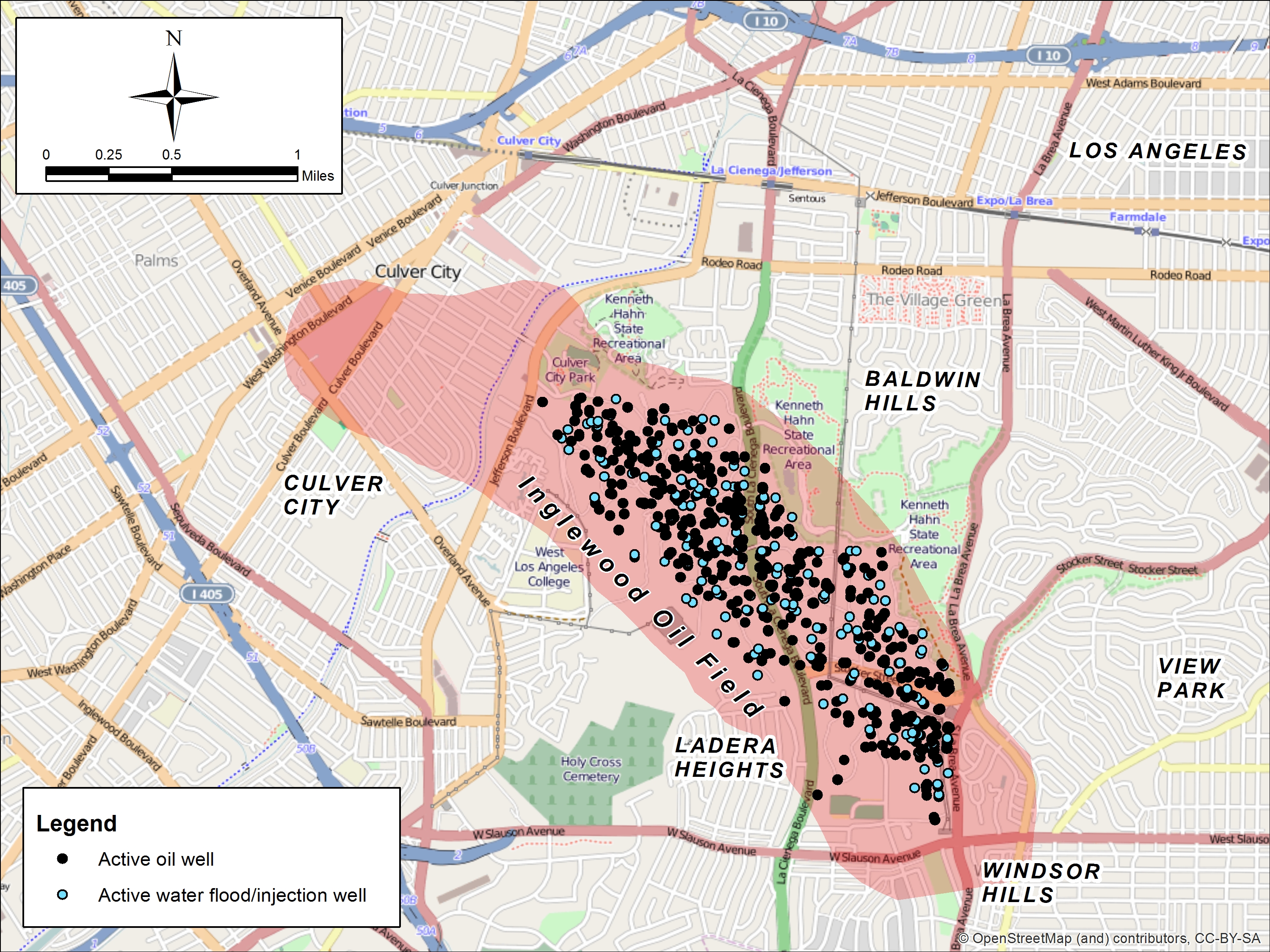
Inglewood Oil Field
Tucked beneath the neighborhoods of Culver City and Baldwin Hills, one of the most productive oil fields in California history has been quietly pumping crude for a century. The Inglewood Oil Field doesn't announce itself — you can live near it for years without knowing it's there. But nearly a million people live within five miles of it, and its story is inseparable from the history of Los Angeles's growth, wealth, and the long reckoning over what that growth cost.
September 28, 1924
Standard Oil geologists sank their first exploratory well into the Baldwin Hills in the fall of 1924. What they found made the company very rich and the surrounding region permanently different. The Inglewood Oil Field, as it came to be known, would go on to produce roughly 400 million barrels of crude oil — making it the eighteenth-largest oil field in California and, by any measure, the largest urban oil field in the United States.
At its peak the field held more than 500 active wells across approximately 1,000 acres. The terrain was fractured and layered in ways that kept yielding — the geology here runs along the Newport-Inglewood Fault, a system of ancient earth movement that created the structural traps where oil accumulated over millions of years.
Oil Beneath the City
What makes the Inglewood Oil Field historically unusual is not just its size but its location. Los Angeles expanded around it rather than displacing it, so by the late twentieth century the field was surrounded on all sides by homes, schools, and businesses. The hilltop positions of many of the wells offer views across the Los Angeles basin that on clear days extend to the Pacific.
The proximity created a persistent tension. Residents near the field's perimeter reported odors, truck traffic, and concerns about air quality. Researchers examining health data in communities adjacent to urban oil extraction found elevated rates of respiratory illness and adverse birth outcomes. For decades those findings collided with property rights arguments, economic claims about jobs and energy production, and regulatory complexity that left the field largely operating under rules established long before modern environmental standards.
The Vote to Close
On September 15, 2021, the Los Angeles County Board of Supervisors voted 5-0 to phase out oil extraction at the Inglewood Oil Field entirely. The decision was unanimous and significant — it set California's largest urban oil field on a path toward permanent closure and positioned Los Angeles County as the first jurisdiction in the state to move against an operating field of this scale on environmental grounds.
The vote came after years of community organizing by residents, health advocates, and environmental groups who had argued that the calculus of keeping the field open — jobs, tax revenue, energy production — did not justify the public health burden borne disproportionately by communities of color living nearby. Baldwin Hills, Inglewood, and Culver City are majority-minority communities. The phrase "sacrifice zone" appeared repeatedly in public testimony.
What Remains
The physical remediation of a century-old oil field is not simple or quick. Plugging wells, removing infrastructure, and assessing soil and groundwater contamination requires years of engineering work and substantial investment. What happens to the land afterward is still being debated — proposals have ranged from parks and open space to housing development.
The Newport-Inglewood Fault beneath the field is itself a significant seismic hazard. The 1933 Long Beach earthquake, which killed 115 people and prompted California's first school safety laws, originated along this fault system. Whatever replaces the oil field will have to account for what's still moving underground.
From the Air
The Inglewood Oil Field occupies the Baldwin Hills ridgeline visible south of the I-10 freeway in Los Angeles. From the air it appears as a roughly rectangular patch of undeveloped terrain amid dense suburban development, with the pumpjack infrastructure visible on the hillsides. The oil field sits northeast of LAX and northwest of Inglewood's SoFi Stadium complex.