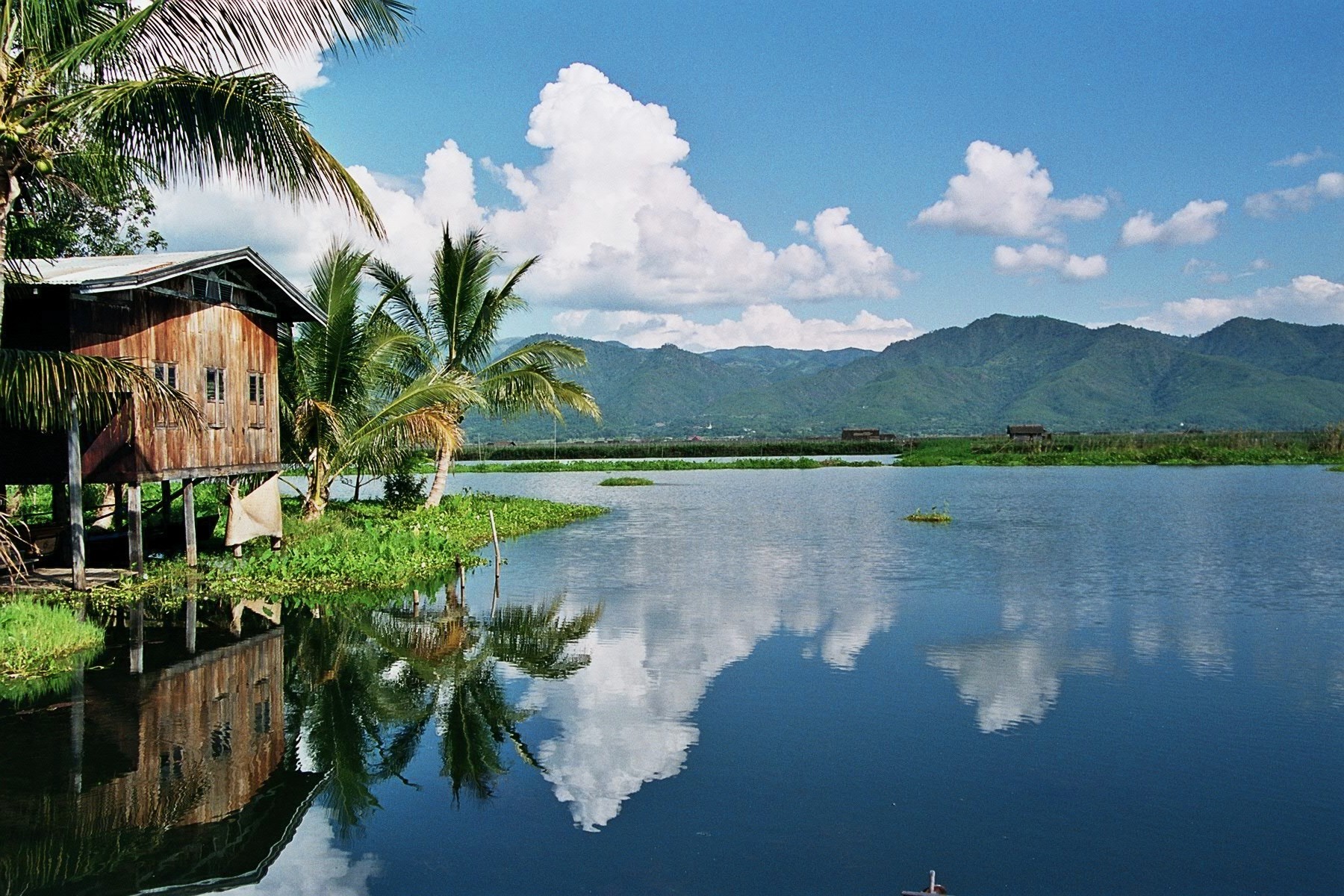
Inle Lake
The fishermen of Inle Lake stand on the sterns of their narrow wooden boats and wrap one leg around a single oar, rowing with a fluid corkscrew motion that frees both hands to work their conical nets. This leg-rowing technique, practiced by the Intha people for generations, is not a performance for tourists. It is the practical solution to a life lived almost entirely on water, where visibility over the tall reeds matters more than speed and where your hands are always needed for something else. At 2,900 feet in Myanmar's Shan Hills, Inle Lake is the country's second largest, a shallow, clear expanse of water where an entire civilization has been built on what floats.
Gardens That Rise and Fall
The floating gardens of Inle Lake are not metaphor. They are exactly what the name describes: agricultural plots built on mats of lake-bottom weeds that farmers dredge from the deep water, haul back by boat, and stack into beds anchored by bamboo poles. Tomatoes, flowers, gourds, and other crops grow in these beds, which rise and fall with the water level, making them resistant to the flooding that devastates conventional farms. The constant contact with nutrient-rich water makes them extraordinarily productive. What began as a local innovation has expanded dramatically since the 1960s, and the floating gardens now cover large sections of the lake's western shore. From above, they appear as geometric green patches stitched across the water's surface, a pattern unlike anything else in Southeast Asia.
Threads from the Lotus
Among the workshops that line the lake's stilt villages, the most remarkable produce a fabric found almost nowhere else on earth. Lotus silk is made by extracting fine threads from the stems of lotus plants, a painstaking process that yields a textile softer than cotton and more breathable than conventional silk. The fibers are so delicate that they must be spun within 24 hours of harvesting before they dry out and become unusable. At Inle Lake, this fabric is woven into special robes called kya thingan, reserved for draping over Buddha images. The lake's weaving tradition extends well beyond lotus silk: high-quality hand-woven Inle longyi fabrics and the ubiquitous Shan bags, used as everyday tote bags across Myanmar, are produced here in quantity. Silver brought by boat from mines in the surrounding hills feeds another workshop tradition, with silversmiths crafting jewelry and ornaments in full view of visitors.
A World Found Nowhere Else
Inle Lake's slightly alkaline waters, with a pH between 7.8 and 8, harbor a biological community of startling uniqueness. More than 35 native fish species swim here, 17 of which are endemic, found in no other body of water on earth. The Sawbwa barb, the emerald dwarf rasbora, and the Inle snakehead are among those that have made their way into the global aquarium trade. Beneath the surface, roughly 45 species of freshwater snail inhabit the lake, 30 of them endemic. Each November through January, some 20,000 migratory gulls descend on the lake, transforming its quiet surface into a noisy congregation. In 2015, Inle became Myanmar's first UNESCO Biosphere Reserve, and it has been a protected Ramsar wetland site since 2018.
The Lake That Shrinks
Between 1935 and 2000, Inle Lake lost 32.4 percent of its open water area. The culprit is largely the success of the floating gardens themselves: over time, the garden beds accumulate sediment and become solid ground, permanently converting lake to land. About 93 percent of the recent water loss, nearly 21 square kilometers, is attributed to this agricultural expansion. Slash-and-burn farming on the surrounding hills sends silt and nutrients cascading into the watershed, feeding algal blooms and choking the water with weeds. Tourism has added its own pressures, with hotels and boat traffic multiplying in recent decades. Some villages have resorted to drilling enclosed wells because the lake's surface water is no longer safe to drink. The shrinking lake even affected the nation's power supply: the hydroelectric plant at Lawpita, which once powered the former capital Yangon, could not operate at full capacity as water levels declined.
Five Days, Five Markets
Commerce on Inle Lake follows a rhythm older than clocks. A rotating market circulates among five sites around the lake on a five-day cycle, so that each village hosts the market once per rotation. When the market falls on the lake itself, trading happens from small boats, creating a floating bazaar that draws both locals buying necessities and tourists hunting for souvenirs. The stilt houses of the lake villages are built from woven bamboo, and daily life plays out on water as naturally as it does on land elsewhere. Cheroots are rolled, tofu is pressed from chickpeas in the Shan tradition, and htamin gyin, a local dish of fermented rice kneaded with fish or potato, is served from kitchens perched above the waterline. The 18-day Phaung Daw U Festival, held each autumn, sends a royal barge shaped like a hintha bird across the lake carrying gilded Buddha images, accompanied by teams of leg-rowers racing in traditional Shan dress.
From the Air
Located at 20.55N, 96.92E in Myanmar's Shan State at 2,900 feet elevation. The lake is clearly visible as a long north-south water body surrounded by the Shan Hills. Nearest airport is Heho (VYHE), approximately 35 km to the northwest. Yangon International (VYYY) is 660 km to the south, Mandalay International (VYMD) is 330 km to the north. Best viewed at 5,000-8,000 feet AGL where the floating gardens and stilt villages are distinguishable.