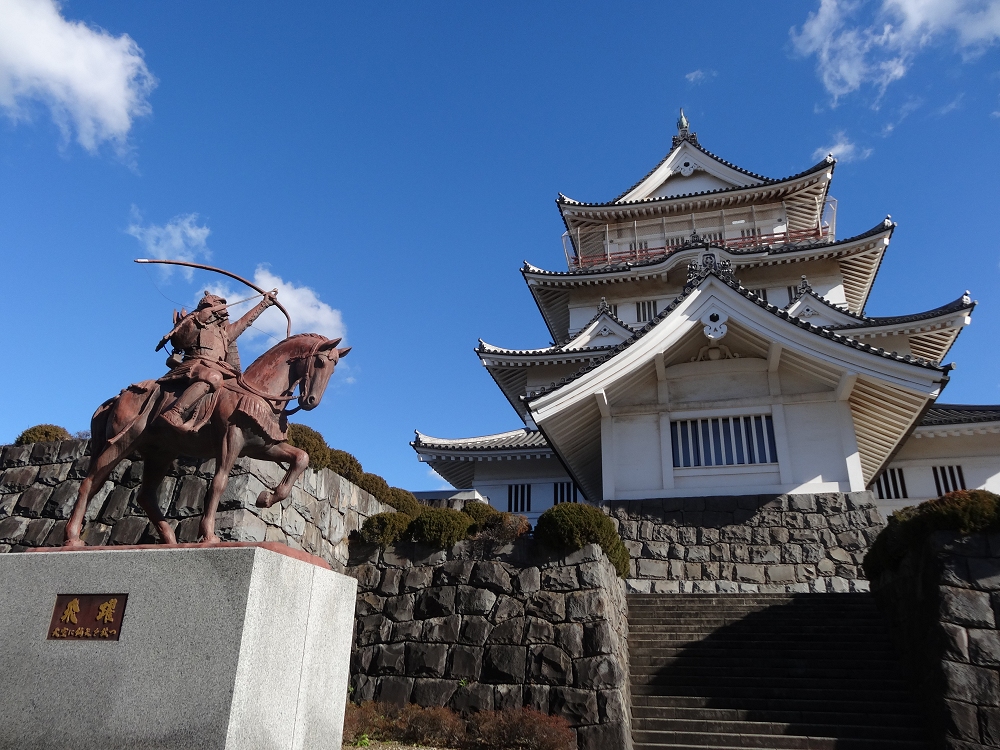
Inohana Castle
The hill is called Inohana -- pig's nose -- for the way its ridge juts out like a snout above the surrounding flatlands of central Chiba. It is not a grand name for the place where a warrior dynasty established its seat of power, but medieval Japanese fortress builders cared more about sightlines than poetry. From the top of this modest plateau, the Chiba clan could survey the full sweep of Tokyo Bay and the waters of the nearby port. In 1126, Taira no Tsuneshige chose this vantage point for his new castle, transferring the clan's base from Oji Castle in Kazusa Province. The move gave the clan a new name -- they began calling themselves "Chiba" -- and gave the city that grew around it an origin story that residents still commemorate nearly nine centuries later.
The Samurai Who Made Tea
On the north side of the castle ruins, a well called Ochanomizu still holds water and legend in equal measure. The story goes that Chiba Tsunetane, the clan head who helped Minamoto no Yoritomo establish the Kamakura shogunate in the late 12th century, drew water from this very well to brew tea for the future shogun. Whether the tale is historically precise matters less than what it reveals: the Chiba clan's relationship with Yoritomo was intimate enough that hospitality at the castle was part of the political narrative. After Yoritomo's victory, the clan was rewarded with vast domains across Japan. But the coming-of-age ceremonies for Chiba clan leaders continued to be held at the nearby Kongouju-ji temple, a kilometer to the north -- a sign that the spiritual center of the clan's identity remained rooted in this specific patch of ground.
A Castle Lost to Time
The true layout of Inohana Castle remains a mystery. It was a hirayama-style fortress -- a castle built on a lowland hill -- situated south of the Miyako River, but the exact location of the Chiba clan's main residence is still debated by historians. Some believe it stood near the present-day Chiba District Court, in the flatter ground around the base of Inohana hill rather than on the plateau itself. It was not until the Edo period, centuries after the castle had fallen out of use, that writers began firmly identifying the hilltop as the Chiba clan's stronghold. An 1858 guidebook to famous places of Narita included a section about Chiba Tsunetane with a diagram placing the old castle at Inohanayama. On the west side of the site, earthworks and dried moats that once marked the inner citadel -- the kuruwa -- survive as the most tangible physical evidence of the medieval fortification.
Concrete Memory
In 1967, Chiba City built a museum on the castle ruins -- not a careful reconstruction of the original medieval hilltop fortress, but a gleaming concrete castle tower replica modeled on the grand tenshu of the Azuchi-Momoyama period, centuries after Inohana Castle's heyday. The choice was deliberate: the museum was meant to evoke the romance of the samurai age, not to document what actually stood here. A bronze statue of Chiba Tsunetane stands before the entrance, sword at his side, gazing across the park that has replaced the fortifications. Inside, the permanent exhibition traces the local history of Chiba City and the Chiba clan through artifacts, documents, and displays. The building has become the defining visual icon of the site, its soaring rooflines visible from across the park -- an imagined castle standing in for one that left only ditches and dirt behind.
Monuments to a Founding
Chiba City has never stopped celebrating the moment Tsuneshige chose this hill. In 1926, eight hundred years after the founding of Chiba-fu, a monument was erected at the castle site to mark the anniversary and honor Tsuneshige's rule during the late Heian period. Fifty years later, in 1976, another monument went up for the 850th anniversary. The castle ruins themselves, including the surviving earthworks and moats, have been designated a cultural asset of the city. A Shinmei Shrine sits north of the museum, occupying what is believed to have been an observation platform that once commanded panoramic views of Tokyo Bay and Chiba Port. The stairs on the east side, once known as Ikedazaka, are said to have served as the castle's back gate. Each of these small details -- a well, a staircase, a dried moat -- carries the weight of a city's foundational narrative, anchoring modern Chiba to its medieval origins on a hill shaped like a pig's nose.
From the Air
Located at 35.6050N, 140.1261E in central Chiba City, Chuo-ku district. The castle site sits on a low hill in Inohana Park. From altitude, look for the park's green space and the distinctive castle-shaped museum building amid the dense urban fabric south of the Miyako River. Chiba Port lies to the west, with Tokyo Bay beyond. Nearest major airports: Narita International (RJAA), approximately 30nm east-northeast; Tokyo Haneda (RJTT), approximately 25nm west across the bay. The site is roughly 800m south of Chiba Shrine. Expect maritime haze off Tokyo Bay, particularly in summer months.