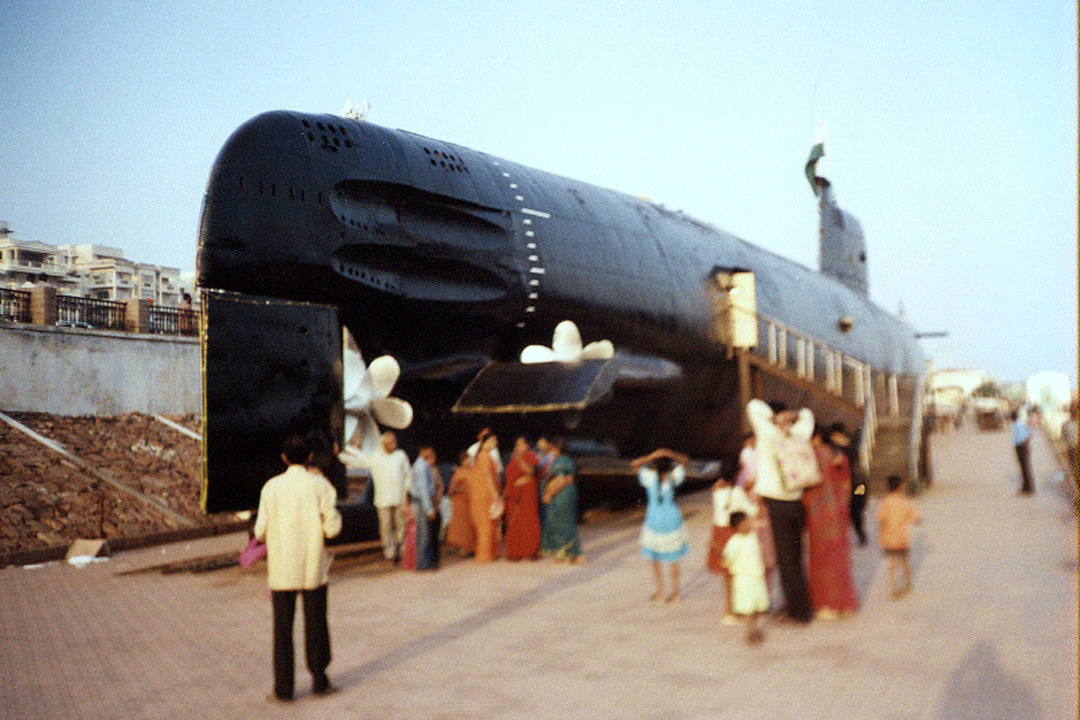
INS Kursura
She spent 31 years beneath the waves, and now she rests on a concrete foundation twenty meters from the surf. INS Kursura, hull number S20, sits on Ramakrishna Beach in Visakhapatnam with her torpedo tubes intact, her diesel engines frozen in place, and her narrow corridors open to anyone willing to pay the admission fee. Commissioned in 1969 as India's fourth submarine and decommissioned in 2001 after logging 73,500 nautical miles, Kursura is one of the few submarine museums in the world that retains its original fittings. The Indian Navy still honors her each year with the "Dressing Ship" ceremony, a distinction typically reserved for vessels in active service.
Built for the Deep
Kursura was a Kalvari-class boat, a Soviet-designed variant of the Foxtrot-class diesel-electric submarine built at the Admiralty Shipyard. At 91.3 meters long with a beam of 7.5 meters, she displaced 1,950 tons on the surface and 2,475 tons submerged, with a maximum diving depth of 985 feet. Three Kolomna 2D42M diesel engines, each producing 2,000 horsepower, drove her at 16 knots on the surface. Submerged, three electric motors could push her to 15 knots. Her armament was formidable: ten torpedo tubes capable of carrying 22 Type 53 torpedoes, or alternatively, 44 naval mines. Her first commanding officer was Commander Arun Auditto, and her maiden voyage from the Soviet Union to India in early 1970 took her through Gothenburg, La Coruna, Takoradi, and Mauritius before she reached home waters.
War Patrols in the Arabian Sea
When tensions between India and Pakistan escalated in late 1971, Kursura and her sister submarine were assigned to patrol the approaches to Karachi harbor and the Makran Coast under the Western Naval Command. The orders came with two constraints: she could not cross demarcated international shipping corridors, and she could attack a target only after positive identification. Kursura departed her home port on November 13 and reached her first patrol station by November 18. She shifted to a second location on November 25, then rendezvoused with INS Karanj at sea on November 30 to transfer instructions before heading to Bombay. During those weeks of silent watching, she monitored commercial tankers and aircraft along international routes. A plan to lay mines off the Pakistani coast was drawn up and then cancelled. Her contribution to the war was not dramatic in the way of surface engagements, but submarine patrol is a discipline of endurance and readiness rather than spectacle.
A Template for Repair
Before the war, Kursura had already performed an unusual act of service. In 1970, her sister submarine Karanj surfaced directly beneath the destroyer INS Ranjit in a catastrophic collision that left Karanj badly damaged. The Bombay Dockyard had no technical drawings of the damaged hull sections, and neither did the Indian Navy. Engineers turned to Kursura, which was docked at Bombay at the time, and used her hull as a physical template for the metalwork repairs. Karanj was restored within months, in time to join the 1971 war effort. After the war, Kursura herself was cannibalized for spare parts to keep other submarines operational, spending years laid up before undergoing a full refit in the Soviet Union between 1980 and 1982. She returned to active duty in 1985 and went on to participate in anti-submarine warfare exercises with Singapore's navy in 1994.
600 Meters to a Second Life
When Kursura was decommissioned on February 27, 2001, the question of what to do with her hull could have ended with a scrapyard. Instead, the Andhra Pradesh government under Chief Minister N. Chandrababu Naidu chose to preserve her as a museum on RK Beach. Towing the submarine just 600 meters to her permanent concrete foundation took 18 months and cost 55 million rupees. She opened to the public on August 24, 2002, becoming the first submarine museum in South Asia. Six retired naval personnel serve as guides inside the vessel. Daily visitors typically number between 500 and 600, surging to 1,500 during tourist season, and in 2010 alone, 270,000 people walked her passageways. U.S. Vice Admiral Carol M. Pottenger, visiting in 2007, wrote in the guestbook that she had never seen anything comparable in the United States.
From the Air
Located at 17.72°N, 83.33°E on Ramakrishna Beach (RK Beach), Visakhapatnam. The submarine is visible from low altitude as a dark hull shape on the beachfront promenade along the city's southern coastline. Nearest airport is Visakhapatnam (VOVZ/VTZ), approximately 8 km to the northwest. The adjacent coastline features the Visakhapatnam naval base (INS Dega) and the busy commercial port. RK Beach road runs parallel to the shore, making the museum easy to identify from above.