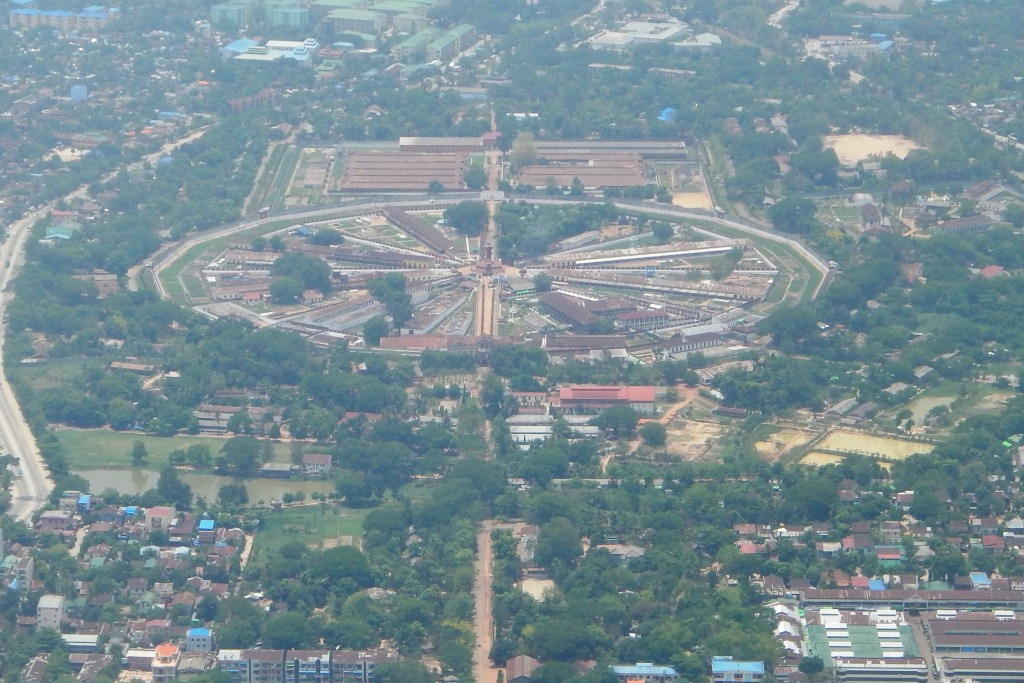
Insein Prison
The name is pronounced "insane," and the coincidence has not been lost on anyone who has passed through its gates. Insein Prison sits in Yangon's northern suburbs, a sprawling compound of low buildings and guard towers that colonial British authorities erected in 1887 to relieve overcrowding at Rangoon Central Gaol. They built it as a panopticon -- a circular surveillance design intended to let a single watchpoint observe every cell. More than a century later, the prison still watches. Its purpose, though, has shifted from containing common criminals to silencing the people Myanmar's successive military governments fear most: those who speak, write, and organize.
Walls That Outlived Their Builders
The British chose the site on Commissioner's Road -- now Bogyoke Aung San Road -- near what was then the edge of colonial Rangoon. The panopticon design reflected a fashionable Victorian theory of punishment: the idea that prisoners who believed they were always being watched would internalize discipline. When British colonial rule ended in 1948, the prison remained. Myanmar's successive governments found it useful for purposes its designers could not have anticipated. From 1988 to 2011, the military junta ran Insein as a primary tool of political repression, first under the State Law and Order Restoration Council and then under the State Peace and Development Council. The architecture of surveillance proved adaptable to any regime.
The Price of Dissent
Insein's roster of political prisoners reads like a history of Myanmar's democracy movement. Student leaders of the 1988 Uprising -- Min Ko Naing, Ko Ko Gyi, Kyaw Min Yu, Mya Aye -- were held here. Win Tin, the intellectual and NLD member who was elected to parliament in 1990 but never permitted to serve, endured years within its walls. Aung San Suu Kyi, the Nobel Peace Prize laureate, was confined to Insein in 2003, 2007, and 2009. The prison held video-journalist Sithu Zeya, arrested in 2010 for documenting a military attack on civilians, and Ngwe Soe Lin, jailed for filming children orphaned by Cyclone Nargis. Conditions inside matched the prison's reputation: inmates reported beatings with sand-filled rubber pipes and being forced to crawl across gravel paths while chased by dogs. A cell block known as the "dog cell" was reserved for those deemed most defiant -- a place where torture intensified and family visits were forbidden.
Wa Lone's Children's Book
Among Insein's more recent prisoners were Reuters journalists Wa Lone and Kyaw Soe Oo, arrested on 12 December 2017 for investigating the Inn Din massacre. Their case drew international outrage -- two reporters jailed for uncovering a military atrocity, held for more than 500 days in the prison that had swallowed so many voices before them. While inside Insein, Wa Lone wrote a children's book called Jay Jay the Journalist, a small act of creation in a place designed to extinguish it. Both journalists were released on 7 May 2019 after a pardon from President Win Myint, but the message their imprisonment sent -- that documenting the truth carries a prison sentence -- lingered well beyond their release.
Resistance Behind Bars
Even inside Insein, defiance found its way through. In May 2011, seven female political prisoners launched a hunger strike to protest an amnesty program that excluded most political detainees. Within days, 22 male prisoners -- including three Buddhist monks -- joined them, demanding better conditions and improved family visitation rights. The government's response was to drag the strike leaders into solitary confinement in the dog cell. Among those moved was Nyi Nyi Htun, an editor of The Kantaryawaddy Times. The hunger strike was crushed, but the fact that it happened at all -- inside one of the most heavily surveilled prisons on earth -- said something about what surveillance alone cannot suppress.
A Compound That Endures
In October 2022, two parcel bombs detonated at the prison, killing eight people -- three guards and five parcel deliverers -- and injuring 18 others. The blast at 9:40 AM was a reminder that Insein exists not in some sealed-off past but in Myanmar's violent present. The prison compound remains operational, still holding political detainees, still drawing condemnation from human rights organizations. From the air, it is a geometric scar in Yangon's urban fabric -- the panopticon's circular logic still visible in the layout, a Victorian idea of total control transplanted to a country that has never stopped resisting it.
From the Air
Located at 16.89°N, 96.10°E in the northern suburbs of Yangon, Myanmar. The prison compound is identifiable from the air by its distinctive circular panopticon layout within a walled perimeter. Nearest major airport is Yangon International (VYYY), approximately 10 km to the north. Viewing altitude of 2,000-4,000 feet recommended to observe the compound's layout. The Hlaing River runs to the west.