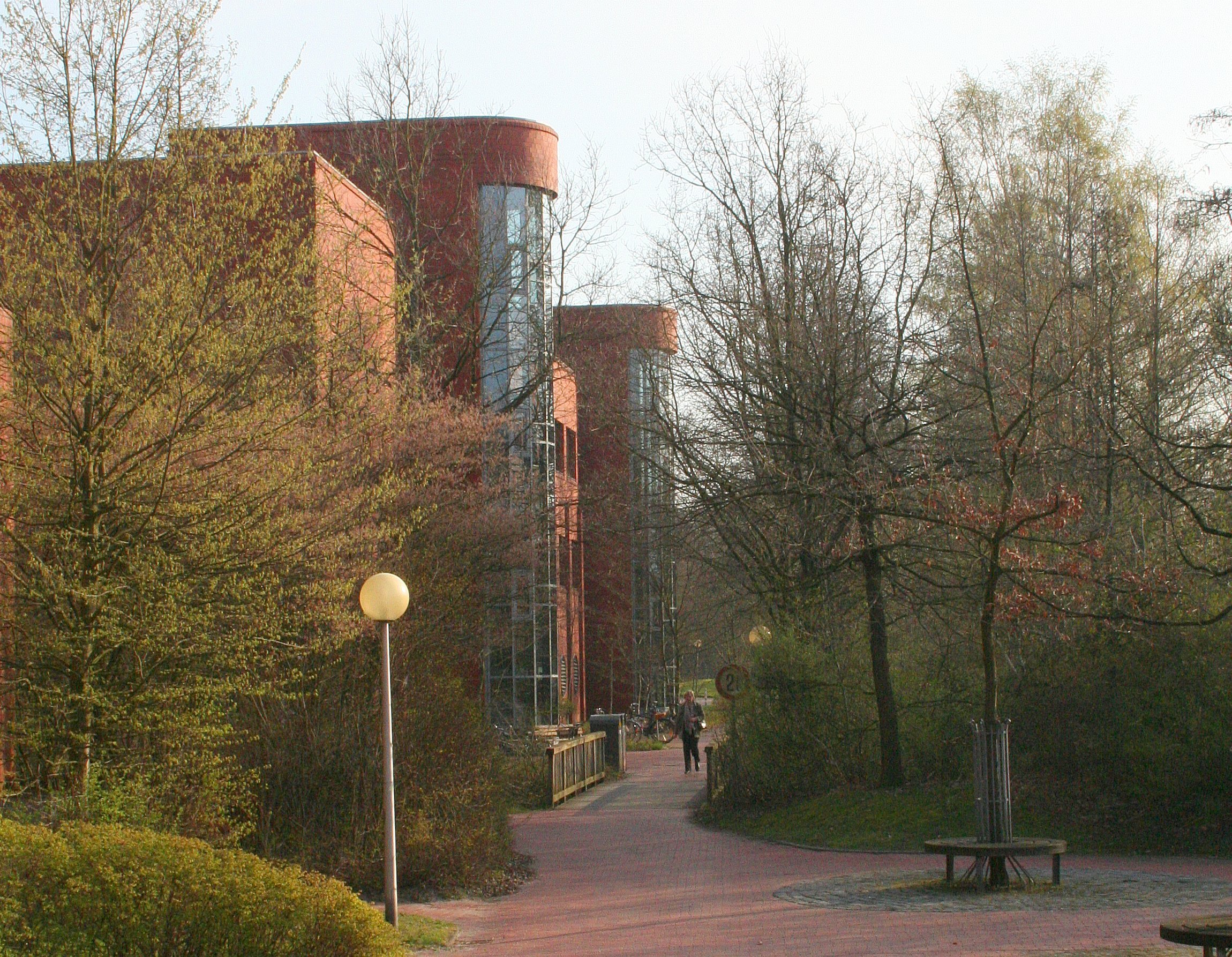
Institute for Chemistry and Biology of the Marine Environment
There is a small platform standing in the Wadden Sea off the island of Spiekeroog, painted in seafarer's yellow and lashed against the storms. It looks like nothing - a metal box on stilts above tidal mud. But for over twenty years it has been measuring, every fifteen minutes, the chemistry and biology of the water rushing past: salinity, oxygen, chlorophyll, suspended sediment, nutrients. This is the Wadden Sea time-series station Spiekeroog, operated by the Institute for Chemistry and Biology of the Marine Environment - ICBM - and it is one of the longest continuous records of coastal ocean change anywhere on Earth.
A University at the Edge of the Sea
The Institute for Chemistry and Biology of the Marine Environment - mercifully abbreviated ICBM - belongs to the Carl von Ossietzky University of Oldenburg, named for a Nobel Peace laureate who died in a Nazi camp. It is the only university-based marine research institute in Lower Saxony, with its main campus at Wechloy in Oldenburg and outposts at Wilhelmshaven and on Spiekeroog. Eighteen research groups span three sections: geochemistry and analytics, biology and ecology, and physics and modelling. The institute was founded in July 1987 as a cooperative venture across the university's mathematics, biology, physics, and chemistry departments, and was made a central organization of the university in 1991. In 2008 the Forschungszentrum Terramare in Wilhelmshaven - founded in 1990 to study shallow seas and coastal zones - was folded into the ICBM.
Reading the Wadden Sea
The Wadden Sea is one of the strangest large ecosystems on Earth: a 500-kilometer-long string of tidal flats stretching from the Netherlands through Germany to Denmark, draining and refilling twice each day. Roughly half its bed is exposed at low tide. Carbon, nitrogen, phosphorus, and sulfur cycle through it in patterns that are still being worked out. Microbial communities consume and produce gases here at rates that matter for the whole North Sea. ICBM researchers come at these questions from every direction - geochemistry, sensor design, mathematical modelling. They build their own marine sensors when commercial ones aren't sensitive enough. They run research vessels along transects nobody else samples. The institute's role is to turn the Wadden Sea from a postcard into a system you can describe in equations.
Cooperation Across the Coast
Marine science along this stretch of coast is densely networked. The ICBM works closely with the Max Planck Institute for Marine Microbiology and MARUM in Bremen, the Alfred Wegener Institute in Bremerhaven, the Senckenberg Institute by the Sea in Wilhelmshaven, and the Jade University of Applied Sciences just across the road. It is a member of the German Marine Research Consortium and the Northwest Marine Research Association. The Jade UAS, in partnership with the ICBM, offers a Bachelor program in marine engineering - training the next generation of people who will design instruments, manage research ships, and process the data the sensors produce.
Where Students Become Researchers
The institute's teaching mission threads through its science. Students at Oldenburg can study marine, environmental, and landscape-ecological sciences at the bachelor level, then move into one of four master programs: Marine Environmental Sciences, Microbiology (taught in English), Environmental Modelling, or Marine Sensors. ERASMUS partnerships bring students from across Europe. By the time they graduate, many have spent weeks on the research vessels and at the Spiekeroog platform, learning what it takes to measure something honestly. Sea-going science is unforgiving of carelessness, and the Wadden Sea - shallow, dynamic, often muddy - is a particularly demanding teacher.
From the Air
The ICBM's Wilhelmshaven outpost is at approximately 53.51°N, 8.15°E, in the inner harbor area west of the Jade Bight. The main Oldenburg campus is 40 km south at the Wechloy site. The Spiekeroog field station is on the East Frisian island of Spiekeroog (~53.78°N, 7.70°E). Recommended viewing altitude FL040-FL060 over Wilhelmshaven; FL050-FL080 over the East Frisian Islands chain reveals the tidal flat patterns the institute studies. Nearest airport: Wilhelmshaven-Mariensiel (EDWI); for Spiekeroog, the island has a small airfield (EDWS).