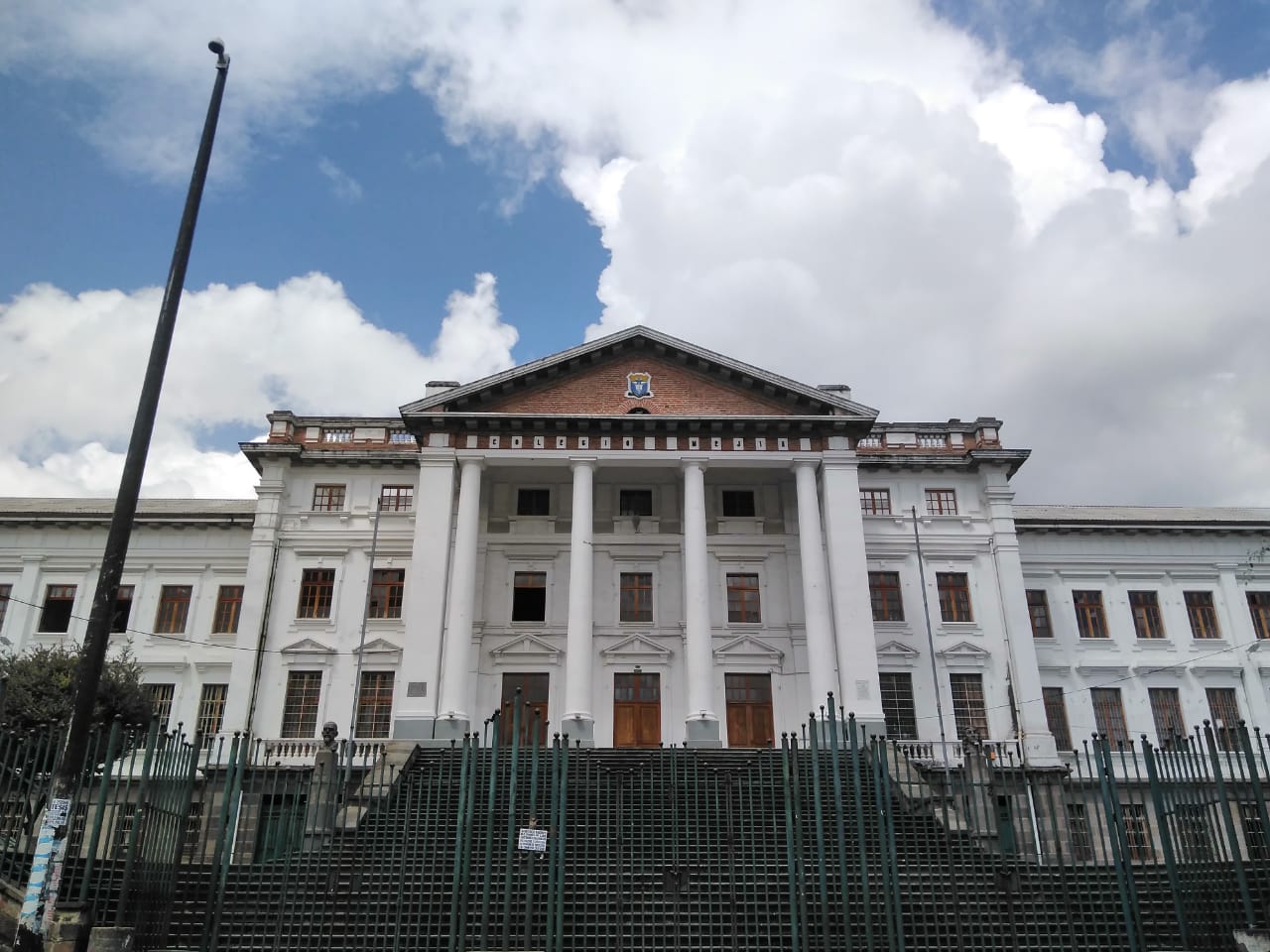
Instituto Nacional Mejia
Eloy Alfaro had a problem in 1897: Ecuador's secondary education was almost entirely run by the Catholic Church, and he intended to change that. Alfaro had just led a liberal revolution that overthrew the conservative government. On June 1 of that year, he founded a public, secular high school in Quito and named it Instituto Nacional Mejia, after Jose Mejia Lequerica, an early Ecuadorian independence thinker. Fifteen years later, on January 28, 1912, Alfaro was assassinated - beaten and burned by a mob in Quito's El Ejido Park. The school he had founded survived him. Today it still occupies a building in the Centro Historico of Quito, and the list of people who passed through its classrooms reads like a short history of twentieth-century Ecuadorian culture.
An Address in the Old Town
The school moved several times before settling into its current home. It began at the northern edge of what is now the Metropolitan Cultural Centre, then relocated to an old building called the antiguo Beaterio at the intersection of Jose Joaquin de Olmedo and Sebastian de Benalcazar streets. Both addresses sat in the heart of Quito's Old Town, a UNESCO World Heritage site. In 1922, the administration commissioned a new, larger building from the German architect Wilhelm Spahr working with local architect Pedro Aulestia Saa. A further expansion went up in the 1950s on the western side of the block - a structure that became, after the Teatro Nacional Sucre, one of the architectural icons of early twentieth-century Quito. By the 1970s, the original Edificio Central next door was ceded to the school to handle growing enrollment.
The Library and the Museum
Inside the main building sits a library whose oldest book dates to 1656 - a volume by the Augustinian friar Gaspar de Villarroel. When Spain expelled the Society of Jesus from its American colonies in the 1760s, the Jesuits left their library collections behind in sacks, and some of those books eventually ended up here. In 1905, Alfaro ordered the purchase of fifty animal specimens from the Deyrolle house in Paris - the legendary taxidermy and natural history firm whose work has stocked museums and wealthy studies for more than a century - along with Ecuadorian specimens, to form the nucleus of a natural history museum inside the school. A later director, the pioneer Ecuadorian zoologist Gustavo Orces, identified about a thousand of the fourteen hundred bird species then known from Ecuador. The museum today occupies eighteen rooms and serves as the de facto Anthropological Museum of Ecuador.
Poets and Presidents
The alumni list is long and distinguished. Jorge Icaza graduated from Mejia before writing Huasipungo in 1934, the novel that introduced international readers to the brutal land-tenure system that bound indigenous Ecuadorians to haciendas for generations. Jorge Carrera Andrade - one of the major Ecuadorian poets of the twentieth century - taught literature at Mejia before becoming Ecuador's diplomat to France. Jorge Enrique Adoum studied here, later served as Pablo Neruda's personal secretary from 1946 to 1948, won the Casa de las Americas Prize in 1960, and returned for a time to teach at his old school. Galo Plaza Lasso, born in New York in 1906, attended Mejia and went on to serve as Mayor of Quito, President of Ecuador from 1948 to 1952, and Secretary General of the Organization of American States from 1968 to 1975. Lenin Moreno, who served as President of Ecuador from 2017 to 2021, spent part of his secondary education here. Paco Moncayo, Commander-in-Chief of the Ecuadorian Armed Forces from 1996 to 1998 and later Mayor of Quito, is another alumnus.
Breaking Ground for Women
Isabel Robalino Bolle - born in Barcelona in 1917 - became the first female lawyer in Ecuador and one of the first women on Quito's City Council in the 1940s. She played a central role in developing Ecuadorian trade unions, wrote history books, founded the Association of Alumni of the Instituto Nacional Mejia, and remained active in public life well past her hundredth birthday. She was elected to the Ecuadorian National Academy of History. The school that Alfaro built to pry education away from the church had, by the time Robalino graduated, become one of the places where Ecuadorian women's public voices began to find their footing. Nelson Estupinan Bass - novelist, playwright, and Afro-Ecuadorian activist from Sua - won the Eugenio Espejo Prize in 1993 and the Maria Moors Cabot Prize in 1961 for his work chronicling Black Ecuadorian experience. For a public school on the equator, the reach of its graduates has been remarkable.
From the Air
Located at 0.21 degrees S, 78.51 degrees W in Quito, Ecuador, within the city's historic center - a UNESCO World Heritage site. Quito sits at approximately 2,850 m (9,350 ft) elevation in a narrow Andean valley between Pichincha Volcano to the west and the Inter-Andean plateau to the east. Nearest airport is Mariscal Sucre International (SEQM), about 18 km east of downtown. The school building is close to the Teatro Nacional Sucre and other landmarks of Quito's Old Town. Best visibility is morning; clouds typically build against the surrounding peaks after noon.