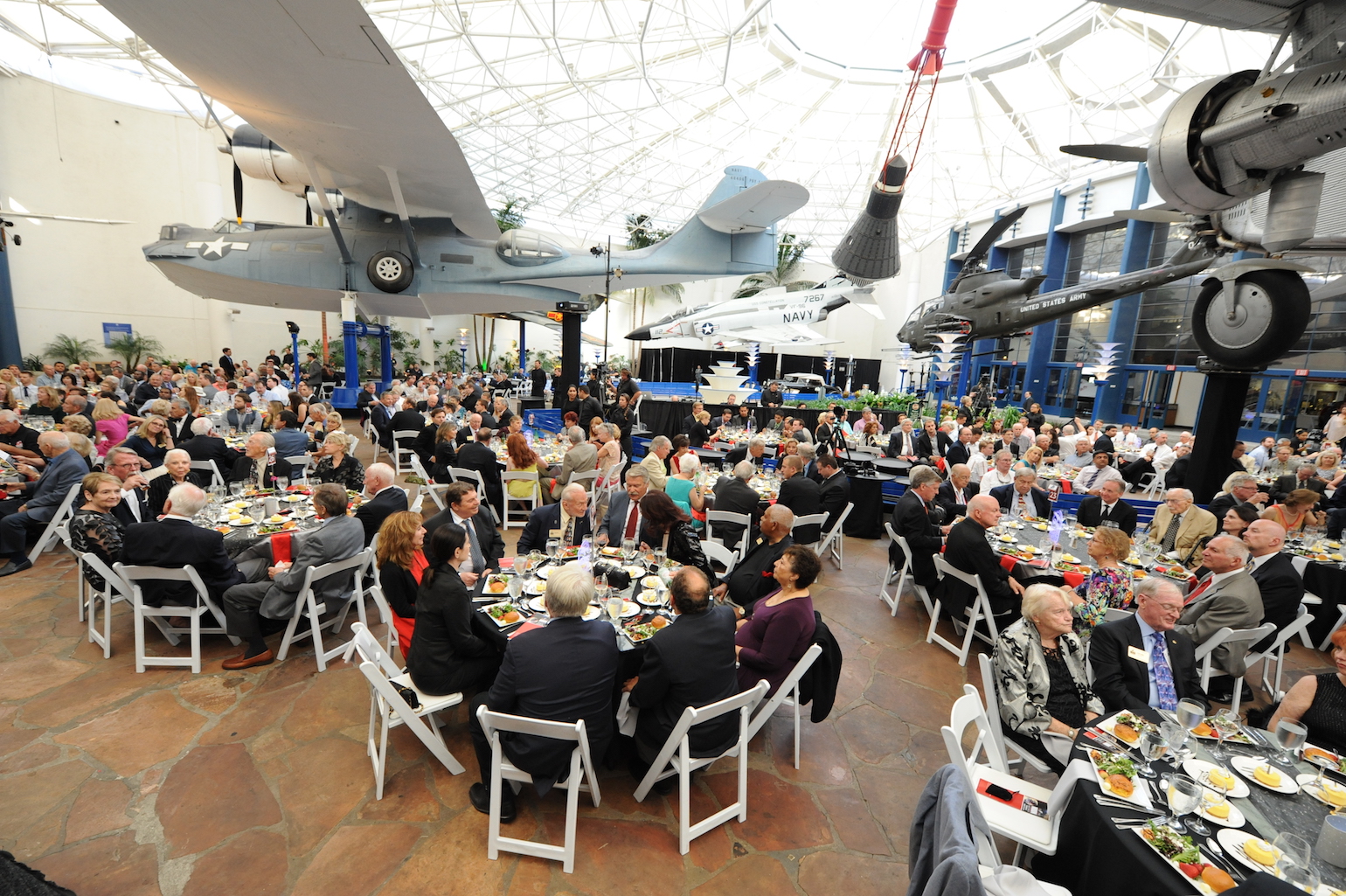
International Air & Space Hall of Fame
Founded in San Diego in 1963, the International Air & Space Hall of Fame has inducted more than 200 aviators, astronauts, engineers, and organizations — and survived a 1978 arson fire that incinerated its entire portrait gallery, only to rebuild in the historic Ford Building of Balboa Park.
Honoring Those Who Changed the Sky
The International Aerospace Hall of Fame was incorporated on September 27, 1963, with a simple and ambitious mission: to honor the great achievers of aviation and space endeavors. The first induction ceremony took place on March 18, 1965, at the San Diego Convention Hall, recognizing a founding class that included Charles Lindbergh, Wernher von Braun, Amelia Earhart's posthumous predecessor Jacqueline Cochran, Glenn Curtiss, and the Wright Brothers themselves.
The institution was affiliated from the start with the San Diego Air & Space Museum, which shared its home in Balboa Park. But for its first three decades, the Hall of Fame maintained its own board of directors and operated as a distinct nonprofit — a separate institution that happened to share a building. The two merged in 1993, bringing the Hall of Fame fully under the museum's umbrella.
The Fire of 1978
On February 22, 1978, arsonists set fire to the Electric Building in Balboa Park, which housed both the Air & Space Museum and the Hall of Fame. The fire was catastrophic. The Hall of Fame's entire portrait gallery burned — more than 60 original paintings, each commissioned to represent an inductee, each crafted to capture the figure in the context of their achievement.
The loss was not just aesthetic. Those portraits were the physical heart of the institution, the accumulated visual record of decades of honorees. They were gone in a single night.
The rebuilding was a significant undertaking. A recovery fund was established with a $4.5 million goal, met through contributions from aviation corporations, foundations, private donors, and government support. The Museum and Hall of Fame had hoped to reopen on December 17, 1978 — the 75th anniversary of the Wright Brothers' first flight at Kitty Hawk. Delays pushed the opening date back more than a year. Finally, exactly two years after the fire, on February 22, 1980, the Hall of Fame reopened in the historic Ford Building in Balboa Park.
The Portraits Rebuilt
The lost portraits were replaced through an unusual process. The board of directors enlisted local artists and gave them wide creative latitude — the replacement paintings were not meant to be faithful reconstructions of what had been lost but original works, each depicting the inductee in a way that captured something of their era and achievement.
The board also established a practice that continues today: each portrait must include a representation of the inductee's specific achievement — usually an aircraft or spacecraft. This rule, born from the need to rebuild after destruction, gave the new collection a coherence that the original gallery had perhaps lacked.
The result was a portrait gallery that was different from what had burned, but not lesser. The artists who painted for the restored Hall of Fame were working in a tradition of commissioned historical portraiture that stretches back centuries, applied to a subject matter — aviation and space — that was entirely of the twentieth century.
Two Centuries of Flight, Honored in San Diego
The Hall of Fame's induction list now covers more than 200 individuals and organizations, spanning from the Montgolfier brothers — who flew their hot air balloon in 1783 — to figures inducted in the twenty-first century. The range is remarkable: military aviators and civilian pioneers, American icons and international legends, engineers and astronauts and test pilots and airline executives.
Chuck Yeager, who broke the sound barrier, is here alongside the Apollo 11 crew. Amelia Earhart alongside Jacqueline Cochran. The Tuskegee Airmen alongside the Blue Angels. The Space Shuttle alongside the Wright Brothers.
San Diego's connection to aerospace history runs deep — the city was home to Ryan Aeronautical, which built Lindbergh's Spirit of St. Louis, and to Convair, which built the Atlas rocket. A hall of fame for flight, located here, sits within a city whose own story is intertwined with the history of wings.
From the Air
The International Air & Space Hall of Fame is located in the San Diego Air & Space Museum within Balboa Park, approximately 3 miles northeast of KSAN (San Diego International Airport). The Ford Building that houses the museum is one of the distinctive Spanish Colonial Revival structures visible on the Balboa Park mesa. The museum's location in a park that celebrates San Diego's civic culture is appropriate for an institution that honors the people who made flight what it is.