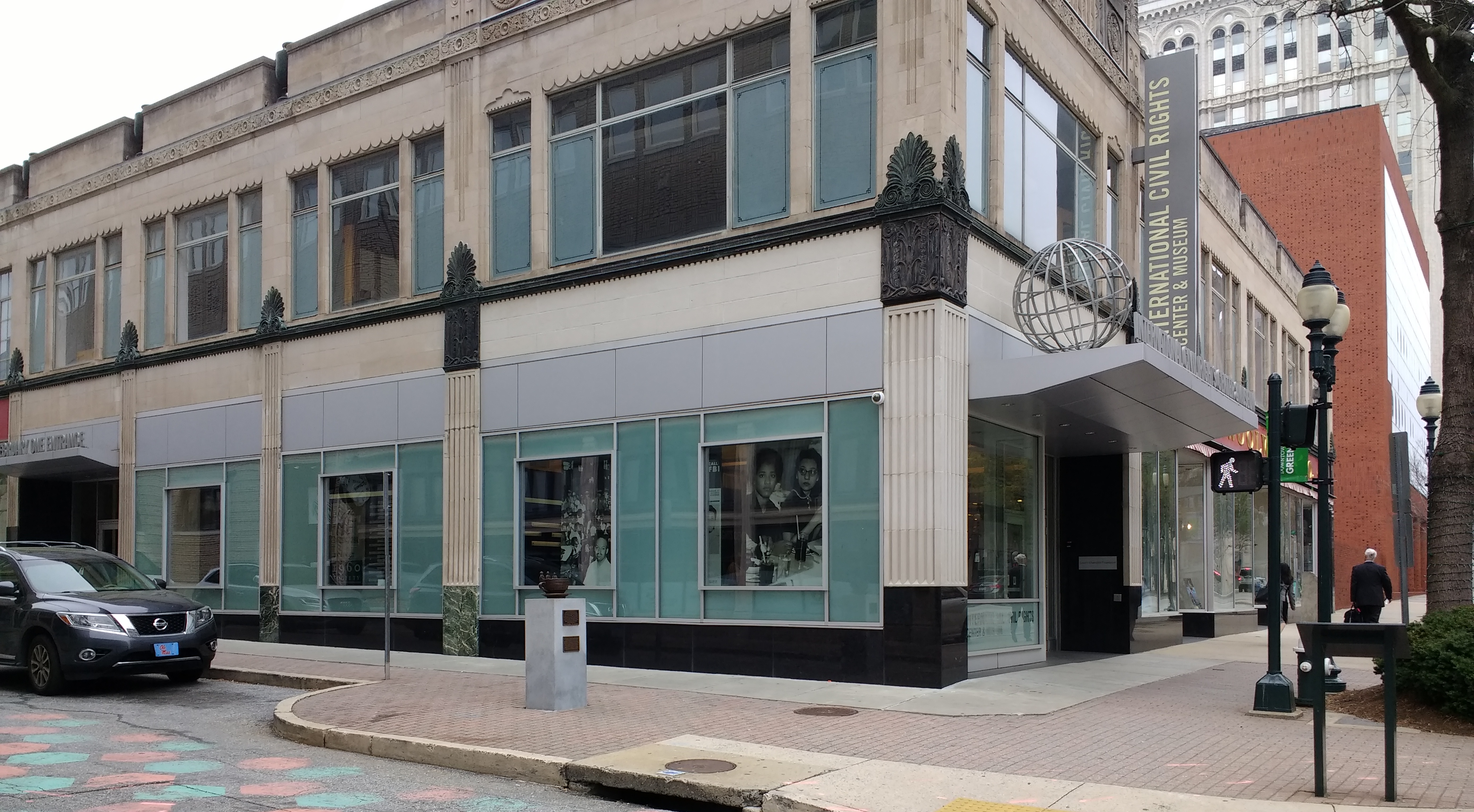
International Civil Rights Center and Museum
Four stools. One lunch counter. On February 1, 1960, Franklin McCain, Joseph McNeil, Ezell Blair Jr. (later Jibreel Khazan), and David Richmond walked into the F.W. Woolworth store at 132 South Elm Street in Greensboro, North Carolina, sat down at the whites-only lunch counter, and refused to leave. They were freshmen at North Carolina Agricultural and Technical State University. The next day, twenty students came. Within weeks, thousands were joining sit-ins at segregated businesses across the South. The counter where it started still stands in the same building, preserved inside a museum that took longer to build than the movement it honors took to change the law.
The Counter That Changed Everything
The Woolworth building was constructed in 1929, designed in the Art Deco style by local architect Charles Hartmann. Originally the Whelan Building, it became Woolworth's in 1939, advertised as "the largest and most modern Woolworth store in the south," complete with a 69-seat luncheonette. For two decades it served Greensboro shoppers under the rigid customs of segregation. Then came February 1, 1960. The four students' quiet defiance ignited a movement that spread to dozens of cities. Facing boycotts and plummeting sales, Woolworth manager Clarence Harris desegregated the store on July 25, 1960. Four years later, the Civil Rights Act of 1964 made such segregation illegal nationwide. A single act of sitting down had helped rewrite federal law.
Singing 'We Shall Overcome' at Closing Time
On October 14, 1993, Woolworth announced it would shutter over 700 stores, including the Greensboro landmark. On the lunch counter's last day, October 23, Reverend Jesse Jackson joined hundreds who gathered to say goodbye, singing "We Shall Overcome" in the minutes before the doors closed at 5 PM. Guilford County commissioner Melvin "Skip" Alston proposed transforming the building into a museum. Not everyone agreed. One fellow commissioner warned it would "even further deepen the crevices between the races." Alston pivoted, proposing a broader civil rights museum rather than one focused solely on African-American history. The commission voted unanimously in favor. Alston and city councilman Earl Jones co-founded Sit-In Movement, Inc., and days before the store's final closure in January 1994, they secured the building.
Seventeen Years in the Making
Building the museum proved harder than saving the building. A section of the original counter with four stools was sent to the Smithsonian's National Museum of American History. But fundraising stalled badly. By January 2000, only $2 million of a $9.1 million goal had been raised, and nearly all of it had been spent. Leadership disputes, accusations of mismanagement, and two failed bond referendums threatened to sink the project. The city loaned $1.5 million in 2013 with strict payback conditions. Greensboro residents voted twice against providing additional public money. The museum's founders pressed on, fueled by the conviction that the history inside the building was too important to abandon. As the 50th anniversary of the sit-ins approached, efforts intensified. Over $9 million in donations and grants materialized. Historic preservation tax credits, sold for $14 million, bridged the final gap.
Fifty Years to the Day
On February 1, 2010, exactly half a century after four freshmen sat down and refused to move, the International Civil Rights Center and Museum opened its doors. Three surviving members of the Greensboro Four, McCain, McNeil, and Khazan, stood as guests of honor. Inside, visitors descend to the lower level, where video presentations and a graphic "Hall of Shame" depict the violence inflicted on civil rights protesters. The original dorm room furniture from the students' 1960 planning session is on display. Then comes the main floor: the massive L-shaped lunch counter, occupying nearly the full width and half the length of the building, still in its original 1960 configuration. Original signage. Dumbwaiters that once carried food from the upstairs kitchen. Among the artifacts: a pen used to sign the Voting Rights Act of 1965 and the uniform of a Tuskegee Airman from Greensboro.
Still Growing
The museum retired its city debt in 2018 after finally turning a profit. In March 2022, Sit-In Movement Inc. purchased an adjacent five-story building and 2.2 acres at 100 South Elm Street for $10.25 million, with $1 million from Guilford County commissioners and $200,000 annually for five years. The expansion signals that the museum's story, like the movement it preserves, is unfinished. The building at 132 South Elm Street is now a National Historic Landmark. Inside, the lunch counter asks the same question it asked in 1960: what are you willing to sit down for?
From the Air
The International Civil Rights Center and Museum is located at 36.0717N, 79.7904W in downtown Greensboro, North Carolina. Look for the dense downtown grid along South Elm Street. The Art Deco Woolworth building is in the Downtown Greensboro Historic District. Nearest major airport: Piedmont Triad International (KGSO), approximately 8nm west. Greensboro lies along the I-85/I-40 corridor between Raleigh and Charlotte. The campus of NC A&T State University, where the four students came from, is visible to the east. Recommended viewing altitude: 2,000-3,000 feet AGL for downtown context.