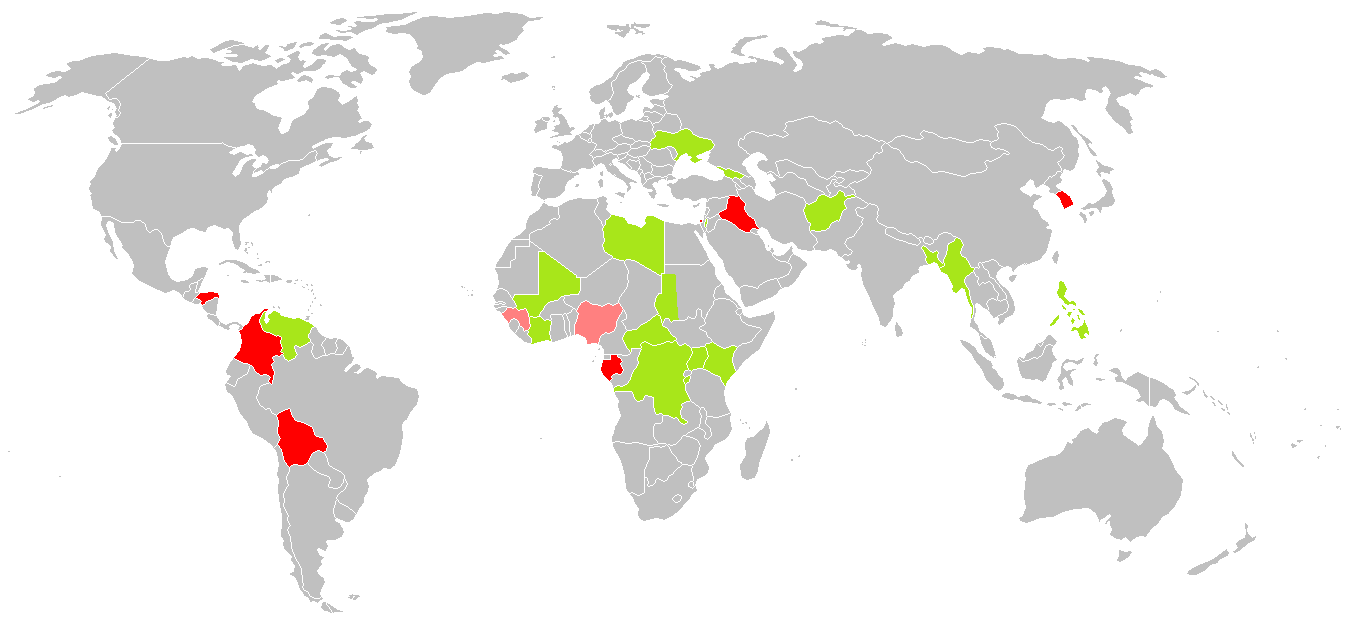
International Criminal Court investigations
On the morning of February 24, 2003, fighters of the FNI and FRPI militias entered the village of Bogoro in eastern Congo and killed at least two hundred civilians. They locked some of the survivors in a room with the corpses. They raped the women and girls. The attack lasted hours. Two decades later, Germain Katanga - one of the commanders who ordered it - was convicted in The Hague as an accessory to crimes against humanity and war crimes and sentenced to twelve years in prison. The conviction is one entry in a very long ledger. The work of the International Criminal Court is not, in the end, about The Hague at all. It is about places like Bogoro - villages most of the world has never heard of, whose names the court keeps alive in the formal language of indictments and judgments.
How a Case Begins
Before any prosecution, there is a question: should the court look at this at all? Investigations open in three ways. A state can refer a situation on its own territory, which is how Uganda, the Democratic Republic of the Congo, and the Central African Republic each first asked the court to come in. The UN Security Council can refer a situation, which is how Darfur reached the docket in 2005 and Libya in 2011. Or the prosecutor can ask the Pre-Trial Chamber for authorisation on the basis of information from individuals, NGOs, or other sources - the route taken for Kenya, for Côte d'Ivoire, for the Palestine and Venezuela investigations opened in 2021. By 2010 the Office of the Prosecutor had received nearly nine thousand communications from people around the world reporting alleged crimes. Roughly half were dismissed at the door for being outside the court's jurisdiction. The rest start a paper trail that, with luck, ends in a courtroom.
Northern Uganda and the Lord's Resistance Army
The court's first arrest warrants, issued on July 8, 2005, targeted five senior commanders of the Lord's Resistance Army, an insurgent group that for two decades terrorised northern Uganda by abducting children and turning them into soldiers, porters, and sexual slaves. The charges read like a syllabus of cruelty: murder, enslavement, sexual enslavement, the conscription of child soldiers, the pillage of villages. One indictee, Okot Odiambo, was named in connection with a February 2004 attack on the Barlonyo refugee camp in which more than three hundred people were massacred. Joseph Kony is still at large. Two of the indicted commanders were killed in the field. Dominic Ongwen - himself abducted into the LRA as a child of around nine - was finally tried at The Hague and in 2021 convicted of sixty-one crimes against humanity and war crimes. He was sentenced to twenty-five years. The court does not pretend the conviction is simple. A perpetrator can also be a victim. Both can be true.
Darfur and the Warrant for a President
When the Security Council referred Darfur to the prosecutor in March 2005, the conflict in western Sudan had already killed hundreds of thousands of people, many of them members of the Fur, Masalit, and Zaghawa ethnic groups, and displaced more than two million from their homes. In 2009 the court issued an arrest warrant for Omar al-Bashir, the sitting President of Sudan, for war crimes and crimes against humanity. In 2010, after the Appeals Chamber ruled that the lower chamber had set too high an evidentiary bar, a second warrant was issued, this time charging Bashir with genocide against three ethnic groups in Darfur. He was the first sitting head of state ever indicted by the ICC. He travelled openly to Chad, to Kenya, to South Africa - all states parties that should have arrested him and did not. The African Union, citing colonial overtones in the court's African focus, formally declined to cooperate in his arrest. Bashir remains at large. The warrants remain in force. The court has been here before, on the long side of patience.
Libya, Côte d'Ivoire, Mali
After the 2011 Libyan civil war, the Security Council referred the situation to the ICC unanimously - the first time China and the United States both voted yes. Within months arrest warrants had been issued against Muammar Gaddafi, his son Saif al-Islam, and his intelligence chief Abdullah Senussi. Gaddafi was killed by rebels before he could be transferred. In Côte d'Ivoire, the post-election violence of 2010-2011 left around three thousand people dead, and the court eventually ruled it had jurisdiction to prosecute former first lady Simone Gbagbo. In Mali, after the 2012 jihadist occupation of Timbuktu, the ICC convicted Ahmad al-Faqi al-Mahdi for the deliberate destruction of nine mausoleums and a mosque - the first conviction in the court's history for crimes against cultural heritage.
Newer Files, Older Patterns
In March 2021, prosecutor Fatou Bensouda opened a formal investigation into the situation in the State of Palestine, the court ruling that its territorial jurisdiction extended to Gaza, the West Bank, and East Jerusalem. Months later her successor, Karim Khan, opened an investigation into Venezuela. The court's investigations of Ukraine and other situations remain ongoing. The work is slow because the work is hard. Witnesses must be protected. Evidence must be gathered in zones still at war. Suspects must be persuaded, coerced, or surrendered into custody. Every indictment is a promise to the people named on it that someone, somewhere, was paying attention. Whether or not the promise is kept depends on the cooperation of governments who have, often, very little reason to cooperate. The court keeps working anyway. The ledger keeps growing. The villages keep their names.
From the Air
The Hague, Netherlands. ICC headquarters at 52.1056 N, 4.3178 E. The investigations are run from the same complex where prosecutors prepare cases for the trial chambers - six glass towers north of central The Hague, between the dune forest and Scheveningen. Nearest airports: Rotterdam The Hague (EHRD) 17 km south, Amsterdam Schiphol (EHAM) 40 km northeast. From the air the court's grounds are distinguishable by their geometry against the open dune landscape that runs north along the North Sea coast.