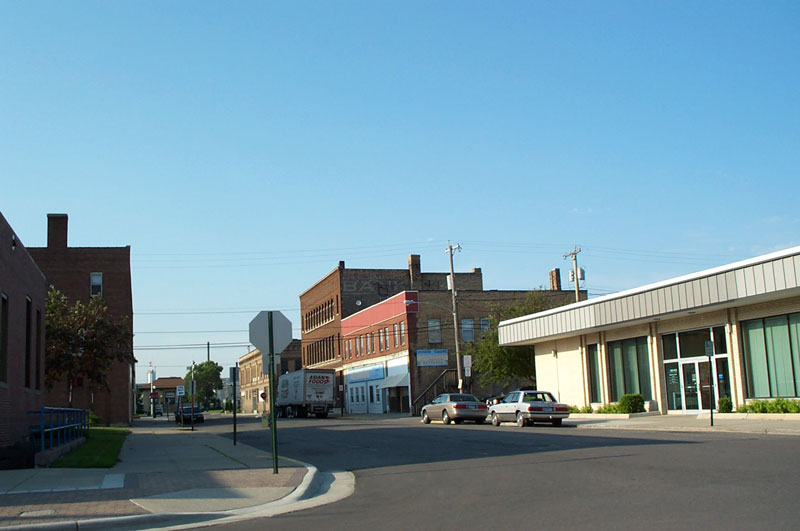
International Falls, Minnesota
Two towns once went to court over the right to be called the coldest place in America. International Falls, Minnesota, population 5,802, won. The legal battle with Fraser, Colorado dragged on for years, involving photographic evidence from a 1955 Pee Wee hockey team, a lapsed federal trademark, and ultimately a decision by the United States Patent and Trademark Office in 2008. Days after the ruling, International Falls recorded a new daily low temperature, as if the weather itself wanted to confirm the verdict. Perched on the Canadian border at the confluence of the Rainy River and Rainy Lake, this small city in Koochiching County has made a virtue of its brutal winters -- and built an identity around them that reaches far beyond thermometer readings.
A Mill Town on the Border
International Falls exists because of water power and timber. In the early twentieth century, industrialist Edward Wellington Backus recognized the hydroelectric potential of the Rainy River and built a dam to power the Minnesota and Ontario Paper Company. The mill, completed in 1910 and hailed as the most modern in the world at the time, went into operation producing newsprint from the vast boreal forests surrounding the town. The paper industry defined the community for generations. Boise Cascade acquired the operation in 1965, and the mill has remained central to the regional economy for over a century. Across the river sits Fort Frances, Ontario -- the two towns connected by an international bridge, their fates intertwined by shared water and shared industry. The name Koochiching, the county where International Falls serves as seat, derives from an Ojibwe word describing the mist rising from the nearby falls.
Bronko and the Hockey Factory
Bronko Nagurski grew up in International Falls and became one of the most dominant football players in American history. At the University of Minnesota, he earned the distinction of being named a first-team consensus All-American at two positions in the same season -- fullback and tackle. He signed with the Chicago Bears in 1930 and led them to three NFL Championships over eight seasons. After retiring, he returned to International Falls, where a museum in Smokey Bear Park now honors his legacy. But Nagurski was only the beginning. The town has produced a remarkable number of hockey players and coaches for its size, including United States Hockey Hall of Fame members Keith Christiansen, Timothy Sheehy, and Mike Curran, all silver medalists with the 1972 U.S. Olympic team in Sapporo. Larry Ross coached International Falls High School hockey for 31 years, capturing six Minnesota state championships between 1954 and 1985.
Frostbite Falls and the Cultural Imagination
The fictional town of Frostbite Falls, Minnesota -- home of Rocky the Flying Squirrel and Bullwinkle J. Moose -- was a direct spoof of International Falls, set in Koochiching County just like the real thing. The cartoon connection gave the town a kind of pop-culture fame that the trademark battle only deepened. In the 1970s, Sears filmed a DieHard battery commercial here, exploiting the punishing cold to sell reliability. That commercial spawned a parody in the first season of Saturday Night Live in 1975. Decades later, the 2019 dark comedy film International Falls was set and filmed in town. Meanwhile, the Icebox Radio Theater broadcasts original radio dramas on 106.9 FM with a transmitter power of just one watt -- a tiny signal from a town that has always punched well above its weight in the American imagination.
Where Two Nations Meet
International Falls sits at a genuine crossroads. U.S. Highway 53 and U.S. Highway 71 converge here, and Minnesota State Highway 11 runs through town. Falls International Airport, with ICAO code KINL, serves the community with two runways and daily Delta Air Lines flights to Minneapolis-Saint Paul. But the defining feature is the border itself. The international bridge to Fort Frances handles steady cross-border traffic, and the town functions as a U.S. port of entry. Voyageurs National Park lies just to the east, offering a wilderness of interconnected lakes, islands, and boreal forest that once served as the highway for French-Canadian fur traders. The Boundary Waters Canoe Area Wilderness extends further east. For a place known primarily for cold, International Falls is the gateway to some of the most spectacular lake country on the continent.
From the Air
Located at 48.5917°N, 93.4053°W on the Canadian border along the Rainy River. Falls International Airport (KINL) lies just south of the city with two runways, serving as the primary general aviation and commercial airport. The international bridge to Fort Frances, Ontario is clearly visible from the air. Voyageurs National Park waterways extend to the east. The paper mill complex along the river is a prominent landmark from altitude. Approach from the south along U.S. Highway 71 or from the east following the Rainy River for the best views of the border crossing area. Best viewing altitude: 3,000-6,000 feet AGL.