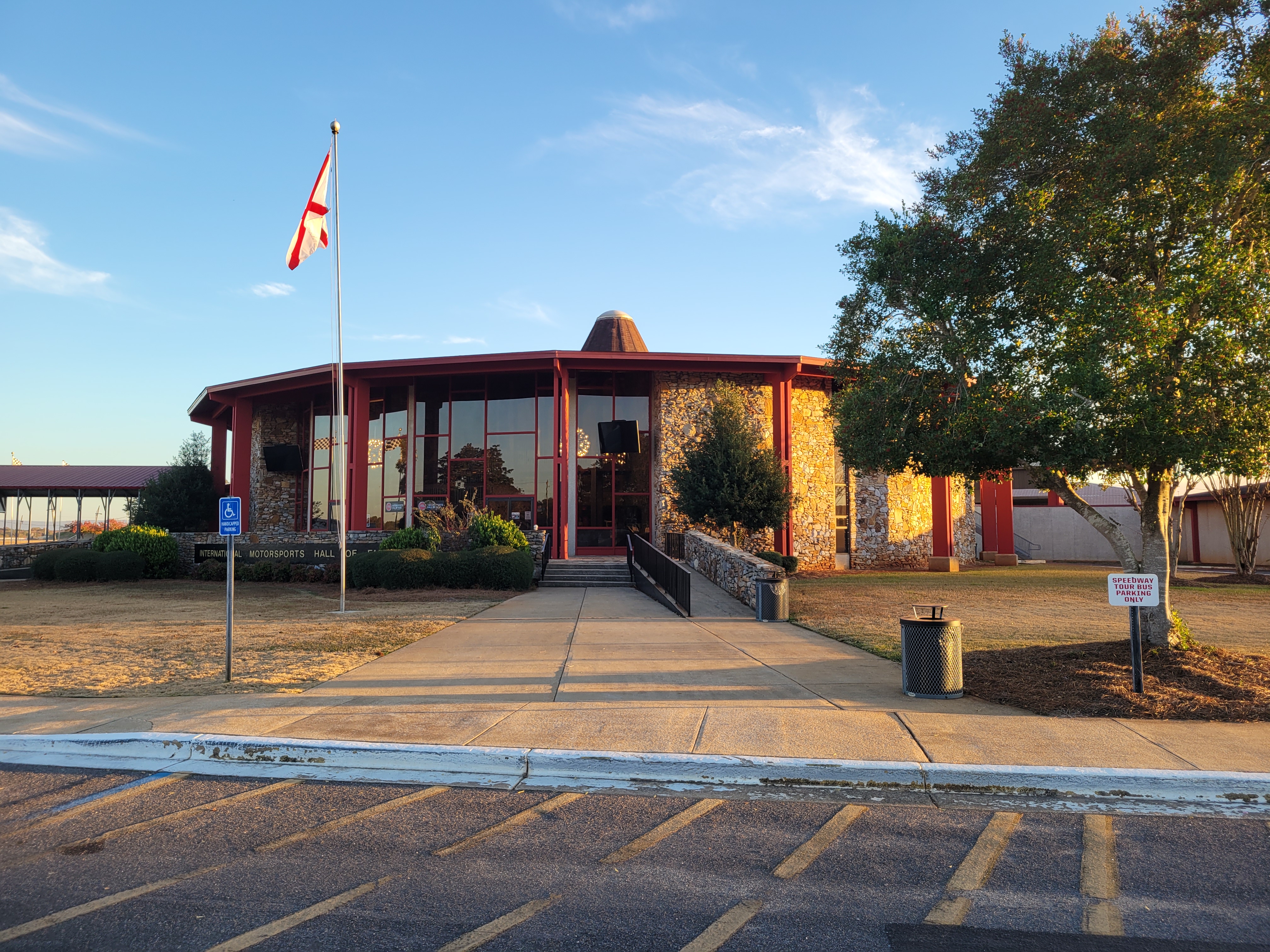
International Motorsports Hall of Fame
It exists because of a tax threat. When Florida politicians moved to levy a tax on Daytona International Speedway in the early 1970s, NASCAR founder Bill France Sr. decided that his planned motorsports hall of fame would go to Alabama instead. He donated land adjacent to the Talladega Superspeedway - the massive 2.66-mile oval he had built in Talladega County - and hired short-track racing promoter Don Naman to realize a vision: a museum that would, in France's words, "preserve the history of motorsports and enshrine forever the people who have been responsible for its growth." The International Motorsports Hall of Fame opened its first buildings in 1983, inducted its first class in 1990, and then, quietly, stopped inducting anyone after 2014.
From Groundbreaking to Grand Opening
Construction was neither quick nor simple. The groundbreaking ceremony took place on the afternoon of March 26, 1981, with about a hundred people present, including Bill France Sr. and his son Bill France Jr. The first three of six planned buildings opened on April 28, 1983, while the second half followed more than seven years later, on July 28, 1990. Three days before that second opening, on the evening of July 25, 1990, the IMHOF held its first induction ceremony at the Birmingham-Jefferson Civic Center Theater, broadcast live on The Nashville Network and hosted by country music artist and racing sponsor T. G. Sheppard. For the next several years, induction ceremonies were held the Wednesday evening before the Winston 500 at Talladega, before briefly shifting to December in 1993 and 1994. After the Speedvision Dome opened in 1996, all subsequent ceremonies took place there.
The Inaugural Twenty
The first class set the tone. Twenty names that read like a who's who of global motorsports: Juan Manuel Fangio, the Argentine master of Formula One. Jim Clark, the quiet Scottish farmer who dominated Grand Prix racing. Stirling Moss, the greatest driver never to win a championship. Jackie Stewart, who made safety a cause. From the American side: Junior Johnson, the moonshine runner turned NASCAR legend. Fireball Roberts, who died from burns suffered in a race at Charlotte. Barney Oldfield, who had raced Henry Ford's cars at the dawn of the automobile age. Buck Baker, Lee Petty, Bobby Unser, Parnelli Jones, Mickey Thompson, Mark Donohue, Graham Hill, Malcolm Campbell, Tony Hulman, Smokey Yunick - and Bill France Sr. himself. It was a class that spanned continents, decades, and every form of motorsport from Formula One to drag racing to land speed records.
Barriers Broken on the Track and in the Hall
The IMHOF's induction criteria were strict. Nominees had to be retired from competition for at least five years, with a fifteen-year waiting period before eligibility and a fifty-one percent vote share required for selection. Unlike other sports halls of fame, no waivers were granted - not even for Dale Earnhardt after his death at Daytona in 2001. Within those constraints, the hall gradually acknowledged motorsport's diversity. Wendell Scott, the first African American driver to win a NASCAR Cup Series race in December 1963, became the first African American inducted in 1999. Shirley Muldowney, the NHRA Top Fuel dragster champion who had fought her way into a male-dominated sport, entered in 2004. Janet Guthrie, the first woman to qualify for both the Indianapolis 500 and the Daytona 500, followed in 2006. A total of 145 individuals were enshrined between 1990 and 2013.
Silence at the Speedway
Nobody has been inducted since 2014. The hall of fame sits adjacent to one of NASCAR's most famous tracks - Talladega Superspeedway, where restrictor plates keep speeds from exceeding 200 miles per hour on the massive banked oval. The museum itself houses race cars, memorabilia, and exhibits tracing the evolution of motorsports from dirt tracks to superspeedways. But the induction ceremonies that once drew racing legends to east-central Alabama have gone quiet. The IMHOF remains open as a museum, its collection of cars and artifacts still drawing visitors who make the pilgrimage to Talladega. Whether its hall of fame will resume honoring new inductees remains an open question, one that hangs over the complex like the ghost of a checkered flag that never dropped.
From the Air
Located at 33.578N, 86.072W in Talladega County, east-central Alabama. The IMHOF sits immediately adjacent to Talladega Superspeedway, which is the dominant visual landmark - an unmistakable 2.66-mile tri-oval visible from high altitude. The speedway's banked turns and vast infield are distinctive from the air. Lincoln Municipal Airport (KTAL) is nearby, approximately 5 miles to the northeast. Birmingham-Shuttlesworth International Airport (KBHM) lies roughly 50 miles to the west. Best viewed at 2,000-4,000 ft AGL. The surrounding terrain is gently rolling Alabama piedmont with mixed forest and rural development.