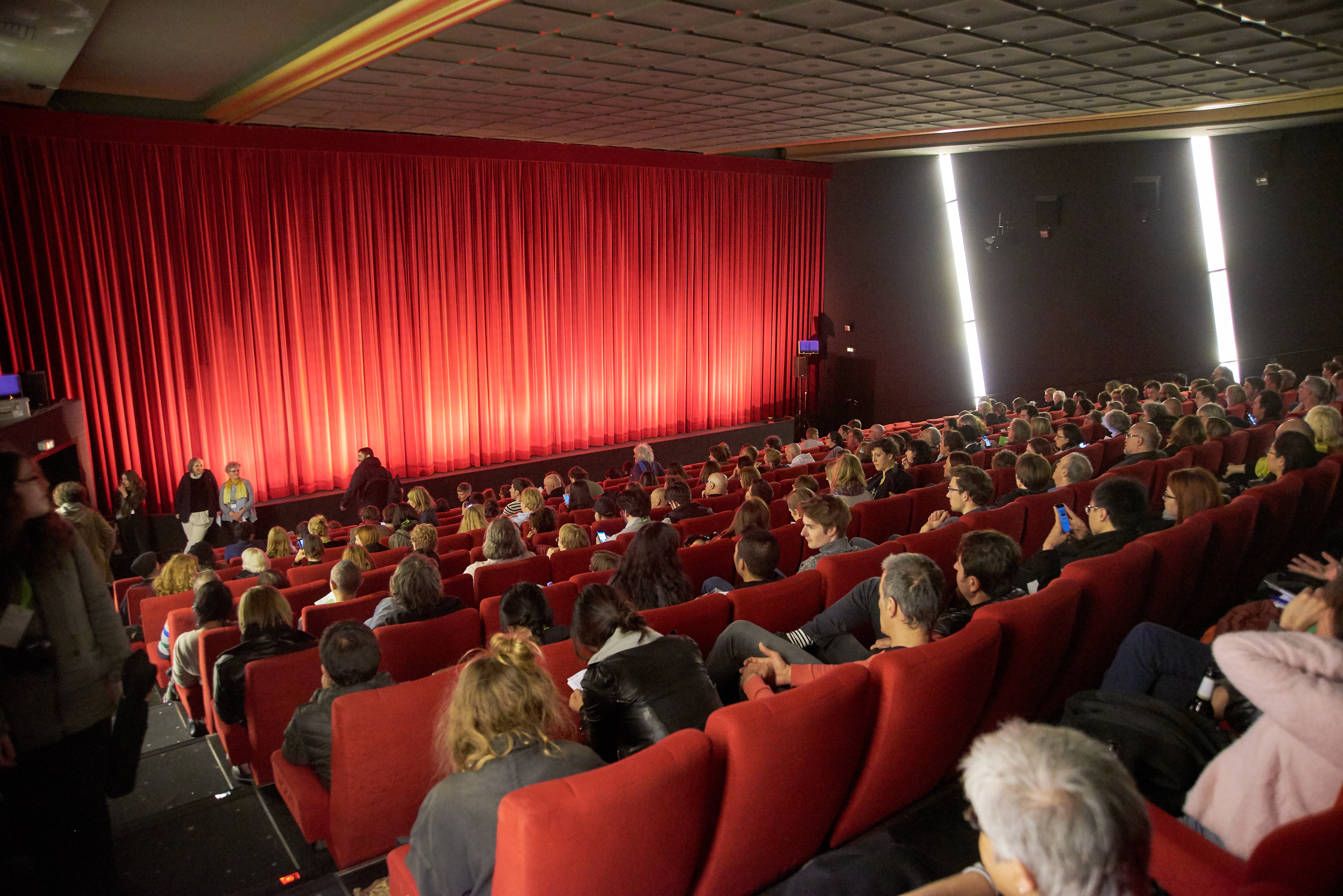
International Short Film Festival Oberhausen
On a February evening in 1962, twenty-six young German filmmakers walked onstage at a small festival in a Ruhr industrial town and signed a single page of text. They called it the Oberhausen Manifesto. The first line of the text declared: "The old film is dead. We believe in the new one." Among the signatories were Alexander Kluge, Peter Schamoni, and Edgar Reitz. Within a decade, the document they signed in a former adult-education hall would be credited with launching the New German Cinema, the wave that produced Fassbinder, Herzog, and Wenders. The festival that hosted them is still here, still running, and is the oldest short film festival in the world.
A Festival for Education
It did not begin as a manifesto-launching pad. In 1954, Hilmar Hoffmann, director of the Oberhausen Volkshochschule, gathered 45 films from Germany, France, and the United States for what he called the "1st West German Educational Film Festival." The motto was straightforward and slightly dry: "Cultural Film - Route to Education." The whole thing fulfilled an educational policy mandate, and that was the point. But by 1958 the program had grown to 190 films from 29 countries, the slogan had become "Way to the Neighbour," and the next year the event was renamed the Westdeutsche Kurzfilmtage - West German Short Film Festival. Oberhausen, an unremarkable industrial city west of Essen, was becoming something nobody planned for: a place where short films were taken seriously.
Window to the East
What really put the festival on the map was geography and the Cold War. Many films produced in the Eastern Bloc could not be seen anywhere else in the West. They could be seen in Oberhausen. The festival's directors, working through diplomatic back channels and quiet invitations, became a kind of conduit between the two halves of postwar Europe. Czechs, Poles, Hungarians, East Germans - their work landed here, in this Ruhr town, in front of audiences that included François Truffaut, Norman McLaren, Alain Resnais, and Lindsay Anderson. The press called Oberhausen a "short film mecca," and the description stuck. The reputation was political, but it was also aesthetic. People came because nobody else was showing what was being shown.
The Manifesto
At the 8th festival in 1962, the Oberhausen Manifesto landed. Its signatories were not yet famous. They were young filmmakers frustrated with a postwar German cinema they considered intellectually bankrupt and commercially exhausted. They wanted state funding, freedom from industry conventions, the right to make films the way the French and Italians were making them. Six years later, Costard's short Besonders wertvoll - which featured a talking penis attacking the new Film Funding Act - triggered a different kind of crisis. The public prosecutor objected, the festival pulled the film from the program, and many German filmmakers withdrew their work in protest. Oberhausen rewrote its rules, opened the German selection to public procedure, and emerged with a new charter of independence. The festival had been politicized twice in less than a decade. It survived both times.
Forty Years of Quiet Reinvention
The 1970s brought the women's movement to Oberhausen. Chantal Akerman and Helma Sanders-Brahms premiered early work here. A Children's and Youth Cinema competition was added in 1978. In the late 1980s, video and the avant-garde edged in as the East-West conflict softened and the festival's role as a window to the East slowly faded. In 1991, the name became the International Short Film Festival Oberhausen, the name it still carries. That same year it launched Germany's first national competition for German short films. In 1999, it created the world's first festival award for music videos, the MuVi, judged purely on visual quality. The careers that touched Oberhausen along the way are dizzying: Polanski, Scorsese, Forman, Werner Herzog, Agnès Varda, Stan Brakhage, Pipilotti Rist, Andrea Arnold, Miranda July. Many of them showed work here before anyone outside their countries knew their names.
Still Running
When COVID hit in 2020, Oberhausen pivoted to become the first all-digital film festival in Germany. Over 2,500 festival passes were sold to viewers in nearly 100 countries. The 2021 edition stayed online, nearly twice the usual length, with three new online competitions. In 2022 the festival returned, hybrid; in 2023 it was back fully in the cinemas. The home venue is the Lichtburg, one of Germany's great surviving picture palaces. Each year the program is built around an enormous thematic strand: "Solidarity as Disruption," "Against Gravity. The Art of Machinima." "The Long Way to the Neighbour. GDR Films in Oberhausen" - which closes a circle on the festival's old motto from 1958. The archive now holds short films from over 70 years of cinema. Oberhausen made the short form important by the simple act of taking it seriously, year after year, in a town nobody outside Germany had any reason to visit.
From the Air
Oberhausen sits at 51.47 N, 6.85 E, in the western Ruhr conurbation between Duisburg and Essen. The festival cinema, the Lichtburg, is in the city center near the main railway station. Recommended viewing altitude 3,000-5,000 ft AGL. Distinctive landmarks include the massive CentrO shopping complex and the Gasometer Oberhausen (an enormous decommissioned gas holder now used as an exhibition space) just east of the city. Nearest airport is Dusseldorf International (EDDL) about 18 nm south; Essen/Mulheim (EDLE) is closer at 10 nm southeast.