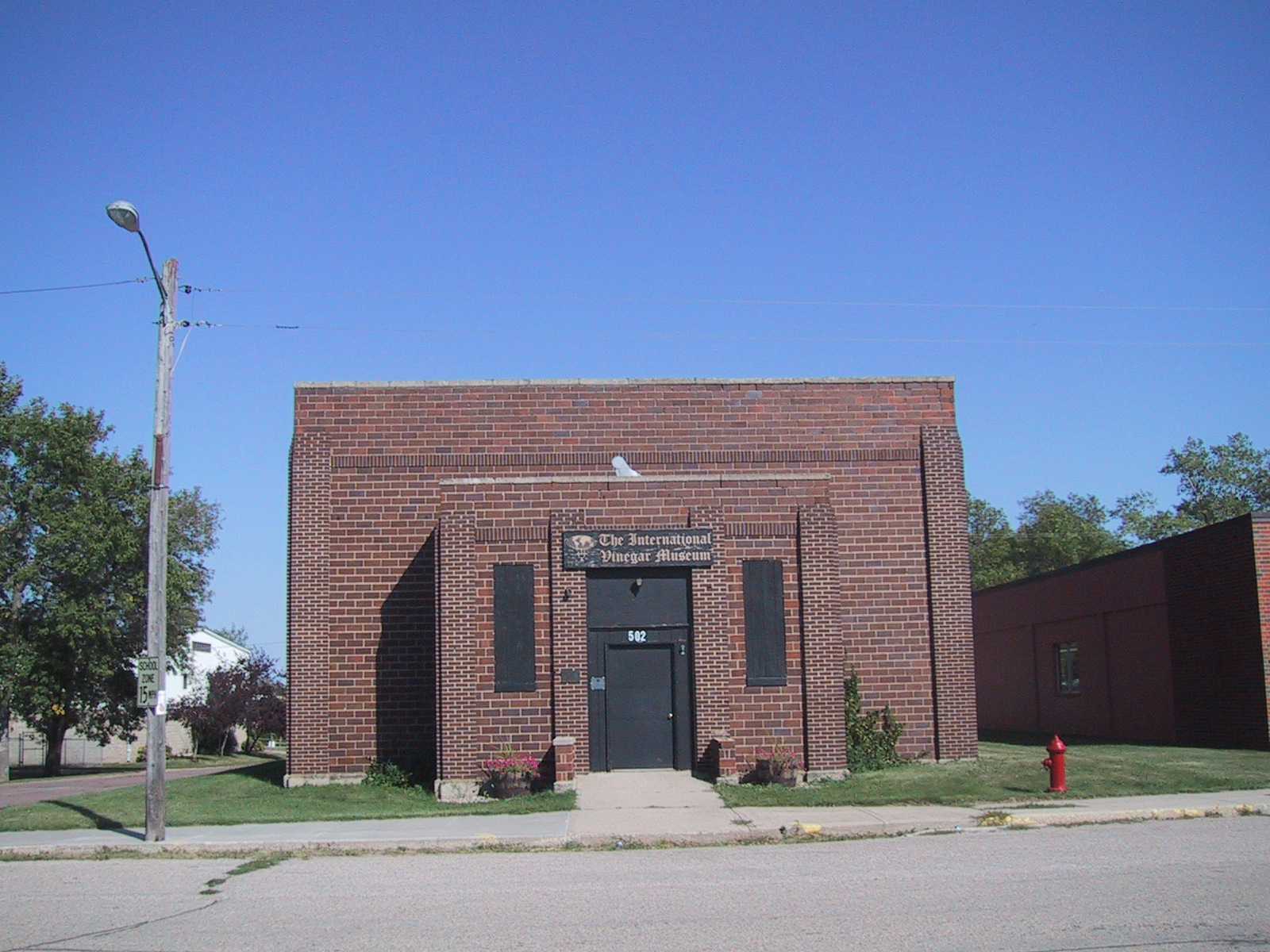
International Vinegar Museum
Of all the substances a town might rally around to save itself, vinegar is not the obvious choice. But Roslyn, South Dakota -- a speck of settlement in the northeast corner of the state, founded along the Soo Line Railroad -- has never had the luxury of obvious choices. In the 1990s, with agriculture in decline and young people leaving, a group of concerned citizens formed the Community Advancement for Roslyn and Eden and went looking for something, anything, to draw visitors. They found their answer in Lawrence Diggs, a resident who had been quietly amassing vinegar knowledge and samples since his research days at San Francisco State University. The result is the International Vinegar Museum, housed in a 1936 WPA brick auditorium at 500 Main Street, where 350 varieties of vinegar from around the world line the shelves of a building that has already lived several lives.
The Building That Wouldn't Quit
The Roslyn Auditorium has been reinventing itself since the day it opened. Built in 1936 with Works Progress Administration funding, it was the town's answer to a loss that still stung: the Roslyn Opera House, the community's social heart, had burned down in 1923, leaving residents without a permanent gathering place for over a decade. The WPA project gave Roslyn what it needed -- a sturdy, no-nonsense one-story red-brick rectangle on the corner of Main Street and Bjornsoa Avenue, with hardwood floors, six pilasters, and a decorative dark-red brick frieze running beneath its parapet. Over the decades, the building served as a gymnasium for Roslyn High School from the 1960s through the 1980s, a performance hall, a meeting place for the Sons and Daughters of Norway and the Modern Woodmen of America, and a senior citizens' center. The building was listed on the National Register of Historic Places on February 9, 2001, recognized both for its local importance and as an artifact of New Deal-era community building.
An Unlikely Expert in an Unlikely Place
Lawrence Diggs arrived in Roslyn in 1989, bringing with him a passion that most people would consider eccentric at best. His research into vinegar at San Francisco State University had given him deep knowledge of the substance's chemistry, history, and cultural significance -- knowledge that, in a city, might have remained a personal curiosity. In a town desperate for distinction, it became the foundation of something extraordinary. When the Community Advancement group decided their attraction needed to be unlike anything else in the region, Diggs's collection was the obvious seed. The museum now houses 350 varieties of vinegar, representing traditions from across the globe. Each bottle tells a story of fermentation, agriculture, and regional taste -- from Italian balsamic aged in wooden casks to rice vinegars central to East Asian cooking. Roslyn also hosts an annual Vinegar Festival each late June, complete with the crowning of an honorary 'royal quart' and a 'vinegar queen.'
Prairie Resilience
Roslyn's story is the story of countless small Great Plains towns: founded in the path of a railroad, sustained by agriculture, and battered by the twin catastrophes of the Great Depression and the Dust Bowl. The Soo Line Railroad brought settlers and commerce; the Depression nearly took everything away. What distinguishes Roslyn is the stubborn creativity of its response. Rather than accept the slow decline that has hollowed out so many prairie communities, its residents looked inward, found an improbable asset, and built something genuinely unique. The museum is open only Thursday through Saturday during the summer months, from early June to Labor Day, reflecting the realities of a seasonal tourist economy in a place where winters are long and visitors scarce. But its very existence -- a world-class collection of vinegar in a WPA auditorium in a town of fewer than 200 people -- is its own kind of monument to rural determination.
Brick and Mortar on the Plains
The building itself rewards a closer look. Its utilitarian vernacular style is pure WPA: functional, durable, and unadorned except where craft demanded it. The main entrance projects outward from the west-facing facade onto Main Street, flanked by long vertical windows. The dark-red brick frieze circling the building just below the roofline adds a touch of intentional beauty to an otherwise practical structure. Several windows have been boarded up over the years, and a simple wooden gable-roofed addition was attached to the rear wall in 1987. Inside, the original layout remains largely intact -- a drop ceiling was added to improve lighting for the museum displays, but the bones of the 1936 auditorium still define the space. It is a building designed to last, and it has outlasted every purpose originally imagined for it.
From the Air
Located at 45.497°N, 97.491°W in rural northeast South Dakota, near the town of Roslyn in Day County. The terrain is flat Great Plains agricultural land. The nearest public-use airports include Watertown Regional Airport (KATY) approximately 40 nm to the south-southeast and Aberdeen Regional Airport (KABR) approximately 45 nm to the west. At low altitude, look for the small grid of Roslyn's streets along Main Street; the red-brick WPA auditorium sits prominently at the corner of Main Street and Bjornsoa Avenue. Best viewed at 2,000-3,000 feet AGL in clear conditions.