Intuit
Scott Cook was watching his wife balance their checkbook. The tedium of it -- the manual reconciliation, the arithmetic errors, the sheer time consumed by something so fundamentally uninteresting -- struck him as a problem worth solving. In 1983, Cook cofounded Intuit with Tom Proulx, a Stanford computer science student, to build personal finance software that ordinary people could actually use. The result was Quicken, which launched in 1984 and eventually became the best-selling personal finance software in America. From that single product grew a company that would come to dominate three of the most essential categories in consumer and small-business financial software: personal finance, small-business accounting, and tax preparation.
The Simplicity Imperative
Quicken succeeded where competitors failed because Cook insisted on radical simplicity. The interface mimicked a paper checkbook register -- a design choice that made the transition from analog to digital feel natural rather than intimidating. Proulx wrote the original code. Early marketing was equally pragmatic: Intuit bought advertising in newspaper inserts and sold directly to consumers, bypassing the software retail channels that favored flashier products. By the late 1980s, Quicken had captured more than 70 percent of the personal finance software market. The company went public in 1993, and Cook's original insight -- that financial software should feel effortless, not technical -- became the organizing principle for everything that followed.
TurboTax and the Tax Machine
Intuit acquired Chipsoft in 1993, gaining TurboTax, which would become the company's most recognizable product and its most controversial. TurboTax democratized tax preparation, allowing millions of Americans to file their own returns without hiring an accountant. By the 2020s, TurboTax commanded roughly 40 percent of the consumer tax-preparation market. The company's QuickBooks accounting software, launched in 1992, became equally dominant in the small-business segment, offering invoicing, payroll, and expense tracking in a single platform. With Quicken, TurboTax, and QuickBooks, Intuit had built a trilogy that touched the financial lives of tens of millions of Americans.
Mountain View Headquarters
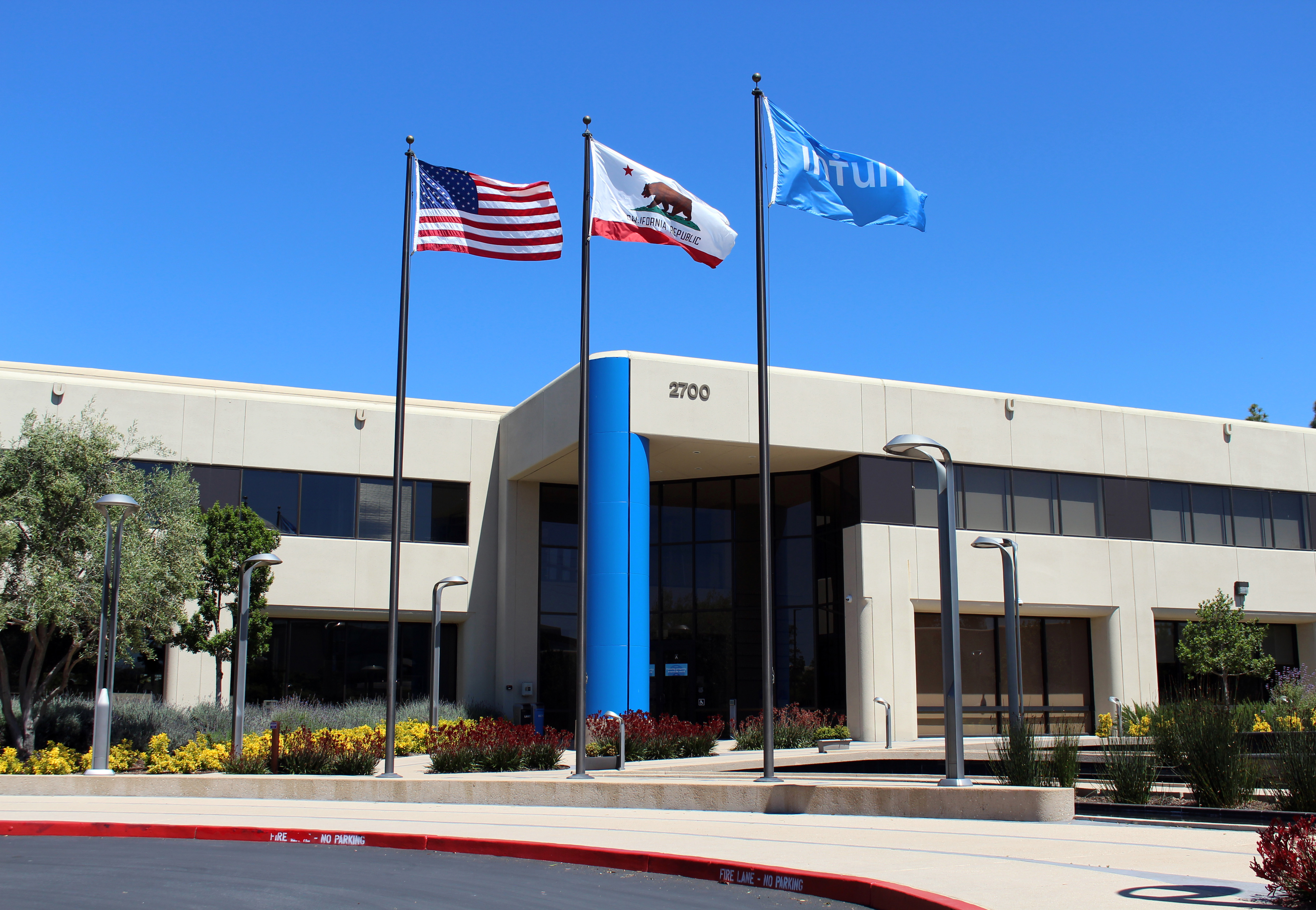
Intuit is headquartered in Mountain View, California, in the heart of Silicon Valley, employing over 17,000 people worldwide. The company's campus sits in the shadow of the tech giants that surround it -- Google, Meta, and the various startups cycling through nearby offices. Yet Intuit has outlasted many of its contemporaries through a dogged focus on its core markets. The company has expanded into credit monitoring through Credit Karma, acquired in 2020, and into email marketing through Mailchimp, acquired in 2021. These moves signal an ambition to become a comprehensive financial platform rather than a collection of software products. From a checkbook frustration in 1983 to a multi-billion-dollar financial technology company, Intuit's trajectory traces the path from analog inconvenience to digital infrastructure.
From the Air
Intuit headquarters is at 37.40°N, 122.10°W in Mountain View, California. The campus is near the intersection of US-101 and CA-85. Nearby airports: Moffett Federal Airfield (KNUQ), San Jose (KSJC), Palo Alto (KPAO). Best viewed at 2,000-4,000 ft AGL.