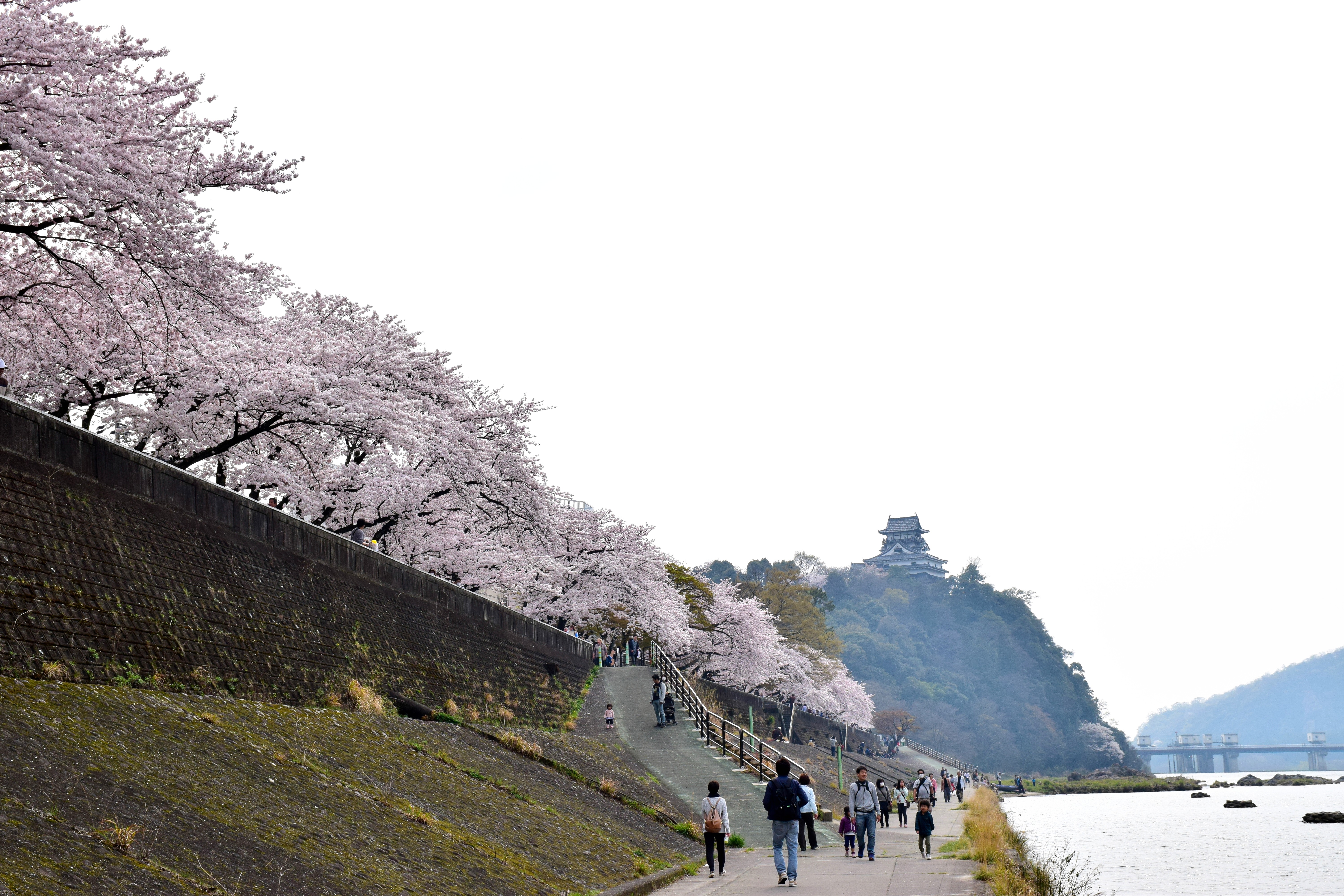
Inuyama Castle: The Family Fortress Above the Kiso
Until 2004, Inuyama Castle belonged to the Naruse family. Not a museum board, not a government agency, not a preservation trust -- a family. For twelve generations spanning 387 years, from 1617 to 2004, the Naruse clan maintained one of Japan's oldest surviving castle towers as a private inheritance, making it the only privately owned castle in the country. The tenshu sits on a bluff above the Kiso River in Aichi Prefecture, where the water carves the border between Aichi and Gifu. It is small as Japanese castle towers go, but its complex rooflines shift shape depending on where you stand, revealing different silhouettes from every angle. Only twelve original pre-modern tenshu survive anywhere in Japan, and Inuyama's is one of just five designated a National Treasure -- alongside Himeji, Matsumoto, Hikone, and Matsue.
The Last Obstacle in Owari
Oda Nobuyasu built the first fortification on this hilltop in 1537, claiming the strategic vantage above the Kiso River during the fractious wars of the Sengoku period. The castle changed hands repeatedly as the Oda clan fought for control of Owari Province. When Oda Nobunaga crushed the Imagawa clan at the Battle of Okehazama in 1560 and began his legendary campaign to unify Japan, his own cousin Oda Nobukiyo held Inuyama against him with backing from the rival Saito clan across the river in Mino Province. Inuyama Castle became the final obstacle to Nobunaga's consolidation of Owari -- and he did not let it stand. He recaptured the fortress in 1564. After Nobunaga's assassination in 1582, the castle passed through multiple castellans under Toyotomi Hideyoshi's rule, with Ishikawa Sadakiyo rebuilding its defenses to contemporary standards. The donjon standing today owes its current shape to Ishikawa's reconstruction.
A Dynasty on the Bluff
After the decisive Battle of Sekigahara in 1600, Tokugawa Ieyasu expelled the Ishikawa clan and folded Inuyama into the Owari Domain. In 1617, the Naruse clan received stewardship of the castle, beginning the longest continuous family guardianship of any Japanese fortress. The Naruse served as daimyo of Inuyama Domain, vassals of the powerful Owari branch of the Tokugawa shogunate, for over 250 years until the Meiji Restoration swept away the feudal order. When the new Meiji government seized the castle in 1871, it destroyed every auxiliary building -- gates, barracks, storehouses -- sparing only the tenshu itself. Then the devastating Great Nobi earthquake of 1891 damaged even that lone survivor. In an unusual arrangement, the government returned the castle to the Naruse family in 1895 on one condition: they must repair and maintain it themselves. The Naruse accepted, and for another century the tenshu remained private property.
Untangling an Old Myth
For generations, scholars believed the tenshu had been physically moved from Kanayama Castle in 1599 -- disassembled, transported, and rebuilt on the Inuyama bluff. The theory was elegant and widely accepted. Then between 1961 and 1965, restorers dismantled the entire tower for a large-scale renovation and examined every timber, joint, and structural detail. The evidence was conclusive: the tenshu had not been transplanted. It was built here. The Japanese government's Cultural Affairs records list the tenshu as dating to 1601, though the broader castle complex traces to 1537, and modifications continued through 1620. Regardless of the precise date, the tower ranks among the oldest original castle structures surviving in Japan, a claim also made by Maruoka Castle in Fukui Prefecture.
From Private Hands to Public Trust
In 2004, the Naruse family transferred ownership of the castle to a nonprofit foundation established by Aichi Prefecture's Board of Education, ending nearly four centuries of private stewardship. The castle became a National Historic Site in 2018, adding another layer of official protection to a structure already designated a National Treasure. Today Inuyama Castle draws visitors who climb the steep wooden stairs inside the compact tower to reach the top-floor observation platform, where the Kiso River bends below and the castle town spreads south in a grid that preserves its Edo-period layout. During the annual Inuyama Festival each April, elaborate karakuri floats -- tall wooden carriages topped with mechanical puppet stages -- parade through the streets below the castle, a tradition dating to the Edo period. The castle itself is the anchor, the fixed point around which centuries of life in this riverside town have orbited.
From the Air
Located at 35.39N, 136.94E on a prominent bluff above the Kiso River in Inuyama, Aichi Prefecture. The castle tower is visible as a small but distinct structure on the wooded hilltop overlooking the river, which runs east-west here forming the prefectural border. Best viewed at 2,000-3,000 feet AGL. The castle town grid is visible below to the south. Nearest airport is Nagoya Airfield / Komaki (RJNA), approximately 10 nautical miles south-southeast. Chubu Centrair International Airport (RJGG) lies roughly 40 nautical miles to the south on an artificial island in Ise Bay.