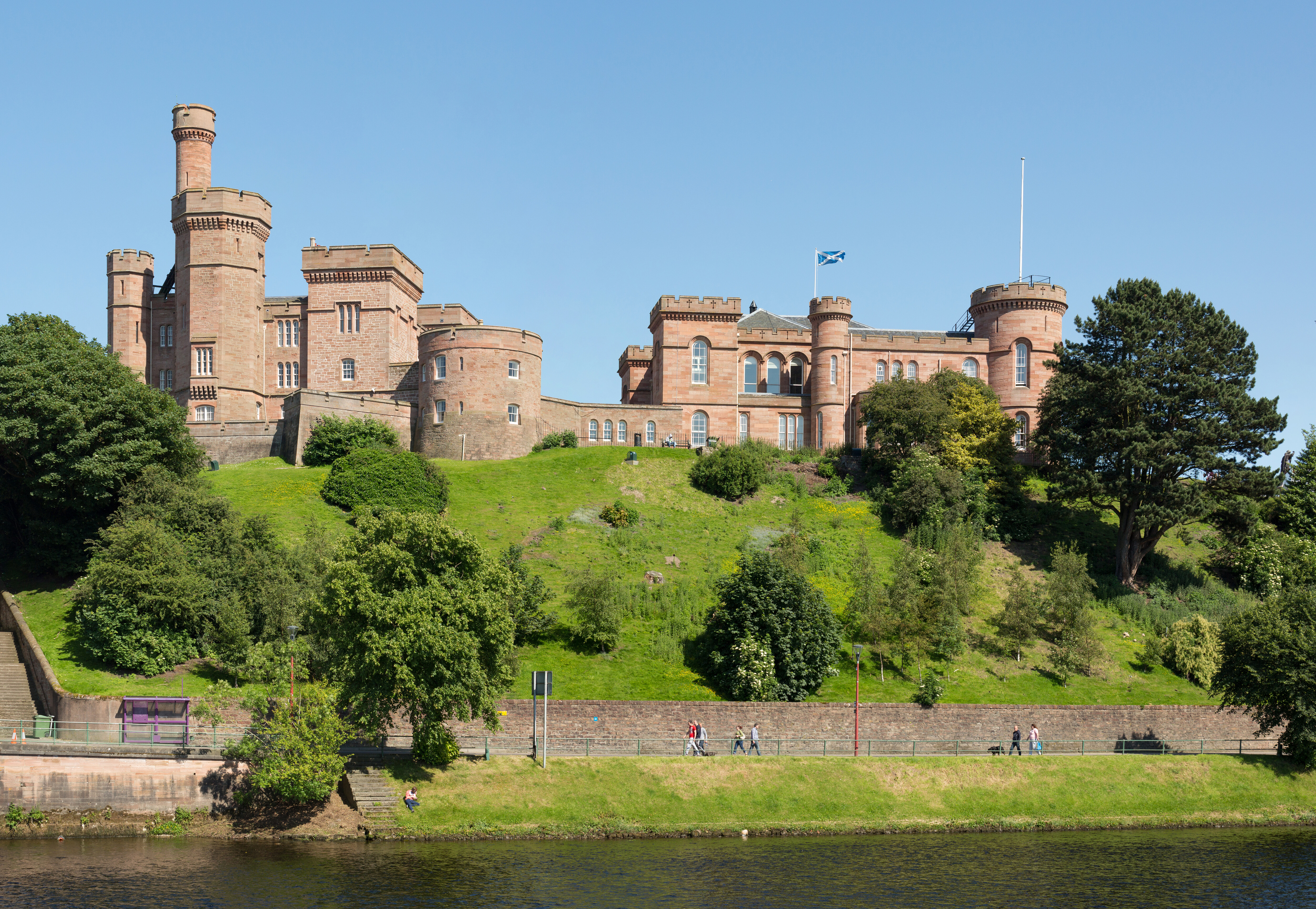
Inverness Castle
In 1428, King James I of Scotland invited fifty Highland clan chiefs to Inverness Castle for what they believed would be a parliament. It was a trap. James arrested them all, executing three and imprisoning the rest. The following year, Alexander, Lord of the Isles, returned with an army of ten thousand men, besieged the castle, and burned the town of Inverness to ashes. The pattern -- royal authority provokes Highland fury, Highland fury destroys whatever the crown has built, the crown rebuilds and tries again -- repeated itself across five centuries. No castle in Scotland has been more consistently contested or more thoroughly destroyed.
The Castle That Would Not Stay Built
A fortification has stood on the hill above the River Ness since at least the eleventh century. Malcolm III is credited with building the first castle here around 1057. Robert the Bruce razed it in 1307 during the Wars of Scottish Independence, following his practice of destroying strongholds that might be used against him. It was rebuilt, only to be targeted again. The 1428 treachery and the 1429 siege by the Lord of the Isles were followed by further destruction and reconstruction. In 1562, Mary, Queen of Scots arrived at Inverness to find the castle gates shut against her by the governor, who supported a rival faction. Clan Munro and Clan Fraser seized the castle on her behalf, and the governor was hanged from the battlements. The castle survived the Civil War sieges of 1649 and 1650, changed hands during the Jacobite risings of 1689 and 1715, and was finally blown up by the Jacobites in 1746 to prevent its use by government forces.
Shakespeare's Shadow
Inverness Castle carries a literary association that has proven more durable than any of its physical structures. Shakespeare set the murder of King Duncan in Macbeth at Inverness Castle, though the historical Macbeth -- Mac Bethad mac Findlaich, who ruled Scotland from 1040 to 1057 -- likely had no connection to the site. The real Macbeth's stronghold was probably at Burghead or Scone. Shakespeare never visited Scotland, and his play's geography is imaginative rather than accurate. Nonetheless, the association has stuck. Visitors arriving at the current castle frequently ask about Macbeth, and the connection features in tourism materials. The castle's appearance on the Royal Bank of Scotland fifty-pound note has further cemented its status as a symbol of the Highlands, even though the building on the banknote is a nineteenth-century courthouse rather than a medieval fortress.
Red Sandstone and New Purpose
The current Inverness Castle was built in 1836 to a design by the architect William Burn, using red sandstone that gives the building its distinctive warm color against the grey Highland skies. It was built not as a military fortification but as a sheriff court and jail -- a symbol of legal authority rather than military power. The building served this judicial function for nearly two centuries. The castle's position remains commanding: it occupies the same hilltop above the River Ness that has attracted fortification for a thousand years, with views down the river to the Beauly Firth and across the city to the hills beyond. The surrounding terraces and the statue of Flora MacDonald, who helped Bonnie Prince Charlie escape after Culloden, connect the nineteenth-century building to the deeper Highland history that the site embodies. The castle has recently been redeveloped as a visitor attraction and cultural hub, the latest in its long sequence of reinventions.
From the Air
Inverness Castle is located at 57.48°N, 4.23°W on a prominent hilltop above the River Ness in the center of Inverness. The red sandstone castle is visible from the air, situated above the river's western bank. The Beauly Firth lies to the north, and the Great Glen extends to the southwest. Inverness Airport (EGPE) is approximately 7 nm to the northeast.