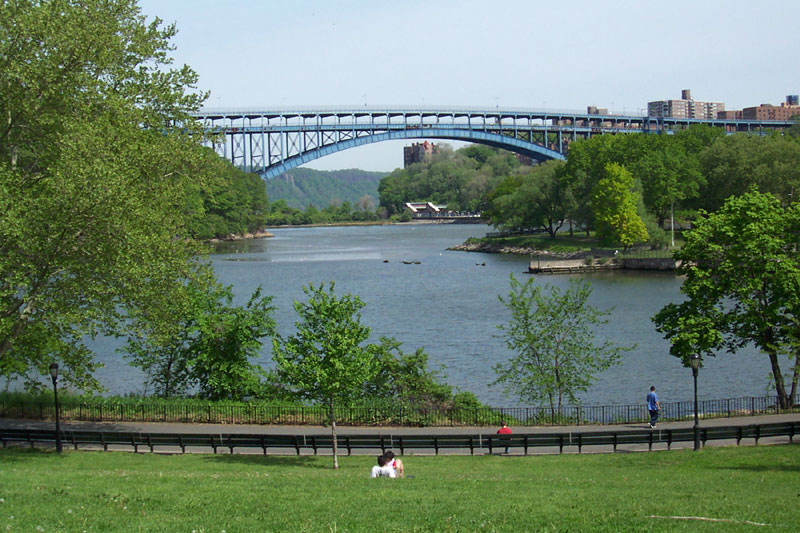
Inwood Hill Park
Manhattan has exactly one old-growth forest, and almost nobody knows about it. At the northern tip of the island, where the Hudson River bends east toward the Harlem River Ship Canal, a ridge of schist rises two hundred feet above the water. The Wecquaesgeek people called this place Shorakapkok -- 'the sitting place' -- and inhabited it for nearly seven hundred years before European contact. Today it is Inwood Hill Park, 196 acres of glacially scoured ridges, ancient tulip trees, and geological surprises wedged between the Henry Hudson Parkway and the Bronx.
Before the City
The landscape here tells a story that begins with ice. Glacial potholes -- including the largest in New York City -- pock the exposed rock, ground out by boulders spinning in meltwater thousands of years ago. The bedrock is a textbook of Manhattan geology: marble, schist, and limestone jostling together, with the seismologically active Dyckman Street Fault running along the park's southern edge. As recently as 1989, that fault produced a magnitude-2 earthquake. The Wecquaesgeek, a Munsee-speaking band of the Wappinger people, built their settlement here on the ridge above the river. By the nineteenth century, the area had become a retreat for New York's wealthy. Isidor Straus, co-owner of Macy's and a passenger who would perish aboard the Titanic, kept a summer estate in Inwood. The Lords of Lord & Taylor built two mansions within what is now the park; both were destroyed by fire.
The Great Tulip Tree and Its Myth
For centuries, a massive tulip tree -- a Liriodendron tulipifera -- stood in the park's Shorakapok Preserve, considered the largest and among the oldest trees on Manhattan. A plaque connected it to Henry Hudson's 1609 voyages and to nearby Native American archaeological finds, though Hudson actually fought a battle with Indigenous people at Nipinichsen, just north of Spuyten Duyvil Creek. A storm felled the tree in 1933. Its stump persisted behind an iron fence until it rotted away in the 1950s, when a boulder and plaque replaced it. That plaque claims this spot is where Peter Minuit negotiated the purchase of Manhattan from Native Americans -- a story that appears in no historical records. Some historians place any such meeting in Lower Manhattan. The association of 'treaty trees' with land purchases has been identified as a common colonial myth, one that promotes a narrative of peaceful settlement over the messier reality.
Robert Moses and the Scars He Left
The park opened officially on May 8, 1926, after Andrew Haswell Green first proposed it in 1895 and the city spent decades acquiring parcels. In the 1930s, Robert Moses and the Works Project Administration reshaped it dramatically -- evicting squatters from abandoned estates, building the West Side Highway directly through the park, and cutting many of the historic tulip trees that dated to the Revolutionary War. Moses was efficient and destructive in equal measure. The Harlem River Ship Canal, excavated from 1937 to 1938, severed a 13.5-acre peninsula from the Bronx mainland, which was absorbed into the park. That peninsula now holds the Inwood Hill Nature Center, opened in 1995 and later damaged by Superstorm Sandy's floodwaters in 2012. Next to it sits Muscota Marsh, Manhattan's only saltwater marsh.
Wild Things in the City
The forest that survives here was once oak-chestnut; the demise of the American chestnut from blight after 1917 shifted its composition to oak and hickory. Blue jays, cardinals, red-tailed hawks, and wild turkeys breed in the woods. Between 2002 and 2007, a project attempted to reintroduce bald eagles to Manhattan using hacking boxes and eaglets from the Midwest, with three or four fledging successfully each year. The nesting structure was removed in 2009, but the effort remains one of the more improbable wildlife experiments in urban history. At ground level, the park absorbs enormous demand from surrounding neighborhoods that lack green space. Families set up elaborate picnicking operations with barbecues, tables, and chairs on the maintained peninsula -- activity that would be prohibited in most other city parks but is permitted here, a practical concession to a community that has few alternatives.
From the Air
Located at 40.873N, 73.925W at the northern tip of Manhattan, where the Harlem River meets the Hudson. Highly visible from altitude as a large forested area contrasting with surrounding urban grid. The Henry Hudson Bridge at the park's northern end links Manhattan to the Bronx. Nearby airports: Teterboro (KTEB) 8 nm west, La Guardia (KLGA) 7 nm east.