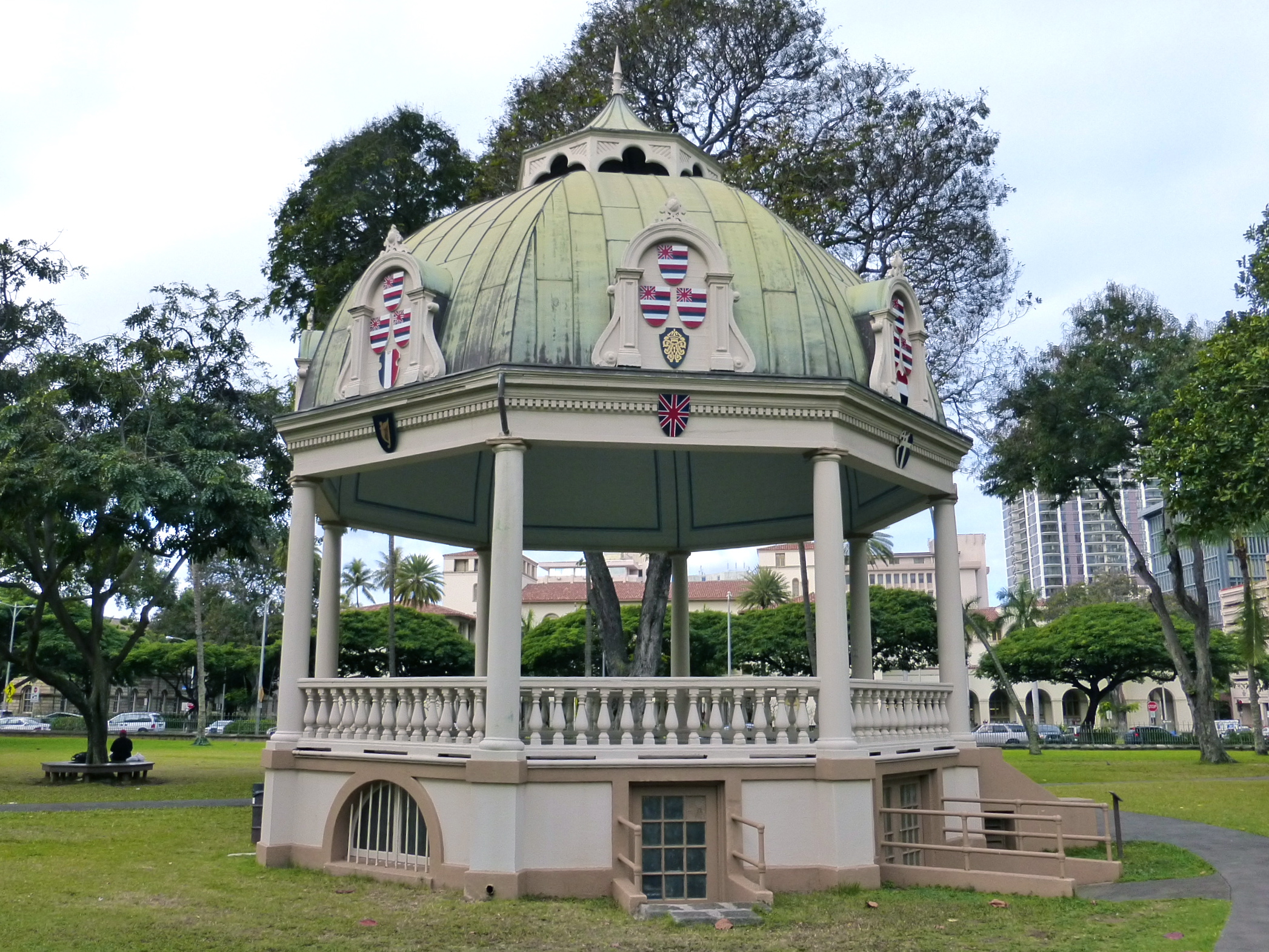
ʻIolani Palace
There is only one royal palace on American soil, and it stands in downtown Honolulu beneath a canopy of banyan trees. ʻIolani Palace was home to the rulers of the Kingdom of Hawaiʻi from 1845 until the monarchy was overthrown in 1893. It had electricity before the White House did. Its throne room hosted coronation balls and, later, the trial of a deposed queen. Today it is a museum, a National Historic Landmark, and one of only four places in Hawaiʻi where the Hawaiian flag can fly alone without the American flag beside it. Even the name carries layers: ʻIolani, after the ʻio, the Hawaiian hawk — a solitary raptor found nowhere else on Earth.
Sacred Ground Before the Palace Rose
The palace sits on land that was significant long before Western-style buildings arrived. An ancient burial site called Pohukaina once occupied the area, a sacred resting place for aliʻi — the Hawaiian ruling class. After King Kamehameha II and his queen Kamāmalu died during a visit to London in 1824, their bodies were returned and interred here in 1825 in a Western-style mausoleum made of coral blocks with a thatched roof. Two chiefs guarded its koa wood door day and night. No one was permitted to enter except for burials or the Hawaiian Memorial Day, observed on December 30. In 1844, a chief named Kekūanaōʻa began building a large home on the site as a gift for his daughter, Victoria Kamāmalu. Kamehameha III purchased the estate instead and made it his royal residence after moving the kingdom's capital from Lāhainā to Honolulu in 1845. That house became the first ʻIolani Palace — grand for its era, though more a stately home than a European-style palace.
Kalākaua's Grand Ambition
By the time King David Kalākaua took the throne, the original palace was rotting from termite damage. Kalākaua was the first monarch to travel around the world, and the grand palaces of Europe gave him an idea: if Hawaiʻi was to be taken seriously as a modern sovereign state, it needed a palace that announced as much. He commissioned a new building directly across the street from Aliʻiōlani Hale, the government office building. Three architects — Thomas J. Baker, Charles J. Wall, and Isaac Moore — designed a structure that rose two stories over a raised basement, with four corner towers and two central towers reaching 76 feet. The cornerstone was laid on December 31, 1879. Construction cost over $340,000, a vast sum for the small kingdom. The building was completed in November 1882, and on February 12, 1883, Kalākaua held a formal European-style coronation ceremony — nine years after he had actually begun his reign. The coronation pavilion was later moved to the palace grounds and converted into a bandstand for the Royal Hawaiian Band.
A Queen Imprisoned in Her Own Palace
The overthrow came on January 17, 1893. The Committee of Safety, a group of mostly American and European residents, deposed Queen Liliʻuokalani with the backing of U.S. Marines. Troops of the provisional government took control of ʻIolani Palace, renamed it the "Executive Building," inventoried its contents, and auctioned off furnishings deemed unsuitable for government operations. In 1895, after a failed counter-rebellion, Liliʻuokalani was imprisoned for nine months in a small upstairs room of her own palace. She spent the time making a quilt, which still hangs in what is now called the Imprisonment Room. Her trial was held in the former throne room. The palace went on to serve as the capitol for the Republic of Hawaiʻi, as military headquarters during World War II, and as the state capitol after Hawaiʻi achieved statehood in 1959. The royal bedroom became the governor's office. Legislators met in the former throne room and senate chambers occupied the old dining room.
Restoration and Remembrance
After more than seventy years of government use, ʻIolani Palace was in poor condition. Governor John A. Burns began restoration efforts in the 1960s. The building was designated a National Historic Landmark in 1962, and government offices finally moved out in 1969 when the new Hawaiʻi State Capitol was completed next door. The Junior League of Honolulu spent years researching the palace's original construction, furnishings, and daily life through nineteenth-century newspapers and photographs. The Friends of ʻIolani Palace, founded by Liliʻuokalani Kawānanakoa Morris, a grand-niece of Queen Kapiʻolani, oversaw the restoration. Wooden additions were stripped away and the interior was rebuilt to match the original plans. The palace reopened as a museum in 1978, and today visitors can walk through the restored throne room, see the Crown Jewels, and stand in the room where a queen was held captive.
A Symbol Still Contested
On January 17, 1993, the centennial of the overthrow, thousands gathered on the palace grounds for a torchlight vigil. The building was draped in black. In 2008, a group of Native Hawaiians calling themselves the Hawaiian Kingdom Government occupied the palace grounds in peaceful protest, asserting that American rule of the islands is illegitimate. The Friends of ʻIolani Palace responded by affirming their respect for the freedom of Hawaiian groups to hold such views while objecting to the blocking of public access to the site. These tensions are not abstract history. The palace remains a living flashpoint where questions of sovereignty, identity, and justice continue to be debated — not in distant academic terms, but on the very ground where Hawaiian kings were crowned and a queen was stripped of her throne.
From the Air
ʻIolani Palace is located at 21.307°N, 157.859°W in downtown Honolulu on Oʻahu. The palace grounds and distinctive bandstand are visible from the air, directly across King Street from Aliʻiōlani Hale and the Kamehameha statue. Best viewed at 1,500–2,000 ft AGL. Nearest airport: Daniel K. Inouye International (PHNL), approximately 5 nm northwest. The Hawaiʻi State Capitol building sits immediately to the northeast. Morning hours offer clearest conditions before trade-wind clouds build.