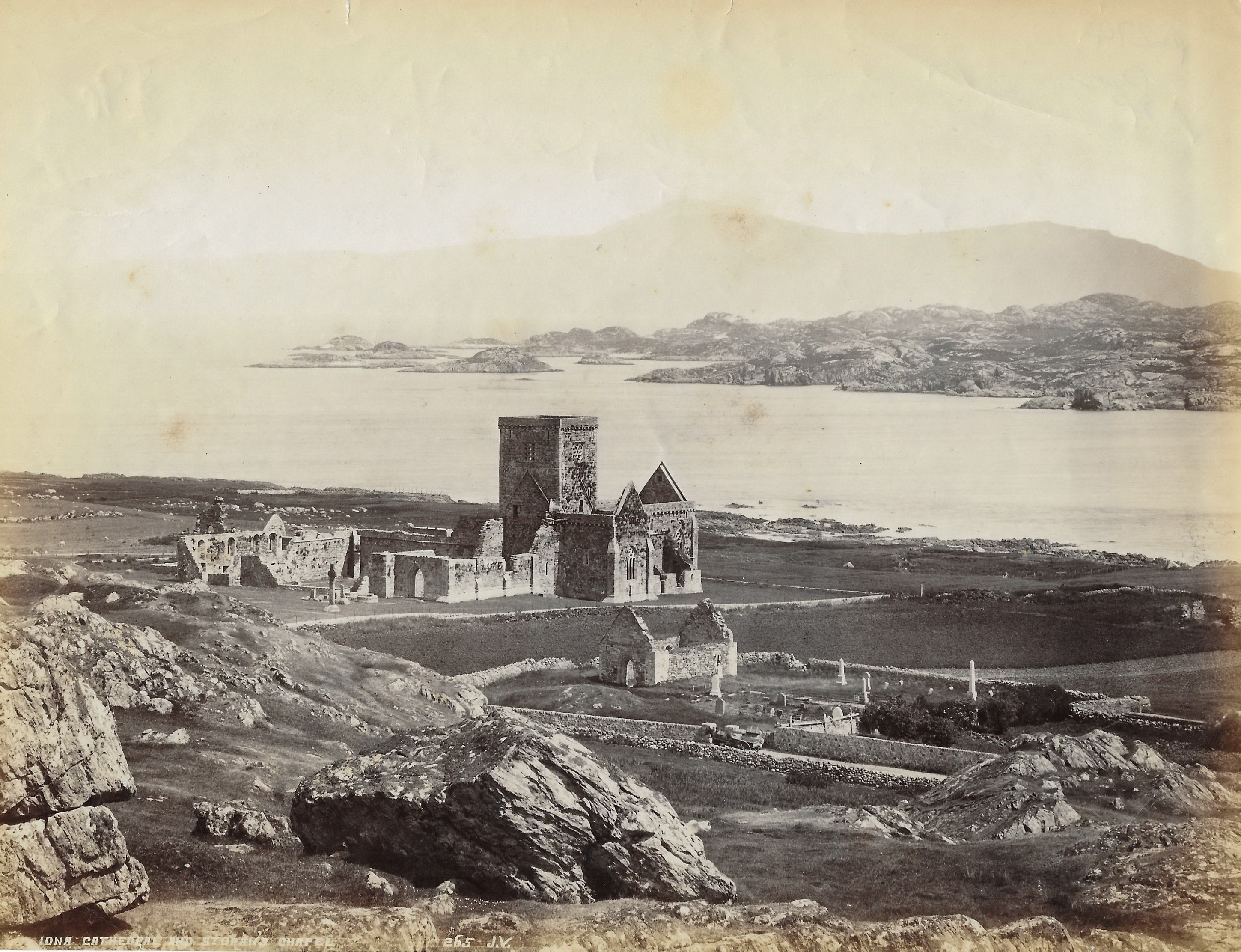
Iona Abbey
The island is barely three miles long and a mile and a half wide. It has no natural harbour, no mineral wealth, no strategic value in any conventional sense. Yet Iona became the most important religious site in Scotland and one of the most influential in all of early medieval Christendom -- because in 563 CE, a fiery Irish monk named Columba arrived with twelve companions and built a monastery of wattle and thatch on a windswept Atlantic shore.
Columba's Foundation
Columba came to Iona from Ireland, possibly as a voluntary exile following his involvement in a battle, possibly as a missionary, probably both. The island was then part of the kingdom of Dal Riata, which straddled the sea between western Scotland and northeastern Ireland. Columba's monastery was not primarily a missionary outpost -- its purpose, as the monks understood it, was to create a perfect community as an image of the heavenly Jerusalem. But its influence radiated outward nonetheless. Monks trained at Iona carried Christianity to the Picts of Scotland and, through Saint Aidan, to the Anglo-Saxons of Northumbria. The island's name was originally 'Hy' or 'Hii'; 'Iona' appears to date from the fourteenth century, a mistranscription of a Latinized 'Ioua.' The scriptorium at Iona produced manuscripts of extraordinary beauty, and the Book of Kells -- that supreme masterpiece of illuminated art -- is believed to have been begun here in the years before 800 CE, before Viking raids forced the monks to relocate it to Ireland.
Blood on Martyrs' Bay
The Vikings found Iona as they found Lindisfarne: wealthy, undefended, and irresistible. In 806, Norse raiders attacked the monastery and killed sixty-eight monks at Martyrs' Bay, a sheltered inlet that still bears the name. The surviving community began to relocate to Kells in Ireland. In 825, Saint Blathmac and the monks who had remained were martyred in another Viking raid, and the abbey was burned. The main relics, including Columba's reliquary shrine, were moved to Ireland in 878. For two centuries Iona endured as a diminished but persistent Christian site. In 1114 the King of Norway seized the island, holding it for fifty years before the Gaelic warlord Somerled recaptured it. Somerled's son Ranald, Lord of the Isles, invited the Benedictine order to establish a new monastery in 1203 on the foundations of Columba's original church. An Augustinian nunnery was founded nearby by Somerled's daughter Bethoc -- one of only three in Scotland.
Cathedral of the Isles
From 1207 to 1493, the Macdonald Lords of the Isles were central to Iona Abbey's medieval existence. They considered it their spiritual seat, expanded the abbey church substantially in the fifteenth century, and were buried in the graveyard alongside -- according to tradition -- forty-eight Scottish kings, as well as rulers from Ireland, Norway, and France. Modern scholars are skeptical of the royal burial claims, which likely grew to enhance Iona's prestige, but the graveyard undeniably holds the remains of Lords of the Isles, Maclean chieftains, MacLeod chiefs, and other prominent Hebrideans. The medieval abbey you see today, restored in the twentieth century, is largely the legacy of the fifteenth-century Clan Donald Lords and their abbots. St Martin's Cross, an eighth-century high cross, still stands by the roadside. St John's Cross survives in replica form near the abbey doorway, with the restored original housed in the Infirmary Museum.
Revival and Renewal
The Reformation brought destruction to Iona in 1559, when a mob incited by John Knox's preaching damaged the abbey buildings. The nunnery fell into ruin. For three centuries the abbey decayed, its stones scavenged, its purpose seemingly exhausted. Revival came in the twentieth century. In 1938, the Reverend George MacLeod founded the Iona Community, an ecumenical Christian order dedicated to peace, justice, and the rebuilding of community. Members physically reconstructed the abbey's surrounding buildings, and the restored complex became the Community's spiritual home. In 2000, the Iona Cathedral Trust transferred care of the abbey, nunnery, and associated sites to Historic Scotland. A further renovation completed in June 2021, funded by the Iona Community at a cost of 3.75 million pounds, added renewable energy and high-speed broadband to a site founded when written records barely existed. Labour Party leader John Smith, who died in 1994, was buried on Iona at his own request -- one more name added to the island's long ledger of those who found meaning in this small, exposed, extraordinary place.
From the Air
Iona Abbey sits at 56.33°N, 6.39°W on the island of Iona, off the southwestern tip of the Isle of Mull in the Inner Hebrides. The abbey and nunnery ruins are clearly visible from the air. The island has no airport; access is by ferry from Fionnphort on Mull. Nearest airstrip: Oban (EGEO) approximately 35 nm to the southeast. The island of Staffa and Fingal's Cave lie about 6 nm to the north.