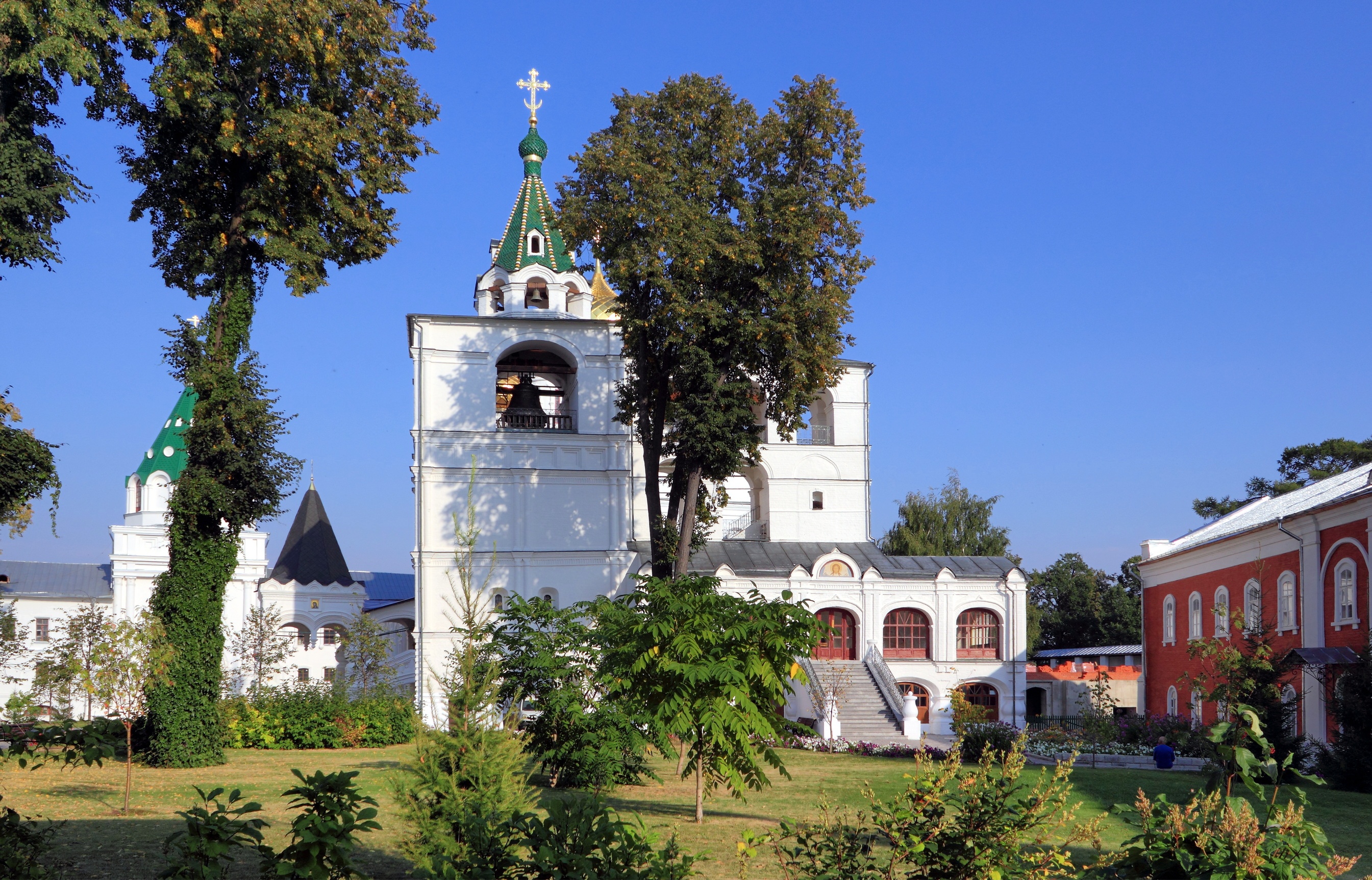
Ipatiev Monastery
The dynasty that ruled Russia for three centuries began, improbably, in a monastery founded by a Tatar nobleman. Around 1330, a Mongol-Tatar murza named Chet converted to Christianity, took the baptismal name Zachary, and built the Ipatiev Monastery on the bank of the Kostroma River where it meets the Volga. According to legend, he had been miraculously cured of a disease by a vision of the Virgin Mary, St. Philip, and St. Hypatius of Gangra. The monastery he raised in gratitude would outlast empires, survive revolution, and become the site where Russian history pivoted in 1613, when the teenage Mikhail Romanov was called from its walls to accept the throne.
The Tatar's Gift
The founding story of Ipatiev Monastery is a conversion narrative that also functions as a genealogy of Russian power. Murza Chet's descendants through the male line included some of the most consequential figures in Russian history: Solomonia Saburova, the first wife of Vasily III, and Tsar Boris Godunov, whose brief, troubled reign ended the Rurikid dynasty and opened the Time of Troubles. Some historians dispute the traditional 1330 founding date, arguing that a monastery existed on the site as early as 1275, established by Vasily Yaroslavich, the prince of Kostroma. In this reading, Chet did not found the monastery but revived a declining institution. Either way, the connection between the Tatar convert's family and the monastery set the stage for its most famous chapter. The Godunov family lavished resources on the complex throughout the 16th century, expanding its walls and enriching its treasury.
Where the Romanovs Began
In early 1613, Russia was emerging from the chaos of the Time of Troubles -- years of famine, invasion, and contested succession that had nearly destroyed the state. A national assembly, the Zemsky Sobor, elected the sixteen-year-old Mikhail Fyodorovich Romanov as tsar. The delegation sent to inform him of his election found him at the Ipatiev Monastery in Kostroma, where he and his mother, the nun Martha, had taken refuge. The monastery became, in effect, the birthplace of the Romanov dynasty. Later tsars honored this connection with patronage and visits, and the Romanov boyar palace within the monastery walls was preserved and eventually restored as a monument to dynastic origins. The compound grew into a significant architectural ensemble, its Trinity Cathedral adorned with frescoes and its bell tower dominating the riverbank skyline.
Revolution and Dissolution
The October Revolution of 1917 ended both the Romanov dynasty and the monastery's religious life. The complex was disbanded and converted into a historical and architectural museum, its buildings preserved not for their spiritual significance but as cultural monuments. This museum status offered some protection during the Soviet decades, when many Russian monasteries were demolished outright. But preservation did not mean safety from all harm. In September 2002, one of the museum's most important exhibits was destroyed: a large wooden church from the village of Spas-Vezhi, built in 1628, burned to the ground. The loss of a nearly four-century-old wooden structure in a single fire illustrated the fragility of heritage that had survived centuries of Russian winters, only to succumb to a modern accident.
A Contested Homecoming
In 1991, with the Soviet Union dissolving, Russian authorities began the process of returning the Ipatiev Monastery to the Russian Orthodox Church. The decision was contentious. Museum officials, who had maintained the complex for seven decades, fought the transfer, arguing that the monastery's historical and artistic significance required secular stewardship. The religious community countered that the monastery's identity was fundamentally ecclesiastical. The debate played out over more than a decade. On December 30, 2004, the Russian government signed an order formally transferring the monastery to the Kostroma Diocese. Today the Ipatiev Monastery operates as an active religious institution while preserving its status as one of Kostroma's most important historical sites. From the air, it sits on a spit of land where the Kostroma River curves before joining the Volga, its white walls and golden domes forming a striking contrast against the dark water. The fortress that a Tatar convert built nearly seven centuries ago still anchors the riverbank, a monument to a founding story that braids faith, dynasty, and the improbable trajectories of Russian history.
From the Air
Located at 57.78N, 40.89E on the bank of the Kostroma River at its confluence with the Volga, just west of Kostroma city center. The monastery's white walls and golden domes are clearly visible from the air, sitting on a pronounced river bend. Best viewed at 2,000-4,000 ft AGL. Kostroma (Sokerkino) Airport (UUBA) is approximately 7 km southeast. The Volga River provides an excellent navigation reference. Kostroma is part of the Golden Ring tourist route northeast of Moscow.