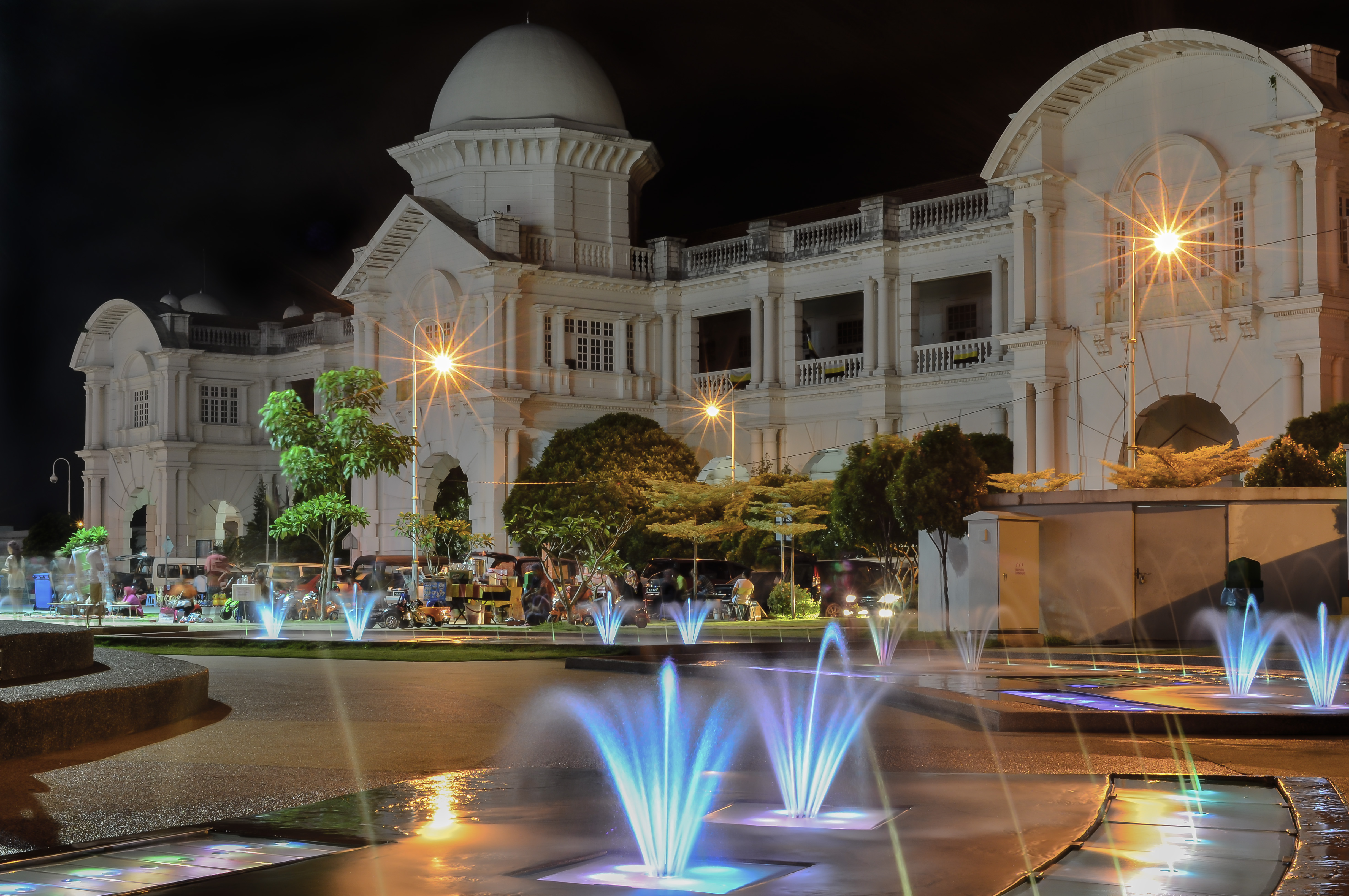
Ipoh Railway Station
Locals call it the Taj Mahal of Ipoh, and the comparison is not entirely tongue-in-cheek. The railway station that anchors Perak's capital is a double-storey confection of domes, engaged columns, and open-air loggias stretching 183 metres along its frontage -- grand enough that the building was designed to house not just trains but also a hotel, a restaurant, and a bar. Architect Arthur Benison Hubback, the British Public Works assistant who left his mark across colonial Malaya, began drawing plans in 1914. World War I delayed everything. Material shortages drove costs higher; labor grew scarce. By the time the station finally opened in 1917, it had already absorbed more history than most buildings accumulate in a lifetime.
Tin, Tracks, and a Wooden Platform
The story of rail in Ipoh begins with tin. Perak's alluvial deposits were among the richest in the world, and moving ore to port demanded infrastructure. In 1893, the Perak Railway laid its first tracks through the city and built a station to match the era's ambitions -- which is to say, a modest single-storey wooden structure with pitched tile roofs and open-air platforms. It was functional, nothing more. For twenty years it served Ipoh through the final days of the Perak Railway and its consolidation into the Federated Malay States Railways. By then, the city had outgrown the station. Ipoh was no longer a mining outpost; it was the capital of Perak, and it wanted a building to prove it.
Hubback's Baroque Vision
Arthur Benison Hubback had already designed the Kuala Lumpur railway station in a dramatic Indo-Saracenic style -- all horseshoe arches and Mughal domes. For Ipoh, he pivoted. The new station leans distinctly Western: late-Edwardian Baroque with rusticated stonework, arched pediments, and a commanding central dome over the porte-cochere. Yet traces of his earlier vocabulary persist. Miniature chhatris -- domed kiosks borrowed from Indian palace architecture -- cap the corner columns on both sides, a quiet nod to the subcontinent in an otherwise European composition. Inside, the Majestic Hotel occupied the upper floor, offering 17 bedrooms with direct access to the second-floor loggia. By 1936, demand had pushed the room count to 21. Guests could step from their rooms onto the covered balcony and watch the trains arrive below, a marriage of hospitality and transit that few modern stations attempt.
Eighty Years of Stillness, Then Electricity
For most of the twentieth century, remarkably little changed. The FMSR became Keretapi Tanah Melayu, the country gained independence, the tin industry rose and fell -- but the station itself slumbered. Platforms stayed at their original level. Passengers still descended through tunnels to reach island platforms sheltered by steel-and-wood pitched canopies. Then came Malaysia's double-tracking and electrification project. Through the 2000s, the platform area was entirely rebuilt: levels raised to meet modern electric carriage entrances, double tracks laid, overhead catenary lines strung. The old tunnels gave way to an overhead bridge, and a curving steel-framed train shed replaced the Victorian canopies. Only the original wooden benches survived the transformation. When the overhaul finished in October 2007, three months before electrified service reached Rawang, the station had leapt from the steam age to the electric age in a single renovation. The Majestic Hotel and the Edwardian facade, mercifully, were preserved.
A Cenotaph, a Tree, and the Weight of Memory
The square fronting the station carries its own layers. A cenotaph unveiled on Armistice Day 1927 honored Perak's World War I dead, and over the decades it accumulated additional plaques: World War II, the Malayan Emergency, the Indonesia-Malaysia confrontation, the Communist re-insurgency period. A recent addition memorializes prisoners of war who died building the Thailand-Burma Railway. The original Great War brass plaque has been restored, though it now sits on a different face of the monument and is shielded by protective plastic against vandals. Beside the cenotaph stands -- or rather, stood -- an Ipoh tree, the poisonous Antiaris species that gave the city its name, planted in 1980 by the Menteri Besar of Perak. A windstorm snapped it on 28 April 2017. A replacement sapling went into the ground the following February. Between 2011 and 2013, the entire square was stripped and rebuilt as the Ipoh Heritage Square, a minimalist plaza of terraces and open lawns that now serves as the starting point for the city's heritage trail.
Scene Stealer
The station's photogenic facade has not gone unnoticed by filmmakers. In 1999, it stood in for a nineteenth-century Siamese railway station in Anna and the King, starring Jodie Foster and Chow Yun-fat. Two decades earlier, Malaysian cartoonist Lat illustrated the station's exterior and original platforms as the backdrop for the final act of Town Boy, his beloved 1981 graphic novel about growing up in Ipoh. Today the station serves KTM's electric ETS services and the Butterworth-Ipoh Komuter line, handling both passengers and freight across nine tracks. Only four tracks carry overhead wires; the remaining five belong to diesel freight. The juxtaposition captures the station perfectly -- one foot in the colonial past, the other reaching toward an electrified future, and a dome overhead large enough to shelter both.
From the Air
Located at 4.597N, 101.073E in central Ipoh, Perak. The station's white Edwardian facade and central dome are identifiable from low altitude along the rail corridor running through the city center. Nearest airport is Sultan Azlan Shah Airport (WMKI/IPH), approximately 7 km south. The Kinta Valley, flanked by limestone karst hills, provides dramatic terrain on approach from any direction. Best viewed at 2,000-3,000 feet AGL on a clear day.